
JAKARTA, JOURNALARTA.COM – Google will officially change its payment system on the Play Store starting June 30, 2026. The shift is a breath of fresh air for app developers, especially game developers in Indonesia, although the impact will only be felt on September 30, 2027.
The new system opens the door to third-party payment options and could trim commission costs that have long weighed on developers. Google’s move has sparked enthusiasm among developers, while also forcing them to prepare for the transition.
Timeline for Google’s New Payment System Rollout
Even though Google has already announced the change, developers in Indonesia do not need to rush. The implementation schedule varies by region. Countries such as the United States, the United Kingdom, and the European Economic Area (EEA) will be the first to adopt the new system on June 30, 2026.
Australia will follow on September 30, 2026, while South Korea and Japan will move on December 31, 2026. “For Indonesia and the rest of the world, the system change will only take effect on September 30, 2027,” the latest Android Developers Blog report, cited by JA_NEWS_FLASH on Thursday (24/6/2026), said.
That means Indonesian game developers targeting the domestic market will still be subject to the old 15% or 30% commission structure until September 2027. But if their apps or games target markets in countries that adopt the new system earlier, developers can join Google’s new program according to each region’s schedule.
Potential Commission Savings Worth Hundreds of Millions of Rupiah
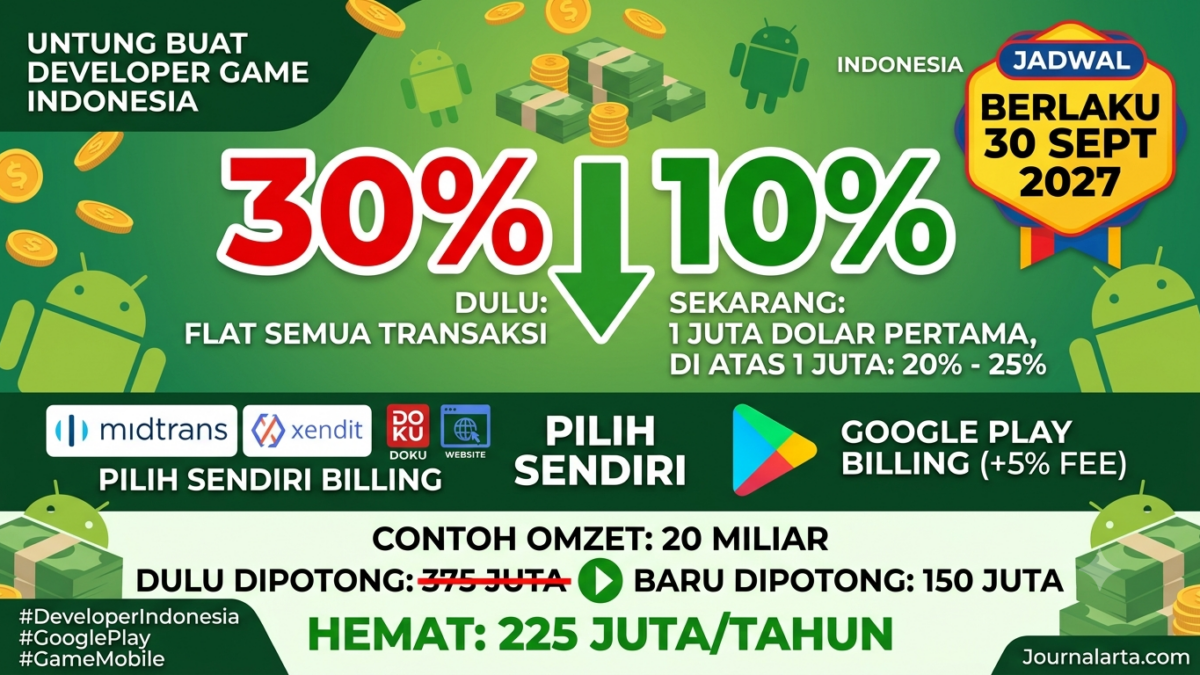
The core of the change is a lower service fee taken by Google. Under the old system, Google cuts 30% from each transaction above US$1 million in annual revenue, and 15% for revenue below US$1 million.
Starting September 30, 2027, the new system will apply in Indonesia:
- Service fee: 10% for the first annual revenue up to US$1 million.
- Service fee above US$1 million: 20% for new installs and 25% for existing installs.
- Billing fee: An additional 5% if the developer chooses to keep using Google Play Billing.
Let’s break down the savings. A game developer in Indonesia with annual revenue of Rp2 billion (about US$125,000) will see a significant difference. Under the old system, Google’s commission would be around Rp300 million. Under the new system, using a self-managed payment system without Google Play Billing, Google’s cut would be only around Rp200 million. Net savings: Rp100 million.
For a developer with larger revenue, say Rp20 billion a year (about US$1.25 million), the savings also become noticeable. The old system could take about Rp375 million. Under the new system, with self-managed billing, Google’s deduction drops sharply to around Rp150 million. That means developers could save Rp225 million per year.
Self-Managed Billing: New Opportunities and New Challenges
Google is now giving developers the freedom to integrate their own third-party payment systems, such as Midtrans, Xendit, Doku, Tripay, or even redirect users to their own payment websites. That is good news.
“The main benefit is not having to pay the extra 5% billing fee to Google. If a transaction is worth Rp100,000, the developer only pays 10% to Google (Rp10,000) plus a payment gateway service fee of around Rp2,000-Rp3,000. Total cost becomes Rp12,000-Rp13,000, far cheaper than Rp30,000 under the old system,” said the Director of the Indonesian Game Association (AGI) [NAMA PEJABAT AGI] to JA_NEWS_FLASH.
But the option also brings challenges. Developers will have to manage issues such as taxes, refunds, and chargebacks on their own, tasks that were previously handled by Google.
User habits in Indonesia, where people are already familiar with Google Play Billing, also mean developers will need to educate users before switching to a new payment method. Technical integration will be more complex too, requiring sufficient developer resources and QA teams.
Big games like Mobile Legends or Genshin Impact may already have the infrastructure for this. But for indie game developers, careful calculations are needed to weigh the savings against integration costs and operational risks.
Apps Experience Program: Potentially Lower Fees
Google has also introduced the Apps Experience and Games Level Up programs. For developers whose games meet certain quality standards, such as strong interface design, high user retention, and minimal crashes, commission for new installs can drop further to a total of 15%.
This program is especially appealing for Indonesian game developers with polished products. Some local games that could benefit include Order of the Gilded Age, Tahu Bulat, and DreadOut. Joining the program could further improve developers’ margins.
Impact on Game Prices and In-App Purchases in Indonesia
The big question is whether lower commission costs will lead to cheaper games or in-app items (IAP) in Indonesia. Google leaves pricing decisions entirely to developers.
The Indonesian market is known to be highly price-sensitive. If a developer saves Rp100 million in commission, they have two options: lower product prices, such as diamond prices in games, to attract more users, or keep prices stable and improve profit margins.
Larger developers are likely to choose the second option first to cover integration costs. Indie developers, meanwhile, may prefer the first to stay competitive.
Competition is set to intensify in 2027. Games that manage to lower prices while maintaining the same quality will have an edge.
Preparing Early for Indonesian Game Developers
Since Indonesia will not be affected until September 2027, developers have about a year and a half to prepare. This is a crucial window to audit revenue, look for suitable payment gateways, and review target markets.
Developers should start researching local payment gateway providers such as Midtrans, Xendit, or Doku. Compare service fees and calculate potential savings after integration costs.
Legal and tax preparation is also essential, since developers will be directly responsible for 11% VAT and other tax matters if they use self-managed payments. User experience testing for the checkout flow is equally important. If the payment flow is too long or too complicated, conversion rates can drop sharply and hurt developers.
There are also risks to watch. These include fragmented payment options that confuse users, higher security and fraud risks if standard protections like Google Play Billing are not in place, and the possibility of future policy changes from Google. Developers are not advised to go all-in on a self-managed payment system without careful consideration.



📝 Leave a Comment
Comment as . Reviewed by an admin before it appears.