Microsoft (MSFT) Bills for AI Agents as Azure Revenue Jumps 48%
Microsoft now charges more customers for the work its AI agents do. Azure revenue grew 48% in the September quarter, operating margin reached about 50%, and Copilot credit users rose more than 75% in one quarter, an analyst's review of the results shows.
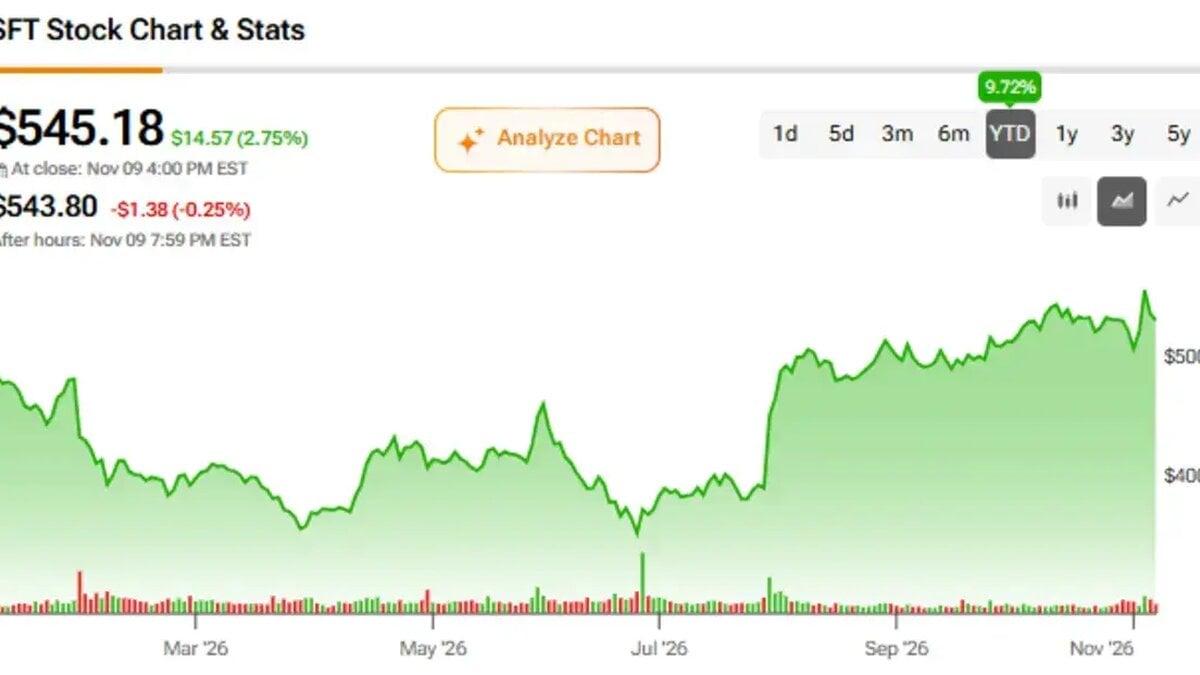
Microsoft (MSFT) now charges a growing number of customers for the work its AI agents do, and Azure cloud revenue grew 48% in the September quarter, according to an analyst's review of the company's latest results. AI agents are software that can finish tasks on their own.
The analyst, who describes himself as bullish on the stock, argues that Microsoft's AI push is starting to pay for itself. The operating margin, the share of sales left after operating costs, reached about 50%.
The stock is up 9.7% this year. It is no longer cheap after its rally since June, he wrote, and AI spending keeps climbing.
He believes agents give Microsoft "a clear way to earn that money back."
Usage-based billing
Copilot, Microsoft's AI assistant, has mainly been sold as a monthly per-user license. Customers can now also buy credits and pay for the work their agents perform.
Copilot customers using these credits grew more than 75% in a single quarter. Paid Microsoft 365 commercial seats rose just 5% year over year.
The two figures measure different things, the analyst noted. License sales follow a customer's headcount, while credit sales follow the work agents take on, which can grow much faster.
Agent 365, Microsoft's registry for managing a company's agents, now holds more than 50 million agents, up over 30% in one quarter. Foundry, where companies build their own AI apps and agents, passed 120,000 customers. Its revenue more than tripled year over year.
Copilot adoption
Daily Copilot users grew more than fivefold year over year, and user satisfaction is at an all-time high, the analyst said. The number of customers with more than 50,000 Copilot seats grew more than eightfold in a year.
Volkswagen (VWAGY) has rolled out Copilot to more than 330,000 employees.
Azure's growth came in ahead of what Wall Street expected, helped by Foundry. Agents need a lot of computing power, which is part of the reason. Management expects 49% to 50% growth in the December quarter, excluding currency effects.
Copilot workload throughput, meaning how much AI work Microsoft's systems can process, rose more than 50% in one quarter. That should make each AI task cheaper to run.
Spending and returns
Microsoft spent $135.9 billion on capital expenditure over the past four quarters, mostly on data centers and chips, and the figure is still rising. The analyst acknowledged that the risk of overinvesting will always be there.
He watches return on invested capital (ROIC) most closely. It measures how much profit a company makes on the money put into its business. Over the last four quarters Microsoft's ROIC was about 22%, slightly lower than a year earlier.
Returns have improved in each of the last two quarters, he said, so he sees no red flag during such a big build-out.
Over the past 12 months the company still generated about $60 billion of free cash flow, the money left after capex. In late October, Microsoft raised $25 billion in its first major U.S. bond sale since 2017.