F1 Software Glitch, Not Rain Caution, Delayed Malaysian GP Start
A software bug in wet-weather engine settings disrupted Lewis Hamilton and other Formula 1 cars during formation laps before the Bahrain Grand Prix in…
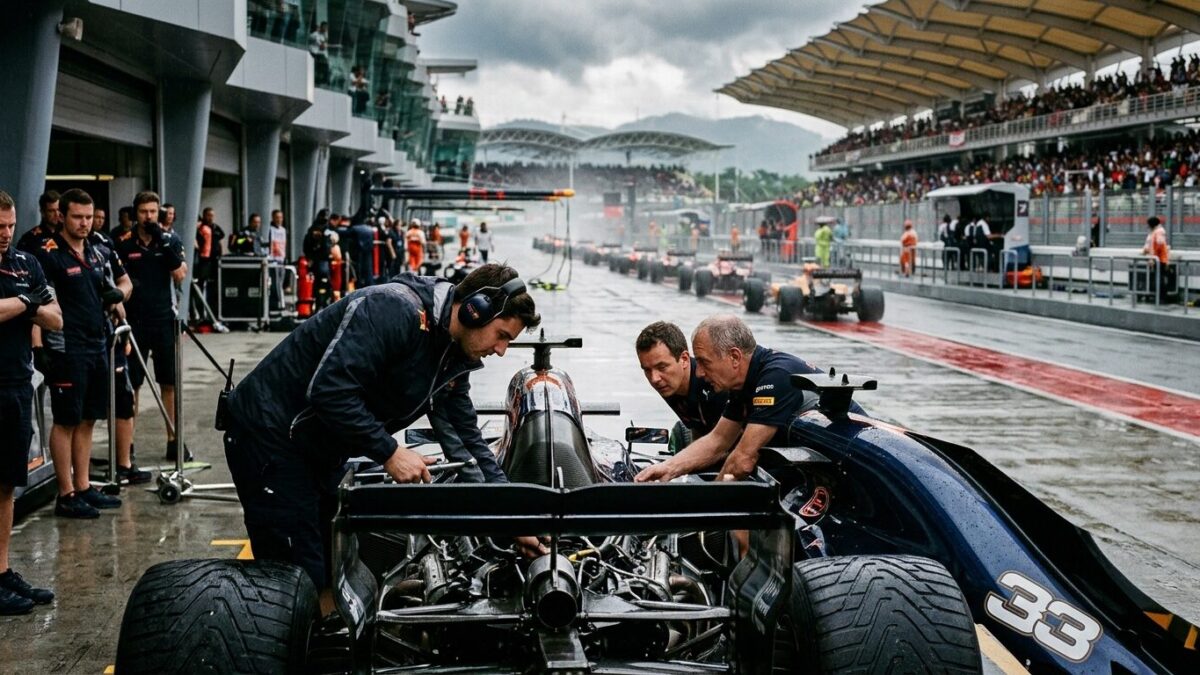
BBC F1 correspondent Andrew Benson said a software fault, not caution over wet-weather racing, caused the delayed start to the Bahrain Grand Prix in Malaysia. The glitch affected Lewis Hamilton and other cars during formation laps, raising questions about how Formula 1’s engine systems handle unusual conditions.
Hamilton eventually finished third after recovering from an incorrect tyre choice at the start. Max Verstappen won, while the pre-race disruption left cars struggling to move in heavy rain and forced officials to halt the formation laps.
A tropical downpour had soaked the circuit. When the cars went out behind the safety car to assess conditions, a bug in the wet-weather engine settings supplied to teams by the FIA affected several cars, including those of Verstappen and Hamilton, who had been on the front row.
The failure meant the teams needed new code. The formation laps were aborted while the code was written and distributed for teams to upload. By the time the race began, no further rain had fallen during the intervening 25 minutes, and the track had become relatively dry.
That distinction matters: the delay was caused by a technical fault, not a decision to hold back racing in the wet. Drivers generally enjoy wet conditions, Benson wrote, but there is an agreement not to race when visibility prevents them from seeing where they are going. Conditions at the original start time in Malaysia met that threshold.
Lewis Hamilton and Verstappen describe the failure
Verstappen and Hamilton compared the cars’ behavior to a “Lego race” after the event. Verstappen said low engine speeds, limited grip and specific features of the circuit had combined to trigger the software problem.
“I triggered [the problem] first and then I looked in my mirror, I was like, 'Wait, are they waiting for me or what's going [on]...?' It was like the Lego race,” the Red Bull driver said.
Hamilton, speaking beside Verstappen at the post-race news conference, described having to stop his car and restart its engine. “Yeah, we had the same speed. I had to stop on track and stop the car and engine and restart it. I've never done that before,” he said.
Mercedes driver George Russell, who retired with an engine failure, said the incident “didn't feel very F1.” The scenes also drew attention to the complexity of the sport’s latest hybrid engines, which combine electrical and combustion power and have generated complaints from drivers about how the cars deploy energy.
Nikolas Tombazis, the FIA’s single-seater director, said the software had been tested but not in the specific conditions that exposed the fault. He said there had been little wet-weather running that year, and promised a full investigation.
“Obviously, that was a major criticality, and we need to make sure we avoid it,” Tombazis said. He said the FIA could not guarantee that no other problem would occur, but that it would work to prevent a repeat of this specific failure.
Tyre call left Hamilton’s counterfactual unanswered
Hamilton’s podium came after Ferrari made an incorrect tyre choice at the start. He later said he could have won had he started on intermediate tyres, but Benson said the available race data could not establish whether that would have happened: Hamilton and Verstappen never ran at comparable pace in similar conditions.
Hamilton began on slick tyres while Verstappen used intermediates. When Verstappen changed to slicks, Hamilton’s tyres were much older. In the few laps Hamilton had clear air before catching Isack Hadjar, his pace was generally well off Verstappen’s, but his tyres were nine laps older.
Hamilton passed Hadjar with only three laps remaining. On one, he was within 0.1 seconds of Verstappen; on the other two, he was 0.5 seconds and 1.2 seconds behind. Benson noted that the figures did not show how hard either driver was pushing.
Formula 1 plans further changes to its engine rules next year, including an altered energy split, according to the BBC report. For this specific software fault, Tombazis said the FIA would work to ensure it did not happen again.
Source: bbc.co.uk