Jakarta Smoke Drifts West, but Air Quality Remains Unhealthy
Wildfire smoke is moving away from Jakarta, but PM2.5 and air-quality readings remain unhealthy at several monitoring sites across the capital.
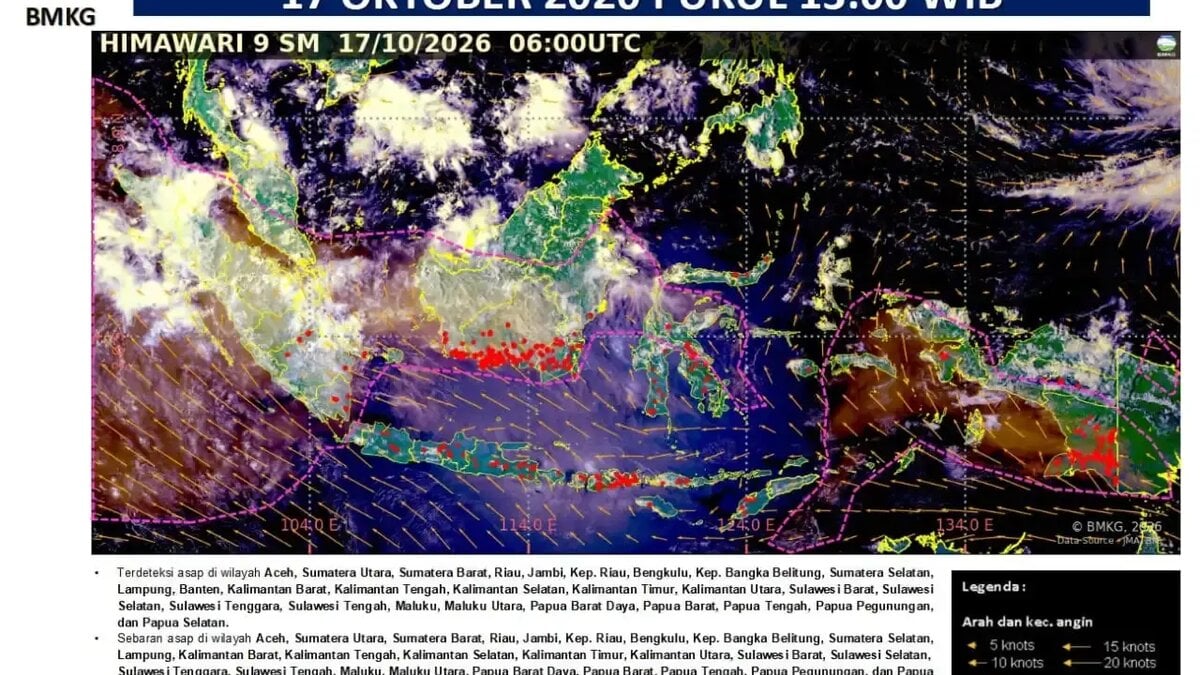
JAKARTA, Indonesia — Wildfire smoke has begun moving away from Greater Jakarta, but air-quality readings remain unhealthy at several locations in the capital, Indonesia’s Meteorology, Climatology and Geophysical Agency (BMKG) said. The shift, observed on Saturday, Oct. 17, 2026, does not mean conditions are the same across Jakarta or that satellite images alone can show what residents are breathing at ground level.
Satellite observations at 8 a.m., 10 a.m. and 1 p.m. local time showed the smoke moving away from western Java. Residual smoke remained visible over the western coast of Banten, at an altitude of about 10,000 to 18,000 feet, or 3 to 5.4 kilometers.
Satellite smoke and surface pollution are different readings
Guswanto, BMKG’s chief secretary, said changes in wind direction and weakening winds at those altitudes had helped shift the smoke. Its presence in satellite imagery does not automatically indicate a rise in pollution at the surface, where people live and work.
“Nevertheless, BMKG urges the public to remain alert and monitor air-quality developments in their respective areas,” Guswanto said in a statement cited on Sunday, Oct. 18.
The smoke briefly entered western Java, including Greater Jakarta, during monitoring on Friday, Oct. 16. BMKG said the episode was temporary and did not affect surface air quality. That distinction matters for residents and travelers: an atmospheric plume visible from above is not, by itself, a measure of pollution at street level.
Satellite imagery tracks smoke in the atmosphere, while PM2.5 measurements and Indonesia’s Air Pollution Standard Index (ISPU) report conditions at ground monitoring sites. The indicators can differ, so a regional picture should not be treated as a uniform reading for every neighborhood.
Jakarta readings range from good to unhealthy
At the Kemayoran monitoring site, PM2.5 concentrations ranged from 46.7 to 109.7 micrograms per cubic meter, spanning the moderate to unhealthy categories. The figures show why the smoke’s movement away from the metropolitan area does not, on its own, settle questions about local air quality.
Data from the Environment Ministry’s ISPU monitors also varied by location. Marunda recorded 49, classified as good, while Tanah Abang registered 60, in the moderate category. Kelapa Gading recorded 103, Menteng 116 and Kebun Jeruk 120; all three readings fell in the unhealthy category.
PM2.5 was the critical pollutant parameter in the ISPU readings at several of those sites. For the public, the practical implication is to follow measurements from nearby monitoring locations rather than assume that one neighborhood’s conditions apply across the capital. BMKG said residents need not panic solely because smoke appears in satellite imagery, but should continue checking local air-quality updates.
The agency said it would continue monitoring atmospheric conditions and share updates to support precautionary measures. Residual smoke along Banten’s western coast and changing readings at Jakarta monitoring sites remain the developments BMKG is tracking.