Webb Captures N159, an Eerie Star-Forming Region
NASA’s James Webb Space Telescope has captured N159, a turbulent star-forming region in the Large Magellanic Cloud. The observation, selected as Webb’s Picture…
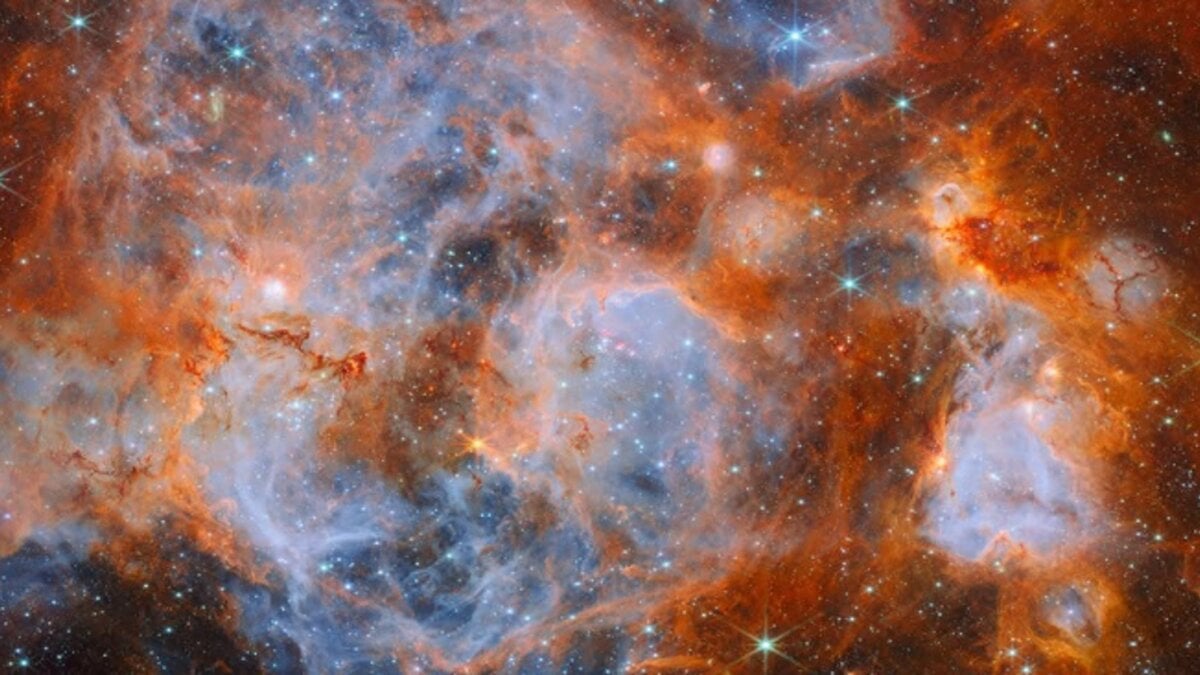
NASA’s James Webb Space Telescope captured N159, a turbulent star-forming region in the Large Magellanic Cloud, revealing dense gas and dust where new stars are forming. The region lies about 161,000 light-years away, and the observation was selected as Webb’s Picture of the Month for October.
It looks like a cosmic cauldron. The image also gives astronomers a way to study star formation in an environment with lower metallicity than the Milky Way.
What Webb’s N159 image reveals
NASA described the observation as a visit to “a turbulent cauldron of star formation to see what is brewing inside dense clumps of gas.” The agency also paired the image with the line, “Double, double toil and trouble; Fire burn and cauldron bubble.”
In astronomy, metallicity refers to the proportion of elements heavier than hydrogen and helium. NASA says N159 has a lower metallicity than our Milky Way, making the region useful for studying conditions in the early universe and how stars formed in those conditions.
The image’s colors trace different materials and processes. Light orange areas show emission from polycyclic aromatic hydrocarbons, carbon-based molecules. Pale blue clouds represent ionized hydrogen, or H II gas, energized by intense ultraviolet light from massive stars.
Dark red filaments cross the center of the nebula. They are made of cool molecular hydrogen and mark its densest parts. Those filaments help shield new stars from harsh radiation and stellar winds.
A view of star formation in action
The structures matter because they show how a turbulent cloud can both expose young stars to radiation and protect them within denser regions. That gives astronomers a closer look at the conditions shaping star formation, rather than just a striking view of a distant nebula.
NASA’s account also discusses Wolf-Rayet stars, which are efficient dust producers. The agency says the James Webb Space Telescope’s Mid-Infrared Instrument shows this process to great effect.
The report separately describes Webb observations of the Serpens Nebula. In one small area of that image, near the top left, astronomers found aligned protostellar outflows. The jets appear as bright, clumpy red streaks: shockwaves produced when the outflows hit surrounding gas and dust.
That observation is distinct from the N159 image, but both show how Webb’s views of gas, dust and young stellar activity can help researchers examine the environments where stars form. NASA’s selection of N159 as its October Picture of the Month brought the region into focus during the Halloween season.
N159 is in the Large Magellanic Cloud, one of the satellite galaxies orbiting our Milky Way. Its distance is about 161,000 light-years.
Source: foxweather.com