Voice Too Queer They: Lorca’s Legacy Finds New Life
Federico García Lorca’s sexuality was kept out of public discussion in Spain for decades. A cabaret tribute in London and the film La Bola Negra are helping a…
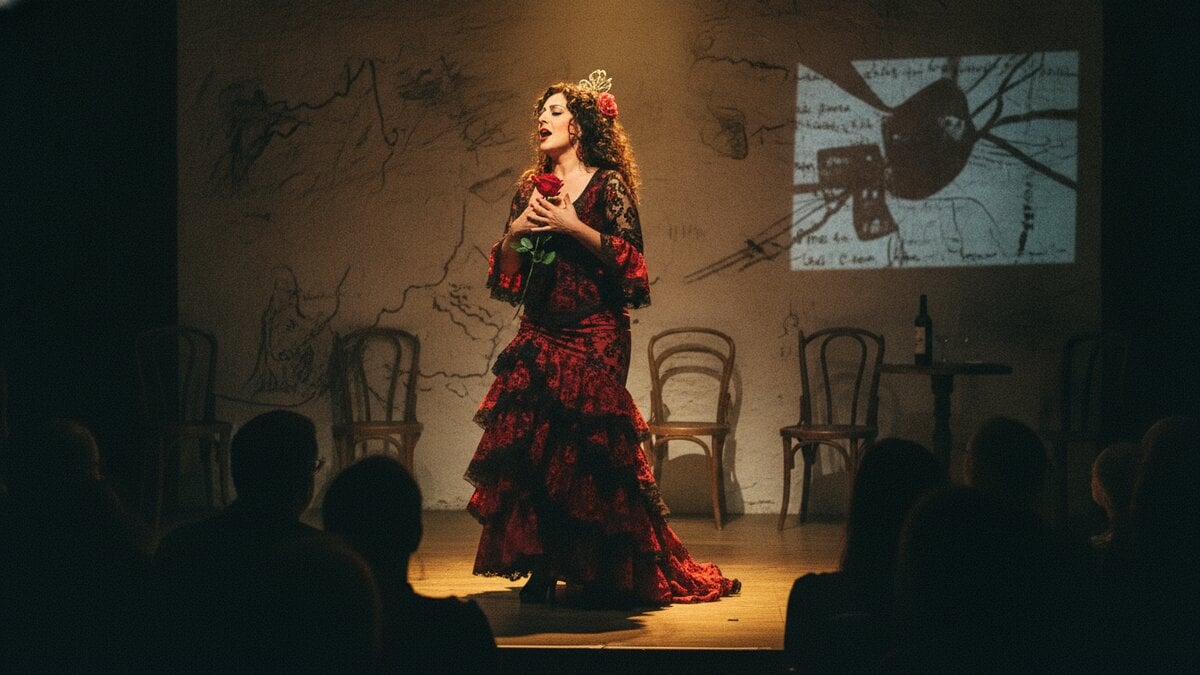
Patricia Langa is bringing Federico García Lorca’s silenced sexuality into a London cabaret, as the film La Bola Negra helps a new generation connect with the Spanish poet’s queer legacy. The performance forms part of the Festival of Queer Spanish Culture, taking place in London this November.
Langa plays Conchita, a grieving Spanish widow inspired loosely by the heroines of Lorca’s 1936 play The House of Bernarda Alba. Her show blends flamenco, lip-sync and poetry, imagining a funeral for the poet and playwright, who was killed by Franco’s nationalist regime. His body was never found.
“His voice was too loud, too queer, too alive for those around him, filled with jealousy and hatred,” Langa says in the performance. “So they silenced him.”
How Lorca became a queer icon
Lorca’s work has found fresh audiences through Booktoks, drag tributes, documentaries and book clubs. The recent film La Bola Negra has added momentum, making the poet an increasingly prominent figure for Spain’s LGBTQ+ community.
For Langa, approaching Lorca through a queer lens has changed how she understands his writing. His first play, The Butterfly’s Evil Spell, centers on a forbidden love between a cockroach and a butterfly. She sees in the work a recurring interest in characters who do not fit expected norms.
“A lot of his work is about being different,” she says. “There is something quite magical about understanding these little tricks that he used to share something that maybe he publicly didn’t feel he was able to.”
Lorca was born near Granada in 1898 and became one of Spain’s most celebrated writers during his lifetime. Although people speculated about his homosexuality, he was never openly gay. Same-sex relations faced violent repression under Franco, and Spain did not clear sentences for those relations until 2001.
The silence continued after Lorca’s death. His family and literary circles kept his sexuality out of discussion for decades, while some academics and writers feared losing access to family archives and university resources if they raised the subject.
What changed the conversation about Lorca?
Ian Gibson, one of Spain’s most respected Lorca biographers, says frank discussion once came at a professional cost. His biography of the poet, published in 1985, placed homosexuality at the center of the story.
“I put homosexuality in the centre of the picture,” Gibson says, “and that was the end of my relationship with the family.”
Gibson points to a biography by Lorca’s brother Francisco, published posthumously in 1980, as an example of the earlier silence. “In that book the word homosexual doesn’t appear. There is no allusion to his sexuality.”
His later book, Lorca y el Mundo Gay, published in 2009, became a resource for readers seeking more about the poet’s sexuality. Copies of a pink-tinted 2026 reissue sit in the window of Berkana, a queer bookshop in Madrid’s Chueca district.
The bookseller says La Bola Negra has brought more demand for work connected to Lorca. La Piedra Oscura, a play by Alberto Conejero on which the film is based, has also become a bestseller. The change gives readers a way to encounter a part of Lorca’s story that earlier literary discussion often left unspoken.
La Bola Negra also recognizes Gibson through a character played by Glenn Close. The biographer moved to Spain in the 1960s to study Lorca and later became a Spanish citizen. The film’s attention, alongside Langa’s performance, places Lorca’s writing and the history of its reception in front of audiences anew.
“If you went around saying that Lorca was gay, the door was shut,” Gibson says.