Rubin Observatory Finds Backward-Orbiting Object Beyond Neptune
The Rubin Observatory in Chile has found an object called R631 just beyond Neptune. Its orbit is tilted 142 degrees, so it circles the sun against the flow of most planets. It will take about 547.84 Earth-years to complete one lap.
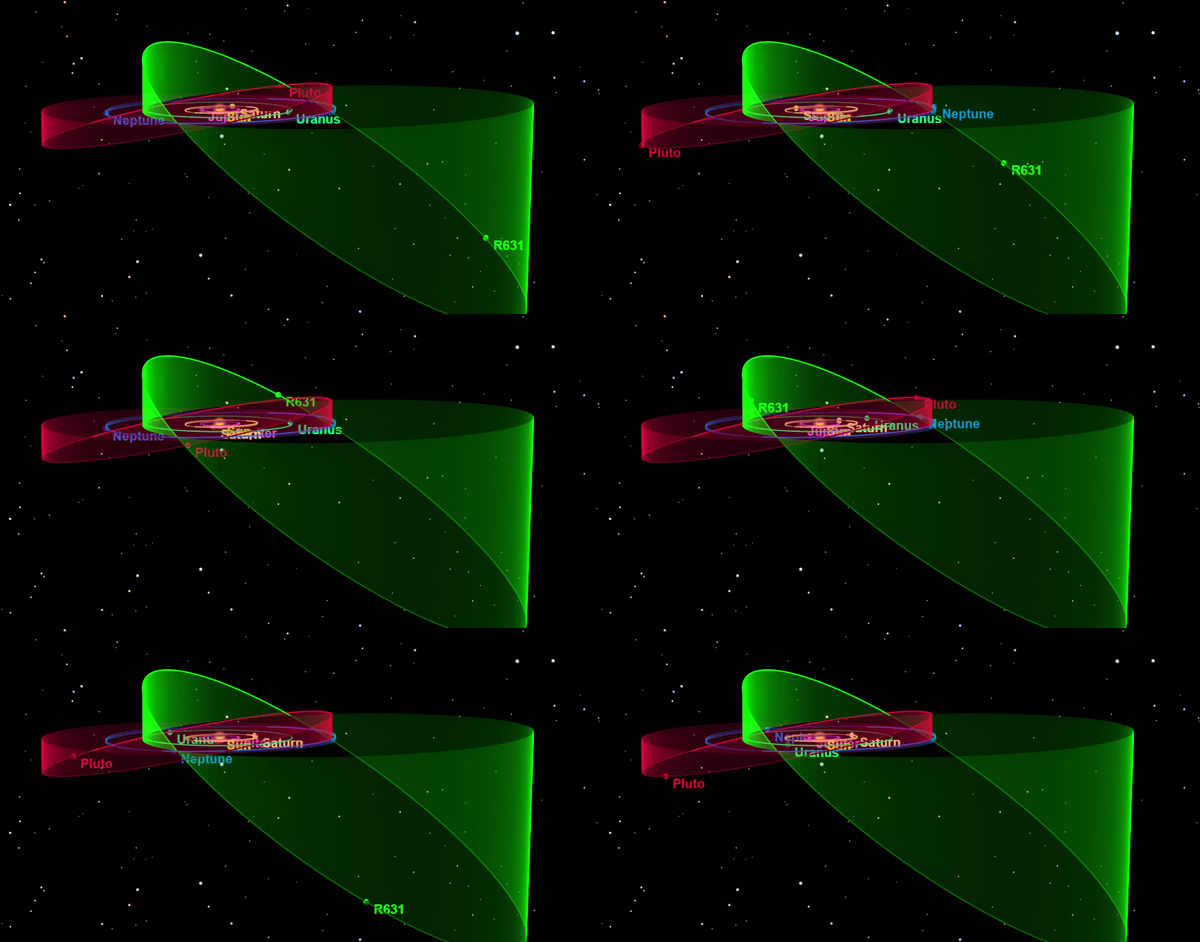
The Rubin Observatory in Chile has found an object beyond Neptune, temporarily designated R631, that orbits the sun in a retrograde direction, based on observations from December 2025 through March 2026. It is a backward world by solar system standards.
Most planets, moons and asteroids travel around the sun in a roughly flat plane. They move in the same direction, counterclockwise as seen from Earth's north. R631 does not.
What retrograde means here
In everyday use, retrograde suggests something moving backward. Astronomers use a stricter test: any object whose orbit is tilted more than 90 degrees from the plane of the solar system counts as retrograde.
R631 has an orbital inclination of 142 degrees. Its path is tilted past perpendicular, and it moves opposite to most planets.
Size, distance and orbit
The object sits 32 astronomical units (AU) from the sun. One AU is the Earth-sun distance, so R631 is 30 times farther out than Earth. Neptune orbits at 30 AU.
Astronomers and citizen observers watching Rubin's alert stream noticed the object. It appeared in the data over four months. The Minor Planet Center will soon assign it an official designation.
R631 will reach perihelion, its closest point to the sun, on October 31, 2047, at 24 AU. If the current orbit is correct, one full lap takes 547.84 Earth-years.
Physicist and astronomer Marshall Eubanks said on the Minor Planet Mailing List that the object could be 62 miles (100 km) across. He said it might resemble Comet Bernardinelli–Bernstein, the largest known Oort cloud comet. If R631 is a comet, it might show activity such as outgassing near its 2047 perihelion.
How it got this way
The solar system formed from a spinning cloud of gas and dust, which helps explain why most objects share one direction of travel. A retrograde orbit needs an unusual history.
One possibility is that R631 formed around another star and was flung out, perhaps when that system passed too close to ours. The sun's gravity then captured it.
Another is that it began in an ordinary forward orbit and passed too close to a large body, such as Jupiter or a passing star. That encounter would have thrown it onto a retrograde path.
Sam Deen, an amateur astronomer who finds lost asteroids and comets in archival data, said the object likely comes from the Kuiper belt. He said it became destabilized after passing too close to Neptune sometime in the past billion years.
R631 is not the first retrograde object found. The Great Comet of 1882 also had a 142-degree inclination.