Physicists Create Supersolid at Room Temperature Using Light-Matter Particles
An international team of physicists has created a supersolid, a state of matter that is both crystal-ordered and frictionless, at room temperature using light-matter hybrid particles. The findings, published in Science Advances, avoid the extreme cooling earlier experiments needed.
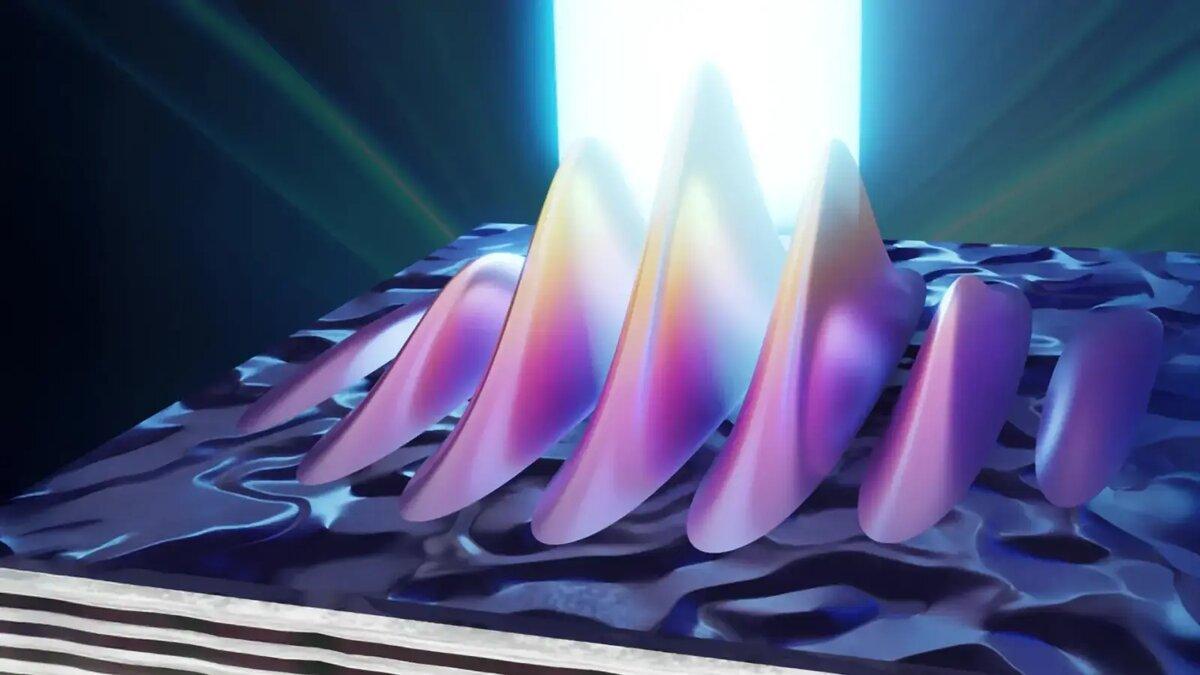
An international team of physicists has created a supersolid at room temperature, in a quantum breakthrough that makes light behave like both a solid and a liquid, according to findings published in Science Advances. Earlier experiments needed matter cooled to near absolute zero.
A supersolid has the orderly structure of a crystal and the frictionless flow of a special kind of liquid. Those two properties seem incompatible. The new work shows them together under far more accessible conditions.
Who did the work
The team came from the Faculty of Physics at the University of Warsaw, the Military University of Technology in Poland, IBM Research Zurich, and the French National Centre for Scientific Research (CNRS). They work together in a group called the TopoLight consortium.
Instead of ultracold atoms, the researchers used hybrid particles called exciton polaritons. These arise when light couples so strongly with matter inside a tiny optical chamber, a microcavity, that the resulting particle shows traits of both.
How the supersolid was made
The team built an optical microcavity containing a specially engineered liquid crystal and covered it with an organic semiconductor. That setup let light and matter interact strongly enough to produce the quantum effects.
Exciton polaritons survive only a few picoseconds, or trillionths of a second. Even so, they can organize into a Bose-Einstein condensate, a collective quantum state in which particles act as one coordinated system. In that state they behave as a quantum superfluid.
Why it was hard before
Superfluidity is a phenomenon in which a fluid loses its viscosity, or internal resistance to flow. A superfluid can move through very narrow passages without the usual friction.
Physicists proposed the supersolid idea in the 1960s. For decades it stayed theoretical. Experimental confirmation came in 2017, in ultracold atomic Bose-Einstein condensates. Producing those conditions generally required sophisticated equipment that chilled matter to temperatures extremely close to absolute zero.
What it could lead to
The researchers say the approach gives scientists a new way to study exotic quantum behavior without extreme cooling. They also say it could help advance technologies ranging from optical computing to highly sensitive sensors.