CERN Scientists Find Evidence of Rare Particle Decay
CERN researchers have found evidence of a particle decay predicted to occur about once in every 10 billion beauty particles. The signal falls short of the threshold for a confirmed discovery, but it gives physicists a new way to test their understanding of fundamental particles.
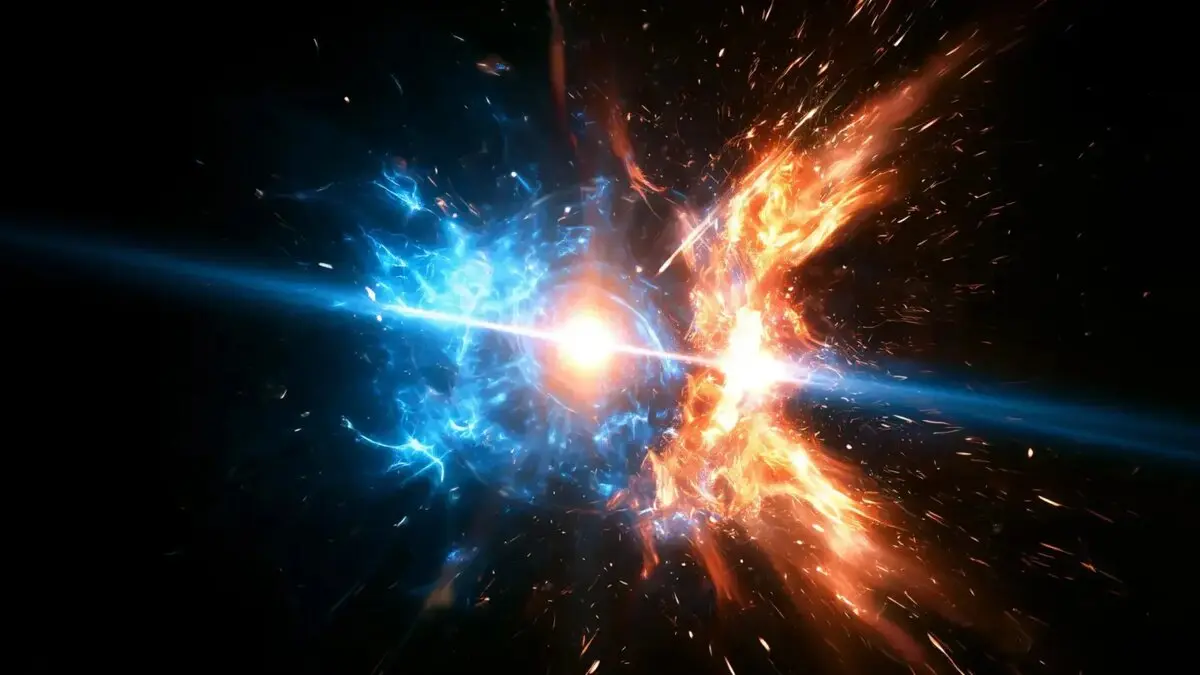
After more than 40 years of searching, CERN scientists have found evidence of a particle decay predicted to occur about once in every 10 billion beauty particles. The result could help physicists test their understanding of fundamental particles and search for signs of unknown forces.
It is not yet a discovery. The signal reached a statistical significance of 3.2 sigma, below the five-sigma threshold physicists generally require for a confirmed discovery.
The evidence came from the upgraded LHCb experiment at CERN's Large Hadron Collider. University of Manchester researchers contributed to the technology used in the measurement.
A rare test of physics
The decay turns a particle containing a beauty quark into two muons, which are heavier relatives of electrons. The process, known as Bd to mu mu, was predicted to occur about once in every 10 billion beauty particles.
Beauty quarks are heavier relatives of the up and down quarks that make up much of ordinary matter. They survive for about one and a half trillionths of a second before decaying into other particles.
Physicists study rare decays because their rates can be sensitive to the effects of particles that cannot be observed directly. Differences between predicted and measured rates could point to unknown particles or forces.
The new measurement agrees with the Standard Model, the scientific framework describing fundamental particles and their interactions. It has not revealed evidence that the theory is wrong.
Professor Conor Fitzpatrick, deputy physics coordinator of the international LHCb collaboration, called the decay “a golden channel to observe the effects of new physics from beyond our current knowledge.”
Detector tracks particle paths
A detector called the Vertex Locator helped researchers track particles produced in collisions. It sits five millimeters from the collider's beams and measures where particles originate and decay.
Dr. Stefano De Capua, who directed detector construction at the University of Manchester, said the team worked with nearly 90 UK companies to build it.
“It is these detectors that we use to locate where the beauty meson was produced and pinpoint where it decayed into two muons,” De Capua said.
The wider LHCb upgrade lets the experiment collect information at up to five times its previous rate. Improved particle tracking also helps researchers identify events that were previously too difficult to measure reliably.
More data planned into 2030s
The upgraded LHCb experiment is expected to gather a substantially larger collection of measurements into the early 2030s. Those data could help physicists measure the decay's frequency more precisely.
Researchers are planning another major upgrade that could increase data collection rates by an additional factor of ten.
 Take the quizWhat Kind of Holiday Spender Are You? Take the Black Friday QuizStart →
- 1Stock Market Today: Dow Slides 1.34% and VIX Jumps 15% at Midday

- 2Joachim Klement to Sell Stocks After S&P 500 Signal

- 3Stock Market Today: Nasdaq, S&P 500 Futures Slide as AI Selloff Deepens

- 4Kenneth Walker’s Groin Injury Puts Cardinals Game in Doubt

- 5Pat Cummins Faces Captaincy Doubts From Mitchell Johnson

 Lifestyle · Food & HealthNormal Blood Pressure Chart by Age: Healthy Ranges Explained
 Lifestyle · Food & HealthWhat Is Raynaud’s Syndrome? Why Fingers Turn White in the Cold
 Lifestyle · Food & Health4 Ways Walking After Meals Helps Your Body, Doctors Say
 Lifestyle · Food & Health4 Reasons to Eat Oatmeal, According to Nutrition Experts