LHCb Particle Decay Opens a Door to the Zeptoverse
Scientists at CERN have found evidence of a rare neutral B meson decay into a muon and an antimuon, a process predicted to occur once in every 10 billion…
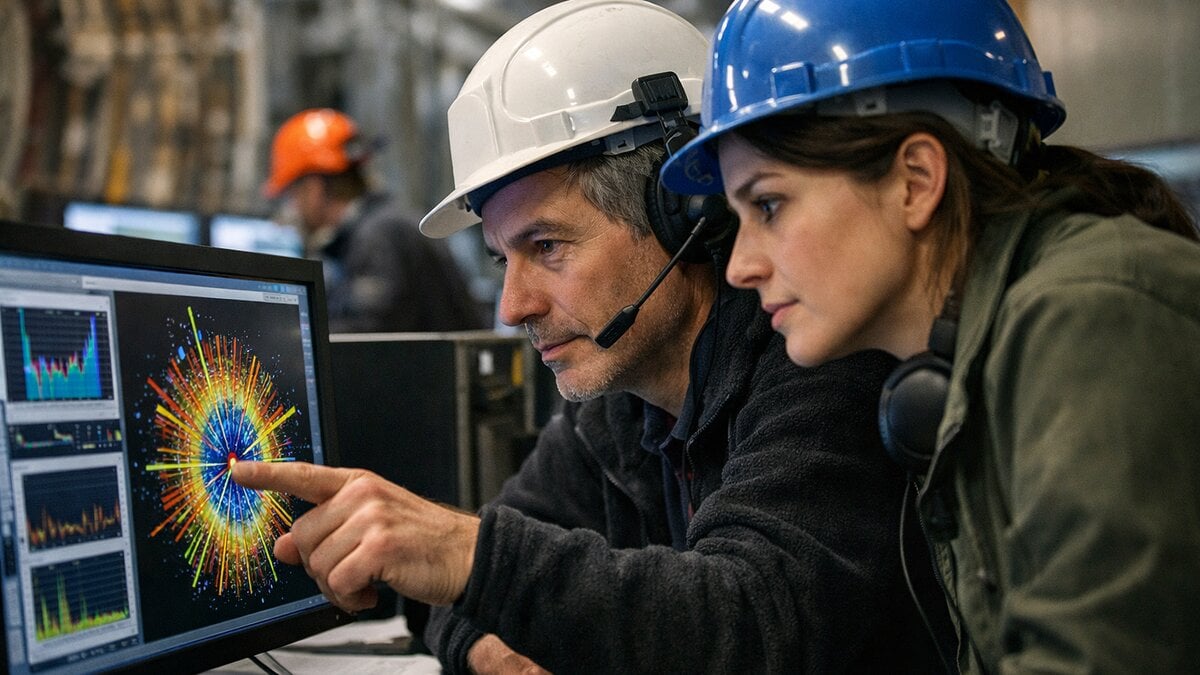
Particle physicists getting first evidence of a rare particle decay have opened a new path toward probing the zeptoverse, a scale far smaller than an atom. Scientists working with CERN’s Large Hadron Collider found signals that a neutral B meson decayed into a muon and an antimuon, a process predicted to happen only once in every 10 billion such decays.
The finding is an experimental first for a decay physicists have pursued for more than four decades. The result gives researchers a way to test the Standard Model’s predictions with unusual precision; it does not yet point to physics beyond those predictions.
Why is this decay so rare?
The Standard Model predicts that, on average, just one neutral B meson in 10 billion will transform into a muon and an antimuon. Detecting the signal therefore means separating a very faint trace from many other particle processes produced in collisions.
“Physicists have been chasing this decay for more than 40 years,” said Marco Santimaria, who co-led the international analysis team. “Extreme precision is required to pick the muons out of the overwhelming background.”
Mesons are short-lived particles created in collisions. Muons resemble electrons but are about 200 times heavier. Researchers examine how particles decay because those transformations can test established physics and offer clues to particles not yet known.
How does the result connect to the zeptoverse?
The zeptoverse refers to a scale where distances are measured in zeptometers, equivalent to one quadrillionth of a meter. A typical atom is about 100,000 million zeptometers across, underscoring how far below atomic dimensions these measurements reach.
The new result does not establish that scientists have discovered new particles or confirmed unexpected behavior. The measurements remain consistent with current physics predictions. But further observations of the decay could expose deviations and help researchers investigate what happens at these tiny scales.
That possibility matters because particle decays offer a way to test how matter behaves where the distances involved are extremely small. A discrepancy between measurements and the Standard Model could provide evidence that its account is incomplete. For now, the evidence marks a starting point, not a confirmed departure from known physics.
The Large Hadron Collider’s 2024 upgrades helped make the observation possible. They increased the speed of data collection, while machine-learning techniques helped researchers suppress the many background processes that could obscure signals from rare decays.
The finding also shows why rare processes can demand long searches and improved tools. Scientists must collect enough collision data to have a chance of identifying an event that the Standard Model expects to occur only once among 10 billion neutral B meson decays.
Researchers have made details of the analysis available in a preprint on arXiv. The evidence provides a new route for testing particle physics at the zeptometer scale, while the measured decay still matches the Standard Model’s prediction.