My Neighbor Totoro Grew From Modest Debut to Japanese Icon
My Neighbor Totoro marked a turning point for Miyazaki Hayao, who had previously avoided Japanese settings in his films. Set in Saitama, the 1988 story drew on…
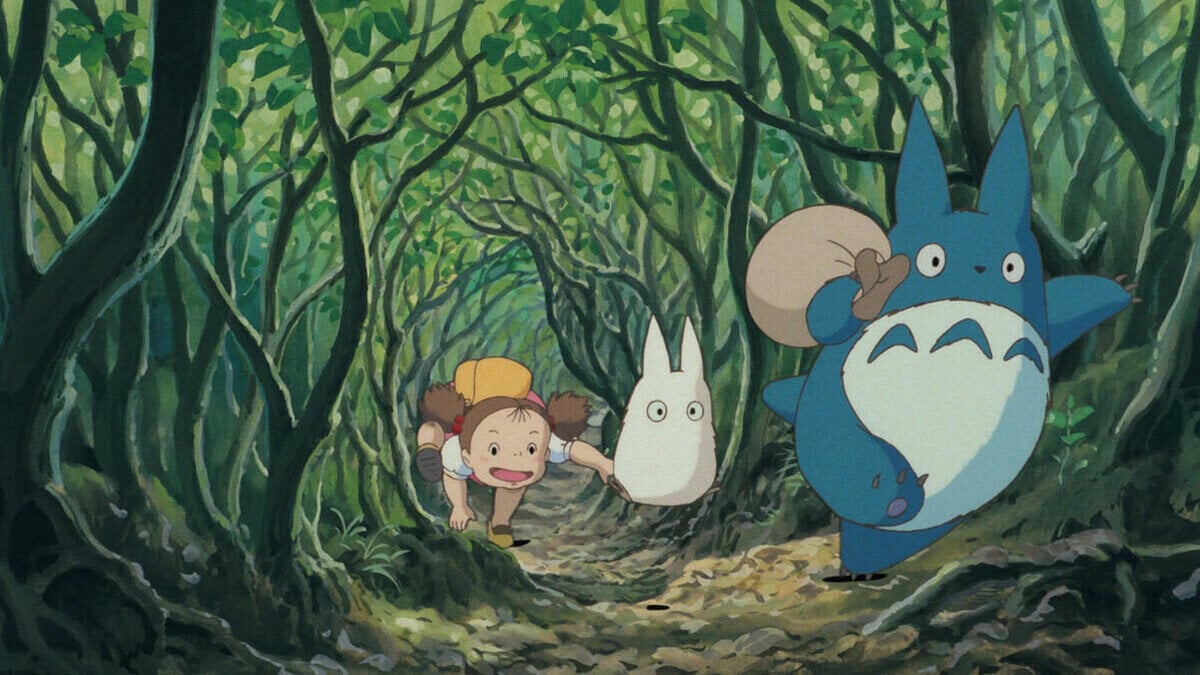
Miyazaki Hayao’s My Neighbor Totoro brought Japan’s forests to the center of his storytelling, marking a turn toward homegrown settings in the director’s work. Released in 1988, the film began modestly at the box office before becoming a lasting part of Japanese popular culture.
Set in Tokorozawa, Saitama, during the 1950s, the story follows sisters Satsuki and Mei after their family moves to the area. They encounter mysterious creatures called Totoro, visible only to children. The forest around them gives the fantasy its sense of place—and reflects Miyazaki’s growing appreciation for Japan’s natural landscape.
The film premiered on April 16, 1988, in a double bill with Takahata Isao’s Grave of the Fireflies. It was Miyazaki’s fourth animated feature, following The Castle of Cagliostro, Nausicaä of the Valley of the Wind and Castle in the Sky.
How did My Neighbor Totoro become a cultural icon?
My Neighbor Totoro gained a broader audience through television broadcasts, home video and merchandise, including plush toys. Its opening song, “Sanpo” (“Hey, Let’s Go”), became a favorite with children in Japan, while Totoro eventually became Studio Ghibli’s logo.
At first, the film had a quiet reception at the box office. Its low-key premise had made the project difficult to launch, and the production was originally planned to run for about 60 minutes. Pairing it with Grave of the Fireflies helped bring it to theaters.
Recognition followed. The film became the first animated feature named best Japanese film in the Kinema Junpō annual rankings. It also won best film at the Mainichi Film Awards and received the Minister of Education Award for Fine Arts.
That change in stature has practical, visible traces. Since November 2020, Tokorozawa Station has played melodies based on “Sanpo” and the film’s main theme to signal that trains are about to depart. A character that began in a film has become part of the sound of daily travel in the town that inspired its setting.
What does Totoro’s forest represent?
The forest connects the film to a recurring feature of Miyazaki’s work: reverence for Japan’s natural world. Totoro’s woodland appears in different forms in other films, especially Princess Mononoke.
The source of that imagery includes laurel forest culture theory, a hypothesis that became influential in Japanese cultural anthropology from the 1970s. Laurel forests are temperate woodlands of broadleaf trees that keep their leaves through winter. Oak, shii, camellia and camphor are examples; the enormous camphor tree where Totoro lives belongs to this landscape.
The theory, advocated by botanist Nakao Sasuke and ethnologist and cultural anthropologist Sasaki Kōmei, links everyday Japanese practices—including slash-and-burn agriculture, sticky rice and fermented foods such as nattō—to cultural practices across a forest belt in East Asia. The belt described in the account stretches from Tibet through Bhutan, China and Taiwan to southwestern Japan.
The forest motif also reaches beyond Totoro’s own story. Forests in Yakushima, Kagoshima Prefecture, served as a real-world model for the Forest Spirit’s habitat in Princess Mononoke. And Totoro’s influence crossed into other films: a plush toy of the large character appears in Pixar’s Toy Story 3 as a homage to Miyazaki.
Thirty-eight years after its release, My Neighbor Totoro is widely recognized as a masterpiece by Miyazaki and Studio Ghibli, while its central character remains part of the studio’s identity.