Ranbir Kapoor’s Ramayana opens worldwide to mixed reviews
Stars as Lord Ram in Ramayana: Rise of a Legend, the first of two planned films that opened worldwide days before Diwali. The reported $500m production brings…
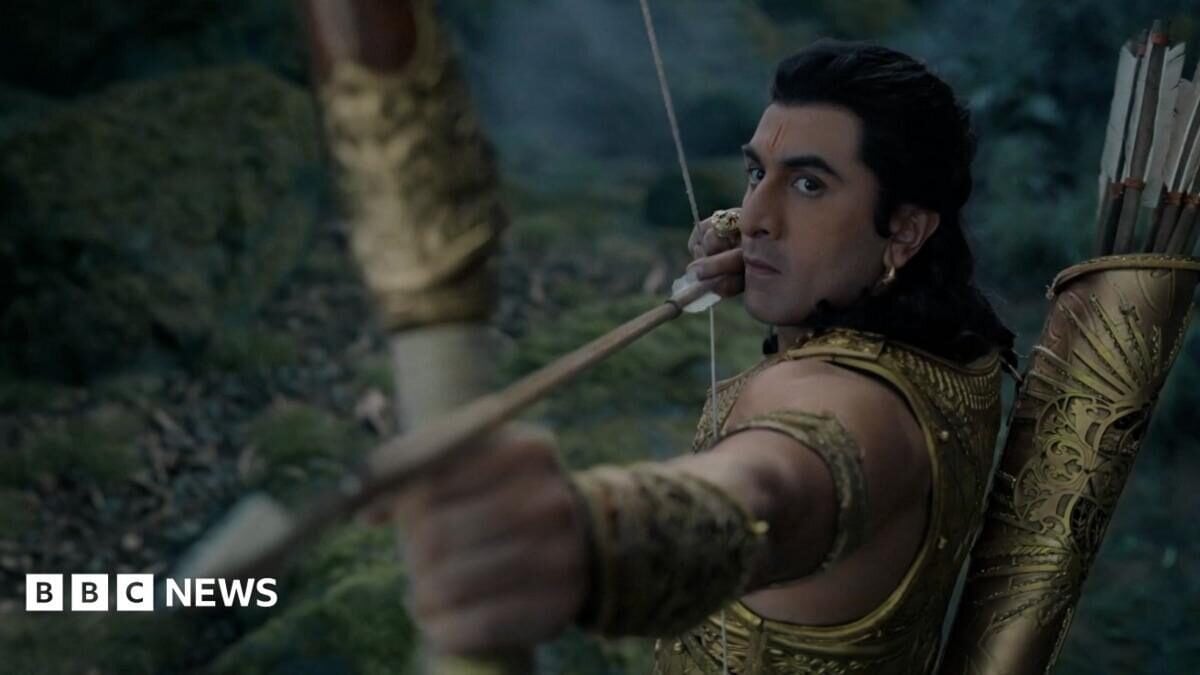
Ranbir Kapoor’s Ramayana has opened in cinemas worldwide, putting one of Hinduism’s most revered stories on screen in a reported $500m production. The first of two planned films arrives days before Diwali, with critics divided over whether its lavish spectacle supports the story or overwhelms it.
Directed by Nitesh Tiwari, Ramayana: Rise of a Legend brings together major Indian stars, Hollywood visual-effects expertise and two Oscar-winning composers. Kapoor plays Lord Ram, the prince of Ayodhya, while Sai Pallavi portrays Sita and Yash plays Ravana, the 10-headed king of Lanka.
The scale is unmistakable.
The film retells a story of love, duty, exile and war, set among gods, demons, celestial weapons and kingdoms. Ram is banished for 14 years and retreats to the forest with Sita, who is kidnapped by Ravana. Their conflict builds toward a battle that the second film will depict; it is set to release next year.
Why are reviews of Ranbir Kapoor’s Ramayana divided?
Critics have praised the film’s visual ambition and performances, but some say the spectacle leaves the storytelling in its shadow. Their contrasting reactions point to the challenge of adapting a familiar epic for a worldwide cinema audience.
Saibal Chatterjee of NDTV gave the film three out of five stars. He wrote that its enormous scale “remains, for the most part, the only thing that stands out” and described the acting as “wildly inconsistent”.
Rishabh Suri of the Hindustan Times awarded it four stars. He praised the performances and visual effects, writing, “I am happy to report, all that money shows on screen,” while criticising the slow first half and underwhelming music.
Shubhra Gupta of The Indian Express also gave it three stars. Though initially doubtful about the extravagant scale, she said she was gradually won over and called the film the “perfect epic”. She found enough sorcery, thrills and adventure to sustain its spectacle without letting the sprawling story disappear beneath it.
International reviews were similarly split. Peter Bradshaw of The Guardian called the film a “thoroughly engaging, rousing and spectacular Indian epic melodrama” and gave it four stars. Siddhant Adlakha of IGN scored it four out of 10, describing the action as “clunky” and its computer-generated imagery as an “eye-sore”.
How does the film bring the epic to cinemas?
Producer Namit Malhotra heads DNEG, the visual-effects company that worked on the film and has also worked on Dune and Interstellar. The production’s music pairs AR Rahman, the Indian composer of Slumdog Millionaire, with Hans Zimmer, whose scores include Gladiator, The Dark Knight and Dune.
That combination helps explain why the film has drawn attention beyond its retelling of a religious epic. It places a story with centuries of expression in poetry, temple sculpture, shadow puppetry, folk theatre, television and cinema inside a large-scale global release. The mixed response also puts the adaptation’s central balancing act in view: the visual world must impress without crowding out the characters and narrative.
The release timing adds another layer. The film opened days ahead of Diwali, the Hindu festival of lights that celebrates Ram’s return to Ayodhya after exile. Its story therefore reaches cinemas close to a festival closely tied to the epic’s central figure.
Giovanni Lago of Next Best Picture praised Yash’s Ravana and the score by Rahman and Zimmer, but felt the expansive story might have worked better as a series in the style of Game of Thrones. The discussion has also included the English-language version, which uses AI to adjust actors’ lip movements; the technique drew criticism.
For audiences, the reviews offer competing expectations: a grand visual spectacle, a familiar story told at enormous scale, and performances that some critics found uneven. The film’s next chapter is already planned, with the second part set to release next year.