Philippe Parreno’s Sydney Gallery Show Responds to Spain
French artist Philippe Parreno has filled three levels of Sydney’s Museum of Contemporary Art with connected environments. Sensors on an abandoned almond farm in Spain influence their sound, airflow and lighting, giving visitors an exhibition shaped by conditions 17,000km away.
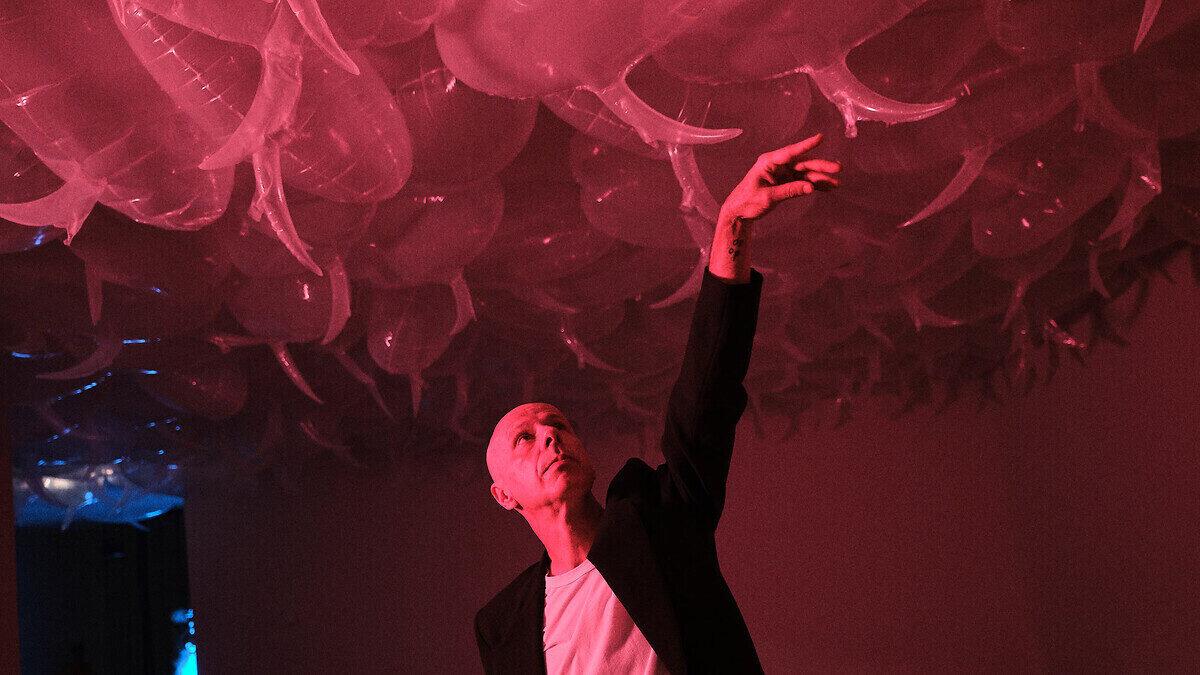
Philippe Parreno’s first major Australian exhibition runs until April 26, 2027, at Sydney’s Museum of Contemporary Art. The French artist’s gallery show draws on live data from an abandoned almond farm in Spain, influencing sound, airflow and lighting 17,000km away.
Called Philippe Parreno: 5 Moons, the exhibition takes its name from the five lunar cycles over its duration. Parreno has arranged works from his four-decade career across three levels of the museum.
Visitors first encounter a white gallery filled with lamps, an industrial fan, speakers, marquee-style lights and a glowing collection of power adapters. A silvery light moves along a pole as bulbs flicker and machine noise mixes with birdsong and distant barking.
A Spanish farm shapes the show
Sensors at the almond farm in the Tabernas desert in southeastern Spain capture wind speed, humidity and temperature. An algorithm uses that data to influence the exhibition’s sound, airflow and lighting in Sydney.
The farm also appears on a large screen in a darkened gallery on the museum’s third floor. An 11-hour film made from footage shot there allows visitors to watch a night pass under the Spanish moon.
Live sound from the terrain plays in the gallery, too. Nocturnal insects from Spain can mingle with sounds from Sydney Harbour outside.
Parreno described his approach as creating an environment where the works respond to one another. “What I normally try to do for exhibition is to try to create sort of a milieu, or an ecosystem, where things are responding to each other,” he said.
The landscape has a family connection for the artist, who was born in Algeria. His family migrated there from the same region of Spain hundreds of years ago.
Floating fish and flashing lights
Across the museum’s three levels, visitors encounter helium-filled fish balloons, a giant cuttlefish on a screen and a ceiling of speech-bubble balloons. The installations combine moving objects, film, sound and light.
In one orange-carpeted gallery, citrus-colored fish float while a grand piano plays. Elsewhere, the cuttlefish’s fins and arms move gently on screen as large speaker banks swivel and emit electronic sound.
In another white-walled space, colored lights flash beneath the speech-bubble balloons. Their pattern translates a mystical adventure by French writer René Daumal into Morse code.
Parreno showed an earlier version of the 5 Moons film at Munich’s Haus der Kunst in 2024. He said he wanted the work to feel as if the land were “speaking to you”.
At the Sydney exhibition, Parreno wants visitors to choose how they spend their time. “In the system we live in, you are always obliged to respond to a signal. Here you are not,” he said. “You just float with your own attention, and you spend the time you want.”
 Take the quizWhat Kind of Holiday Spender Are You? Take the Black Friday QuizStart →
- 1Stock Market Today: Dow Slides 1.34% and VIX Jumps 15% at Midday
- 2Joachim Klement to Sell Stocks After S&P 500 Signal
- 3Stock Market Today: Nasdaq, S&P 500 Futures Slide as AI Selloff Deepens
- 4Kenneth Walker’s Groin Injury Puts Cardinals Game in Doubt

- 5Pat Cummins Faces Captaincy Doubts From Mitchell Johnson

 Lifestyle · Food & HealthNormal Blood Pressure Chart by Age: Healthy Ranges Explained
 Lifestyle · Food & HealthWhat Is Raynaud’s Syndrome? Why Fingers Turn White in the Cold
 Lifestyle · Food & Health4 Ways Walking After Meals Helps Your Body, Doctors Say
 Lifestyle · Food & Health4 Reasons to Eat Oatmeal, According to Nutrition Experts