
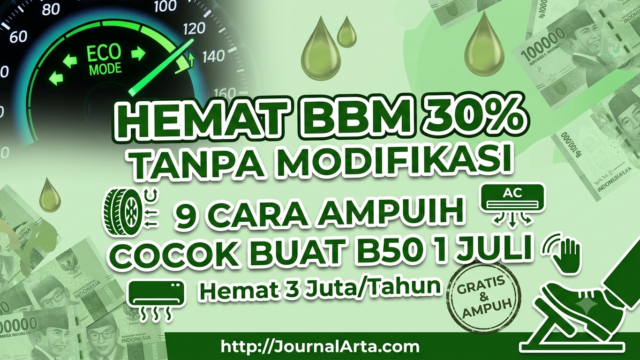
JAKARTA — Indonesia’s B50 biodiesel mandate takes effect July 1, 2026, priced in line with subsidized diesel — but the real savings won’t come from the pump. They’ll come from how you drive. These nine habits have been shown to cut fuel consumption by up to 30% without touching the engine.
The impact hits your wallet fast. A driver spending roughly Rp1 million a month on fuel could save Rp250,000–Rp300,000 every month — around Rp3 million a year. It works for gasoline cars, diesel vehicles, and motorcycles alike, and it’s especially relevant as B50 rolls out nationwide.
9 Ways to Save Fuel Without Engine Modifications
1. Keep RPM between 2,000 and 3,000
This is where your engine runs most efficiently. Sudden acceleration and hard braking alone waste 20–30% more fuel than necessary. The basic eco-driving approach: press the gas gradually, keep a safe following distance, let the vehicle’s momentum do the work. The payoff? A 50-liter tank can carry you roughly 65 kilometers farther.
2. Keep tires at factory-specified pressure
Tires that are 20% below the recommended pressure are enough to push fuel consumption up by 10%. Check pressure every two weeks — the correct figure is on the sticker inside the driver’s door. Properly inflated tires reduce rolling resistance, so the engine doesn’t have to work as hard.
3. Turn off the AC when stuck in traffic for more than 3 minutes
Air conditioning consumes 10–15% of your fuel. Stuck in a jam for more than three minutes? Turn it off and crack a window. One important caveat: above 60 km/h, closing the windows and running the AC on low is actually more efficient. Open windows at highway speeds create aerodynamic drag that burns more fuel than the AC does.
4. Clear unnecessary weight from the trunk
Every extra 50 kg adds 1–2% to fuel consumption. Remove anything from the trunk that doesn’t need to be there. Even an empty roof rack or roof box raises aerodynamic drag and increases consumption by 5–10%.
5. Use the right engine oil — and change it on time
Oil that’s too thick or doesn’t match manufacturer specs increases internal friction. Use whatever the owner’s manual recommends and change it every 5,000–10,000 km. A clean, well-lubricated engine burns fuel more completely — and that means fewer stops at the pump.
6. Warm up the engine for just 30 seconds
Modern fuel-injected vehicles don’t need a five-minute warm-up. Thirty seconds after starting is enough. Longer idling just burns fuel pointlessly. Replace it with driving slowly for the first minute or two, which brings the engine and oil up to operating temperature more effectively.
7. Close windows above 60 km/h
Driving at higher speeds with windows down can add 10–15% to fuel consumption — aerodynamic drag rises sharply. At those speeds, close the windows and run the AC on a low setting. It’s more fuel-efficient, and quieter too.
8. Plan your route and avoid peak congestion
Stop-and-go traffic is the single most wasteful driving condition for fuel. Use Google Maps or Waze to check traffic before you leave. Leaving just 15 minutes earlier to avoid a jam can save up to 15% on fuel — and spares the engine from repeatedly cooling down and restarting.
9. Fill up in the morning, and fill it full
Fuel is denser at lower temperatures, so you get slightly more volume per liter in the cooler morning air. Aim for 6–8 a.m. A full tank also reduces fuel vapor evaporation inside the tank. One specific note for B50: fill the tank completely the first time you use it, to help the engine adapt to the new blend more smoothly.
B50 Plus These 9 Habits: Savings That Compound
B50 is priced at the subsidized diesel rate. Apply all nine habits at once and you’re cutting consumption by 30% while the price stays flat — the savings multiply. A six-month trial by Indonesia’s Ministry of Energy and Mineral Resources found that B50 has better water content characteristics than B40, producing cleaner combustion, provided the engine is serviced regularly.
Put both together and your fueling pattern could shift from seven fill-ups a month to just five.
Three Mistakes That Keep Costs High Even With B50
First: driving above 100 km/h. Every 10 km/h above 90 km/h adds roughly 8% to fuel consumption. Second: a never-replaced air filter. A clogged filter restricts airflow to the engine, directly hurting combustion efficiency — up to 10% more waste. Third: ignoring wheel alignment and balancing. Misaligned tires create excess friction and force the engine to work harder than it should.
Nothing here costs money or requires a trip to the mechanic. These nine habits are free, and the results show up on next month’s fuel bill. B50 goes live July 1, 2026. Building these habits now means your driving routine is already dialed in before the transition even begins.
Key Takeaways
- Driving behavior — not fuel type — accounts for most of the potential 30% savings.
- Simple checks like tire pressure and oil type together can save 10–15% with zero cost.
- B50’s cleaner combustion profile amplifies these gains, but only if the engine is maintained regularly.
FAQ
Does B50 require engine modifications? No. B50 is compatible with current diesel engines without hardware changes, according to Ministry of Energy testing.
How much can I realistically save? Applying all nine habits consistently, drivers spending Rp1 million/month on fuel could save Rp250,000–Rp300,000 monthly.
When does B50 take effect? July 1, 2026, nationwide across Indonesia.



📝 Leave a Comment
Comment as . Reviewed by an admin before it appears.