
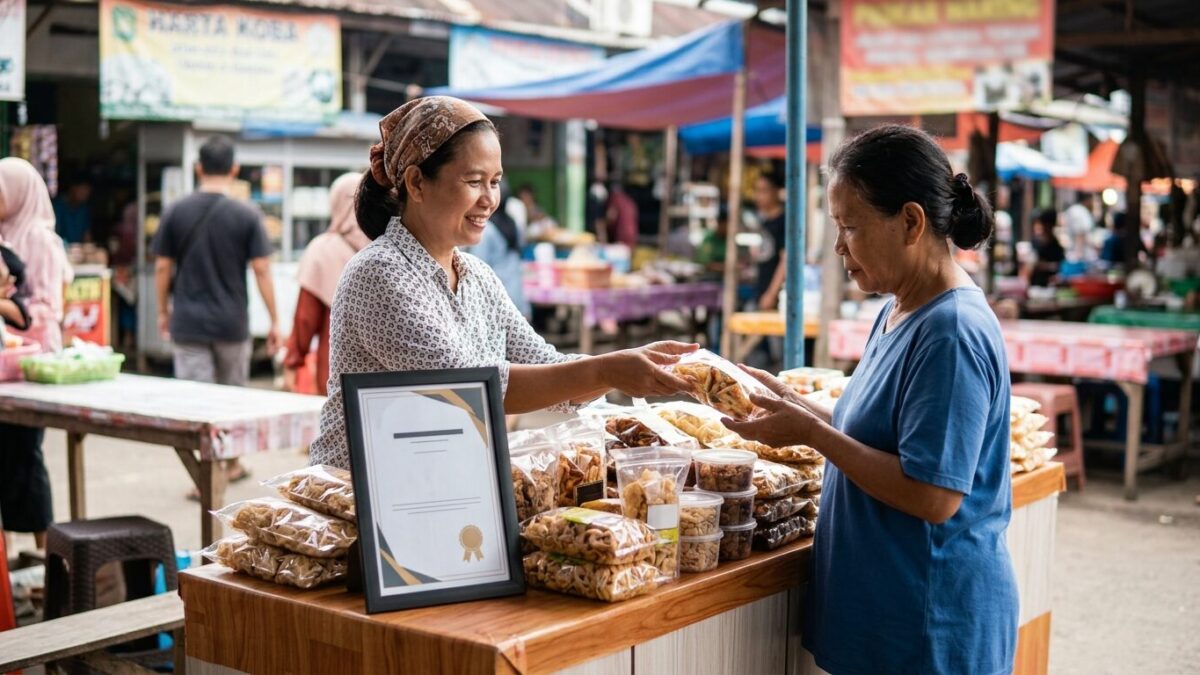
KOBA — The Bangka Tengah Regency Government is facilitating free halal certification for MSMEs to improve product quality and expand market access. The program targets small business owners in food, beverages, and processed agricultural and fishery products.
Bangka Tengah Regent Algafry Rahman said the local government continues to prepare a range of programs to strengthen product quality and the production capacity of local entrepreneurs. He said free halal certification is part of that effort.
“The local government is facilitating the issuance of halal certificates for MSME actors free of charge as part of a program to improve the quality of regional flagship products,” Algafry said in Koba on Sunday.
Free halal certification opens market access
For many business owners, halal certification is more than a label. The document helps determine consumer trust, especially in the food and beverage sector, which is closely tied to daily household needs. In modern retail, shopping centers, and online platforms, halal status is often a requirement buyers look for before choosing a product.
Algafry said halal certification adds value to products while giving consumers assurance about quality and safety. For business owners, the certificate can open access to broader distribution networks. Products with halal status are also easier to market outside the region and may have a chance to enter inter-district markets across the Bangka Belitung Islands.
The program also carries another meaning for the local government. Bangka Tengah wants to strengthen its local economy through the MSME sector, which has long absorbed labor and kept money circulating in the community. When small businesses grow, the impact reaches the supply chain, transportation, and daily trade.
“Strengthening the MSME sector is one of the focuses of regional economic development because it can absorb labor and drive the community economy,” Algafry said.
327 businesses already have halal certificates
Data from the Bangka Tengah Office of Industry, Trade, Cooperatives, and SMEs shows that 327 business owners already have halal certificates. The figure indicates growing interest, even though the room for expansion remains large compared with the number of active business actors in the region.
By March 2026, the local government recorded around 26,000 active MSME actors in Bangka Tengah. They operate across various sectors, from agriculture, plantation, and fisheries to trade and food processing. Among them, processed food businesses are one of the most dominant types of enterprises.
That means the demand for halal certification in the area is quite large. Many business owners operate in a line that is very close to household consumption needs. If the certification process becomes faster and free of charge, more small businesses can improve competitiveness without being burdened by upfront costs that can sometimes be heavy.
The local government also hopes this facility will be used to the fullest by business owners. For MSMEs that still rely on local sales, a halal certificate can become a differentiator. Simple, but meaningful.
Why this program matters for MSMEs
In many regions, the biggest obstacles for MSMEs are not only production-related. Certification costs, limited information, and a lack of mentoring often keep small business owners stuck at the same scale for years. A free halal certification program reduces one major burden.
For food MSMEs, the halal label is also closely tied to consumer buying behavior. In Indonesia, trust in the production process carries significant weight. Buyers want to know the ingredients, processing methods, and whether the product they purchase meets the applicable standards.
That is why local government support can become a strong lever. Business owners get the documents they need, while the region gains flagship products that are more ready to compete. If the number of 327 halal certificates keeps rising, Bangka Tengah’s small business ecosystem has a chance to move in a more orderly and measurable way.
Algafry stressed that the regional flagship product quality improvement program will continue in line with MSME needs. The local government, he said, wants business owners not only to survive, but also to grow.
“Through these various programs, it is hoped that MSMEs in Bangka Tengah can continue to grow and contribute to regional economic growth,” he said.
With around 26,000 active MSMEs and 327 of them already holding halal certificates, the Bangka Tengah Regency Government still has a long job ahead. But the policy direction is clear: strengthening local products through facilities that directly address business owners’ needs.
On the ground, programs like this usually have two effects at once. Business owners gain product legality certainty, and consumers get a sense of security when buying. For the region, both matter. Business keeps moving, and trust grows with it.

📝 Leave a Comment
Comment as . Reviewed by an admin before it appears.