Bolivia Military Emergency as Rodrigo Paz Clears Blockades
Bolivia military emergency lasts 90 days as Rodrigo Paz sends troops to clear road blockades and restore food and fuel supplies.
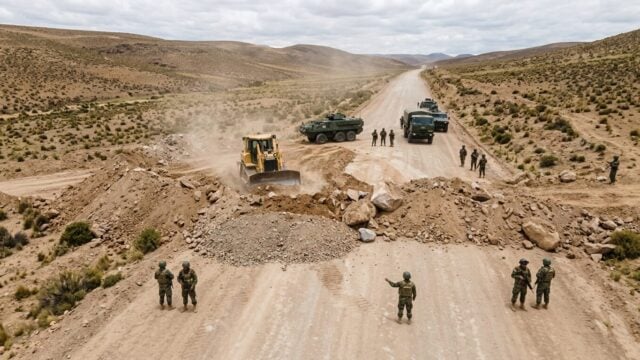
BOLIVIA — Bolivia Military Emergency as Rodrigo Paz Clears Blockades entered its most forceful phase on Tuesday, with President Rodrigo Paz declaring a 90-day national emergency and ordering the army to clear road blockades that have crippled transport, food delivery and fuel shipments across the country.
The intervention lands hard on daily life. Grocery prices have climbed, gas stations have been crowded for hours, and retailers say shelves are thinning as trucks sit stranded on blocked highways.
Troops, bulldozers and road clearance in El Alto
Within hours of the announcement, military convoys and bulldozers were moving toward key blockade points. In El Alto, the satellite city above La Paz and a frequent flashpoint for street mobilization, heavy equipment was used to remove rocks, wood and debris piled across the highway.
The response split opinion on the ground. Some residents applauded the operation and handed water to officers working under the sun. Others stood back in silence, watching the road being opened piece by piece.
“Everything has become very difficult in El Alto for more than 50 days. We have had trouble working and cannot move freely,” Carla Butron, a local vegetable seller, told AFP. Her comment captures the direct cost of the standoff: lost income, slower trade and longer trips for basic goods.
Why the blockade crisis matters beyond politics
What looks like a political confrontation has become an economic squeeze. Bolivia’s exporters say the losses are piling up fast, and the effect is spreading through agriculture, freight and manufacturing.
| Industry sector | Estimated loss (USD) | Direct impact |
|---|---|---|
| Agriculture & food | 120 million | Export goods rotting in transport trucks |
| Transport & logistics | 85 million | Hundreds of trucks stuck on interprovincial routes |
| Manufacturing & retail | 45 million | No raw materials for local factories |
The Bolivia Exporters Association says the closures have already produced losses large enough to threaten small and medium-sized firms that depend on predictable routes and regular fuel supplies. If the disruption drags on, economists warn that annual inflation could rise to its highest level in two decades.
That matters far beyond Bolivia’s borders too. A longer blockade cycle would tighten food supplies in urban centers, push transport costs higher and deepen pressure on businesses already operating on thin margins. For consumers, that usually shows up quickly at the market stall: fewer goods, higher prices, and longer waits for fuel.
Negotiations stall as pressure builds
The protests were triggered by anger from left-wing groups over the liberal economic reforms backed by Rodrigo Paz. Protest leaders have demanded that the president step down, even though he was elected less than a year ago.
The government had already struck a peace agreement with the Bolivian Workers’ Central, or COB, the country’s largest labor union. The deal included a pledge not to privatize state-owned companies that provide essential services. But Indigenous factions rejected the agreement and stayed on the streets, setting up temporary tents along key intercity logistics routes.
“We want him to leave. We do not want him to lead this country anymore because his policies only benefit a small urban elite,” said Lidia Callisaya, an Aymara Indigenous leader at a roadside barricade outside La Paz. Her remarks show how the dispute has widened well beyond transport routes. It is now a fight over who gets to define Bolivia’s economic direction.
Morales factor keeps tensions high
Rodrigo Paz has also accused criminal groups and supporters of former president Evo Morales of fueling the unrest. Morales, who led Bolivia from 2006 to 2019, still commands a loyal grassroots base, especially in rural and Indigenous communities.
Morales is reportedly in the Chapare region, his main political stronghold, to avoid a legal summons over allegations of child trafficking. He has denied the accusation and said it is politically motivated, aimed at blocking any future role he might play in national politics.
Interior Minister Marco Antonio Oviedo said security forces would act firmly to enforce the law nationwide. “The law must be enforced without exception. Anyone who tries to divide the nation and damage the economy for personal gain will face action,” Oviedo said at an emergency news conference in La Paz.
Through social media, Morales rejected the accusation and said Paz’s government is influenced by foreign corporate interests. With troops now deployed and blockades still threatening key supply lines, the next test is whether reopened roads can stay open long enough for food, fuel and freight to move again.