
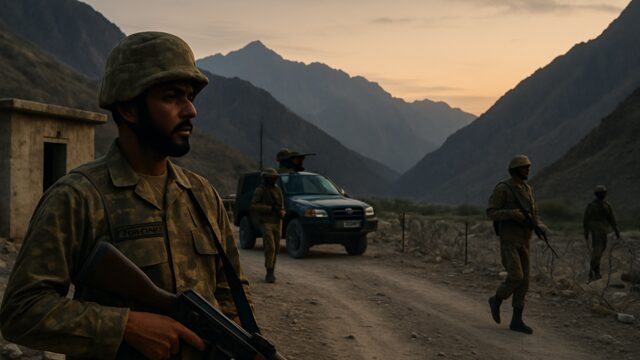
ISLAMABAD — Pakistan operation along the Afghanistan border killed 29 militants and sparked a fresh round of tension between Islamabad and Kabul after an armed attack in Karachi a day earlier. Pakistan Information Minister Attaullah Tarar said the operation was launched in response to a series of militant attacks inside the country.
The impact was immediate. The two neighbors, whose ties have long been fragile, now face the prospect of sharper friction as Pakistan again accuses armed groups of finding shelter on Afghan soil. Kabul did not immediately respond to the latest attack.
The Karachi attack that set it off
The operation came soon after armed men attacked the regional headquarters of the Rangers paramilitary force in Karachi, a major port city in southern Pakistan. In that Saturday night attack, three security personnel were killed. Three attackers were shot dead, while one other was arrested wounded. Pakistan’s military said the man was an Afghan national.
Jamaat-ul-Ahrar, a splinter faction of Tehrik-e-Taliban Pakistan, or TTP, claimed responsibility for the Karachi attack. That claim matters because Pakistan has long blamed TTP and allied groups for much of the violence targeting police and security forces.
On this point, the Pakistani government chose a hard line. Tarar said the latest operation targeted hideouts and safe locations used by militant groups near the border line. In reports cited by foreign media, the operation was carried out in Bajaur, Khyber Pakhtunkhwa, and then followed by targeted strikes on several sites on the Afghan side.
Who Islamabad says it targeted
In the statements circulating after the assault, Pakistan accused those locations of being used by Jamaat-ul-Ahrar and by a group Islamabad calls Fitna al-Khwarij, the term the Pakistani government uses for TTP. The group is distinct from the Afghan Taliban, though the two share ideological roots and both emerged from the region’s long conflict.
According to an AP report cited by other media outlets, the border operation killed 29 militants. That figure has not been separately confirmed in the most detailed official statement available in the source material, but it matches the government’s claim that the strikes hit militant bases in border areas. On the ground, operations like this usually cut both ways: they pressure armed groups, and they also raise the political temperature across borders.
Pakistan has repeatedly carried out strikes along the frontier, and at times inside Afghanistan, over the past year, saying it is hunting TTP hideouts and other armed networks. Kabul has repeatedly denied accusations that the Afghan Taliban government shelters groups that attack Pakistan.
Why Islamabad-Kabul ties are under strain
What makes this episode important is not only the death toll. It is the direction of escalation. When Pakistan attacks targets across the border, Afghanistan almost certainly views it as a violation of sovereignty. Pakistan, for its part, argues that military pressure is necessary because attacks on security forces keep recurring.
That leaves diplomacy stuck. Several rounds of peace talks mediated by outside parties have failed to produce a durable ceasefire. In April, China hosted talks between the two sides and said Pakistan and Afghanistan had agreed not to widen the conflict. In practice, the tension has not eased.
For people living near the frontier, the effects can be immediate. Security activity rises, access in some sensitive areas can be disrupted, and the threat of militant retaliation never goes away. The Karachi attack also showed that Pakistan’s security problem is not only a border issue. Armed networks can move across provinces, from Khyber Pakhtunkhwa to a large city like Karachi.
Tarar said the operation was meant to dismantle militant hideouts believed to be behind the wave of violence in Pakistan. “This operation was launched in response to militant attacks across the country,” Attaullah Tarar, Pakistan’s information minister, said in a post on X.


📝 Leave a Comment
Comment as . Reviewed by an admin before it appears.