
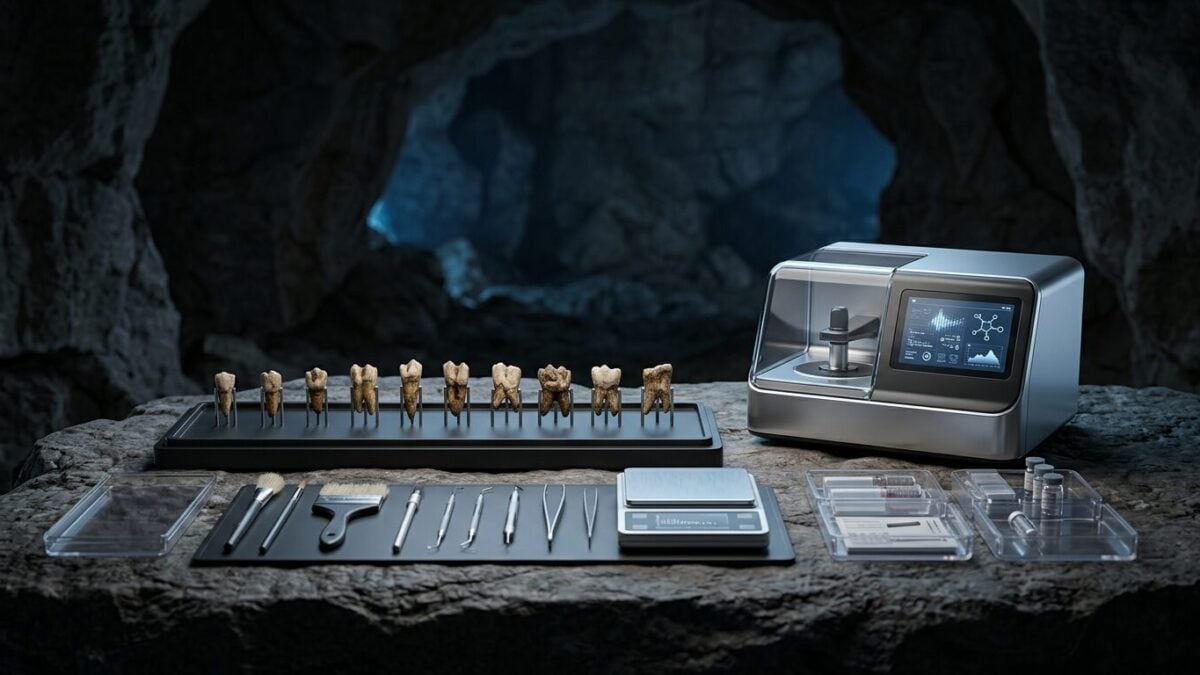
RISING STAR, SOUTH AFRICA — Protein analysis of Homo naledi fossils from the Rising Star cave system has made the ancient human site even harder to explain. In the samples studied, researchers found no protein marker linked to the Y chromosome, raising a strong suspicion that most of the individuals found there were female.
The finding matters not because it delivers a final answer, but because it shifts a debate that has long divided experts: was Rising Star really a deliberately made burial site, and if so, who was buried there? The question now cuts deeper. Where are the male Homo naledi?
Tooth proteins that opened a new clue
Homo naledi was first identified from discoveries in South Africa in 2013. At the time, researchers found 15 individuals inside the Rising Star cave system. With later work, the number of specimens linked to the species has reached at least 20 individuals, who lived between 236,000 and 335,000 years ago.
The research team traced the biological sex of those individuals through peptides associated with amelogenin, a protein that forms tooth enamel. Amelogenin X appears in both sexes because all humans have an X chromosome. Amelogenin Y is different. It is tied to the Y chromosome and usually points to a biologically male individual.
In the enamel samples examined, none showed any sign of amelogenin Y. That is what makes this difficult. It does not mean the individuals were definitely all XX. The only solid conclusion so far is that the protein marker usually associated with the Y chromosome was not detected in the available samples.
That is a simple sentence, but the impact is large. If the population really lacked male markers almost entirely, Rising Star could preserve a social or biological pattern that is highly unusual for ancient hominins.
Why scientists are not rushing to conclude
The trouble is, science rarely gives neat answers. The study team itself wrote that the disappearance of the amelogenin Y marker could have several explanations. It may be that the group found at the site was indeed dominated by females. It may also be that a gene deletion or mutation occurred in a particular Homo naledi population, so the Y marker no longer appeared even though the individuals were still male.
The statistics they ran suggest a high probability that most specimens at the site were female. But high probability is not certainty. The researchers remain cautious because ancient protein analysis from tooth enamel offers only a very limited biomolecular window.
Palesa Madupe, an evolutionary anthropologist at the University of Copenhagen, explained why enamel is so valuable for this kind of study. “Unlike bone remains, proteins in tooth enamel are preserved because enamel, the hardest tissue in the human body, protects proteins from environmental contamination even for millions of years,” she said.
For fossils that lived in warm climates and over very long time spans, enamel is often the only way in. Not glamorous. Effective, though.
Rising Star and the debate over deliberate burial
The name Rising Star has sparked debate for years. Some researchers believe Homo naledi may have intentionally placed the bodies of group members inside the cave. If true, that would be among the earliest pieces of evidence for deliberate burial in human history.
Still, the idea has never been fully accepted. Some experts argue that the available evidence is not strong enough to call it ritual burial. They question how the bodies reached such a hard-to-access part of the cave, whether they were placed there on purpose, or whether natural processes carried them in.
Lee Berger, the paleoanthropologist also involved in the latest study, previously argued that Homo naledi did in fact practice deliberate burial. That claim was sharply challenged by other researchers. For that reason, the new paper adopts a more cautious tone. No grand statement. Just a push for more evidence.
If Rising Star really is a burial site, then why do the samples found there seem so lopsided? The scenario becomes fascinating. It may have been a cave reserved for females. Or there may be another burial cave for males, still undiscovered.
A narrow gene pool, an isolated population
There is another explanation that is just as plausible. The researchers found that the protein sequences in the individuals showed very low genetic diversity. That pattern often appears in isolated, small populations, or in groups that experienced inbreeding over a long period.
If that is what happened, the amelogenin Y gene may have disappeared through mutation or genetic deletion, then spread quickly through a population that went through a genetic bottleneck. In that situation, some individuals could still have been male, but the biomolecular signal usually used to identify them would no longer appear.
Marc Dickinson, a fossil chemist at the University of York, called the absence of male markers in the group “very interesting.” In his view, the finding offers a rare window into not only the biology of our ancestors, but also the way they lived.
“Advances in ancient protein analysis open the door to a much richer and more nuanced understanding of ancient hominins,” Dickinson said.
That sounds academic, but the effect is real. The sharper the analytical tools become, the harder it is to flatten ancient humans into something uniform. They had variation. They had strategies for survival. They may also have had social rules very different from what we imagine.
Why this matters to readers
The Rising Star finding is not only about South Africa or a hard-to-pronounce scientific name. It goes to the heart of how we read the origins of human behavior. If a group of Homo naledi truly treated bodies differently by sex, then the management of the dead and their social structure were far more complex than long assumed.
On the other hand, if the Y marker disappeared for genetic reasons, then our reading of who was in the cave has to change. Both possibilities reshape the bigger story of human evolution.
That is the appeal. Fossils are not just silent bones. Sometimes, a single protein in tooth enamel can force science to rewrite a chapter of history.
For now, researchers are not ready to close the Rising Star case. They are opening a new door instead. Was the cave really a burial space for females? Was there another cave for males? Or does Homo naledi carry a genetic variation we still do not understand? The answer is still waiting for the next sample, and maybe for analytical tools sharper than the ones available today.
Quick summary:
1. Analysis of Homo naledi tooth enamel from Rising Star found no protein marker for the Y chromosome.
2. That strengthens the idea that most individuals at the site were female, though it is not yet certain.
3. The result could affect the broader debate over Homo naledi burial ritual and social structure.
Further research will determine whether Rising Star really holds a secret about role division within Homo naledi groups, or whether it is only pointing to another part of the story that has yet to be found beneath the ground in South Africa.





📝 Leave a Comment
Comment as . Reviewed by an admin before it appears.