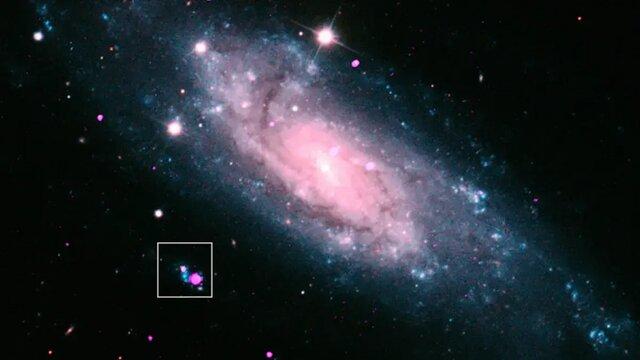
Scientists Find Mysterious Invisible Object Up to 2.8 Suns Heavy
Astronomers have detected an unseen object in the J0008+0128 star system by tracking its pull on a red giant. A study in Science Advances says it may be a rare supermassive neutron star, up to 2.8 times the Sun's mass, in a poorly understood mass range.
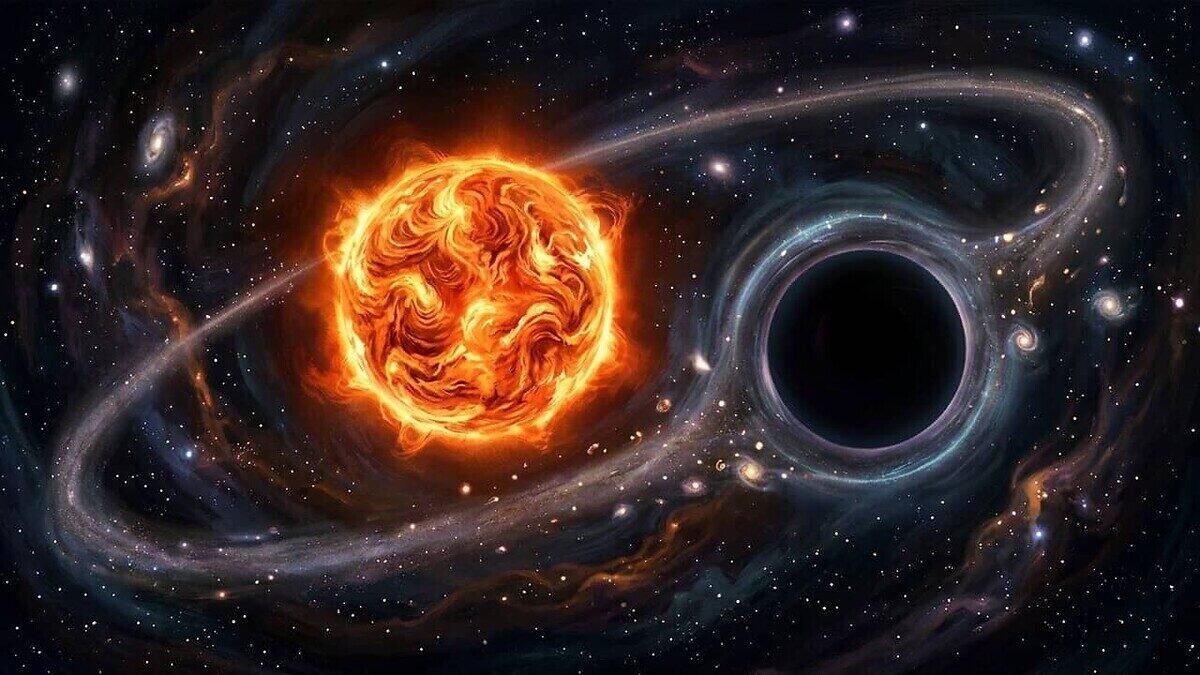
Scientists find mysterious invisible object in the J0008+0128 star system, a body that may be a rare supermassive neutron star with a mass up to 2.8 times that of the Sun, according to a study published in Science Advances.
Researchers never saw it directly. They detected it through its gravitational pull on a nearby red giant star.
Why the mass matters
The estimated mass places the object inside what astronomers call the "mass gap." Few stellar remnants have been observed between 2.5 and five times the Sun's mass, and scientists have long struggled to explain why.
Stellar remnants are the dense objects left when stars die. Depending on the original star's size, massive stars usually become neutron stars or black holes.
Stars more than 25 times as massive as the Sun are expected to collapse into black holes after exploding. Those roughly 10 to 25 times the Sun's mass generally become neutron stars. Smaller stars like the Sun end as white dwarfs.
An unusually wide orbit
Mass is not the only puzzle. The object follows a wide orbit around its red giant companion, taking about 1,218 days to complete one revolution. That combination of mass and orbit has challenged thousands of computer simulations of how stars live and die.
Neutron stars typically measure only a few miles across. Their matter is packed so tightly that atoms are crushed, leaving mostly neutrons alongside protons and electrons. White dwarfs are far larger, roughly the size of Earth.
What researchers say
Song Wang, an associate researcher at the National Astronomical Observatories, Chinese Academy of Sciences, co-authored the study. He told 404 Media the team searches for compact objects, mainly neutron stars and black holes, using large spectroscopic surveys.
"We have found more than 10 neutron stars, and J0008+0128 is the most massive one among them," Wang said.
He said a heavy neutron star could help settle a long-standing problem: the "equation of state," which describes how a neutron star's internal pressure and density are related. That relationship determines how much mass a neutron star can hold before gravity forces it to collapse into a black hole.
"The equation of state of neutron stars is a long-standing unsolved problem in astrophysics, and neutron star masses can provide crucial observational tests," Wang said. He added that measuring neutron stars above two solar masses can "place important constraints on the equation of state of matter at extreme densities."
The researchers describe the object as a likely neutron star, not a confirmed one.