Supernova Impostor Baffled Astronomers 15 Years; Chandra Found Why
A star that faked a supernova 27 times has a hidden partner. NASA's Chandra X-ray Observatory caught the star, AT 2016blu, mid-outburst in March 2026 and found a neutron star or black hole circling it every 113 days, a University of Virginia-led team says.
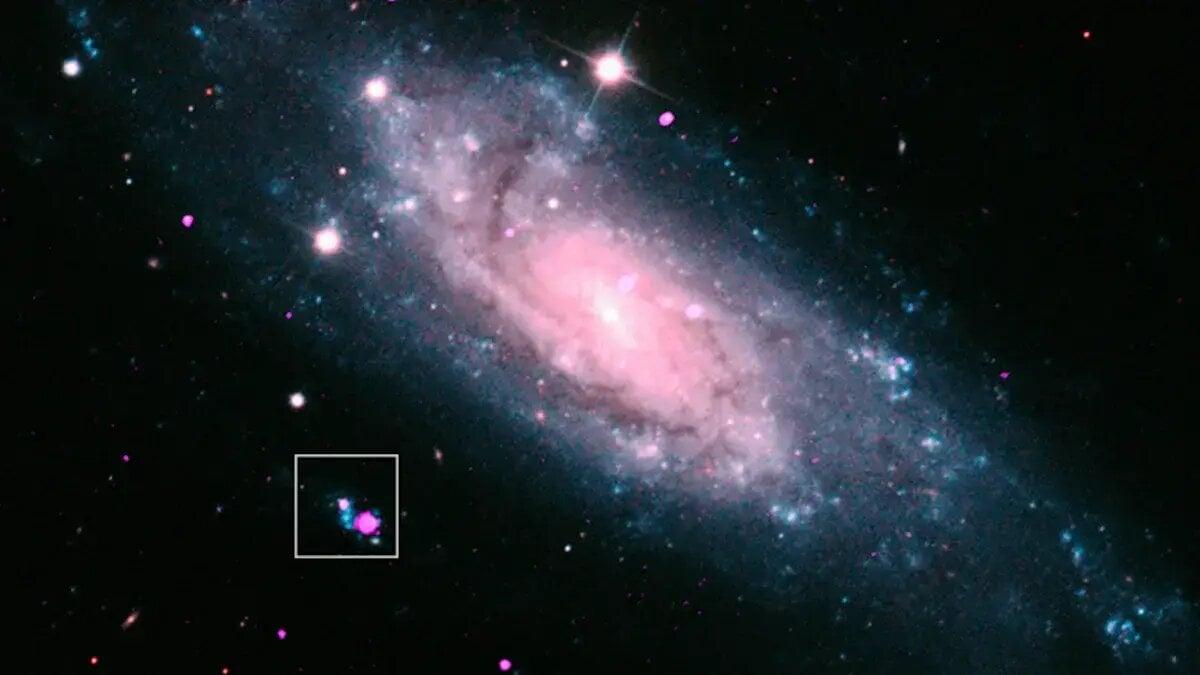
A supernova impostor baffled astronomers for 15 years until NASA's Chandra X-ray Observatory showed the star, called AT 2016blu, is being fed on by a hidden black hole or neutron star, according to a University of Virginia-led team.
The star has faked a supernova 27 times and counting. It survives each blast.
A false alarm in 2012
Astronomers spotted what looked like a supernova on January 11, 2012, on the outskirts of the spiral galaxy NGC 4559. The galaxy sits about 25 million light-years away in the constellation Coma Berenices.
A real supernova destroys a massive star that has run out of nuclear fuel. This one did not. When the light faded, the star was still there, and it flared again every 113 days.
"For 15 years, astronomers have been watching this star get really bright and then dim again on a regular basis," said Mojgan Aghakhanloo of the University of Virginia in Charlottesville.
Why X-rays mattered
AT 2016blu is a luminous blue variable, one of the most massive and luminous types of star. These stars are highly unstable and periodically throw material from their outer layers into space. Faking a supernova is not typical behavior for them.
Several other supernova impostors have been seen over the past decade or two. Until now, nobody knew what made them repeatedly flare.
Team member Núria Torres-Albà, also of the University of Virginia, said the researchers needed X-ray data timed to catch the star during an outburst. Aghakhanloo's team won observing time on Chandra to target one, and the chance came in March 2026.
Chandra had looked toward NGC 4559 in 2001 and 2002 and noticed nothing unusual. This time it captured a powerful blast of X-rays that coincided with another false supernova. "Until we were able to get Chandra data at the right time, we couldn't figure out what was making this happen," Aghakhanloo said.
A companion on a 113-day orbit
The observations indicate that AT 2016blu has an unseen companion. It is a compact, high-gravity object, either a neutron star or a stellar-mass black hole, on an elliptical 113-day orbit around the blue star.
Both kinds of object are the cores left behind when massive stars truly go supernova. That means AT 2016blu was once a binary star system.
Each time the companion swings closest to the luminous blue variable, its gravity pulls material off the unstable star. That sets off the chain of events behind the outbursts.
The stolen gas forms a swirling accretion disk around the compact object. It spins so fast and gets so hot that it emits X-rays, the signal Chandra detected.
Those X-rays energize the cloud of material the blue star ejected years earlier. The heated cloud then glows extremely brightly in visible light, producing the impression of a supernova.