What Happens When You Quit Smoking: The Body’s Repair Timeline
Your body starts repairing itself about 20 minutes after your last cigarette. Here is what changes, and when, from the first hours to 15 years later.
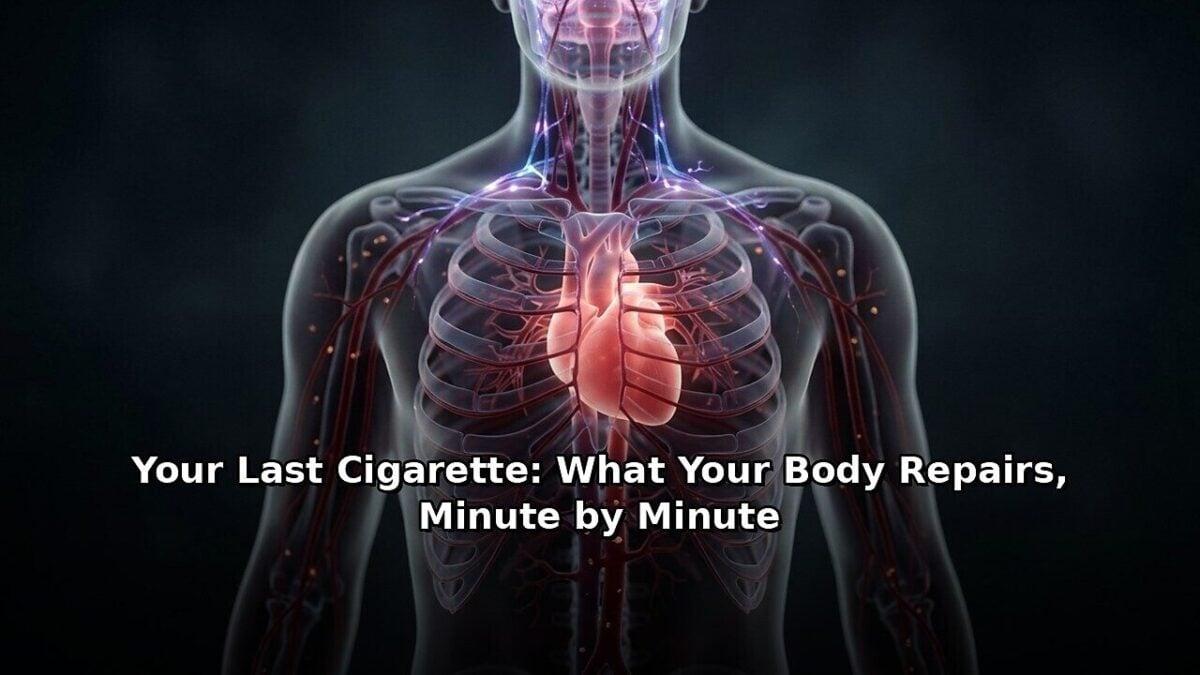
Your body starts repairing itself about 20 minutes after your last cigarette. Some changes arrive within hours, some take a year, and the biggest ones take a decade or more. Knowing the order makes the hard first days easier to get through, because you can see what is coming.
The short version
- 20 minutes: heart rate and blood pressure drop.
- 12 hours: carbon monoxide in your blood falls to normal.
- 2 to 3 days: nicotine is gone, taste and smell return, breathing gets easier. For many people these are the hardest days.
- 1 year: the extra risk of heart disease is about half that of someone who still smokes.
- 10 to 15 years: lung cancer death risk is about halved, and heart disease risk is close to a nonsmoker's.
The timeline at a glance
| Time after your last cigarette | What changes |
|---|---|
| 20 minutes | Heart rate and blood pressure come down. |
| 12 hours | Carbon monoxide in the blood drops to a normal level, so more oxygen reaches your organs. |
| 48 hours | Nicotine has left the body. Taste and smell start to improve. |
| 72 hours | Breathing feels easier and energy rises. |
| 2 weeks to 3 months | Circulation improves and lung function increases. |
| 1 to 12 months | Coughing and shortness of breath decrease as the lungs' cleaning hairs recover. |
| 1 year | Excess risk of coronary heart disease is half that of a smoker. |
| 5 years | Risk of mouth, throat, esophagus and bladder cancer is cut in half. Stroke risk can fall to a nonsmoker's within 2 to 5 years. |
| 10 years | Risk of dying from lung cancer is about half that of a smoker. |
| 15 years | Risk of coronary heart disease is the same as a nonsmoker's. |
The first minutes and hours
Nicotine pushes your heart to beat faster and tightens your blood vessels. About 20 minutes after the last cigarette, that push fades, and heart rate and blood pressure start to come down.
Cigarette smoke also fills your blood with carbon monoxide, the same gas that comes out of a car exhaust. It takes the place of oxygen in your red blood cells. Within about 12 hours, the level falls back to normal and your organs get more of the oxygen they need.
Days two and three: the hard part
By about 48 hours, the nicotine is gone. Food starts to taste of something again and smells come back sharper.
By around 72 hours, breathing is easier and many people notice more energy. This is also when cravings, irritability and restlessness tend to be at their strongest. For many people the first few days are the hardest stretch of the whole journey, and it gets easier after them.
Getting help works: nicotine replacement, prescription medicines and quit lines raise the chance of quitting for good. A doctor, pharmacist or your local quit line can help you choose. In the US, the free quit line is 1-800-QUIT-NOW.
Weeks and months: the lungs start cleaning themselves
Between two weeks and three months, circulation improves and lung function increases. Walking up stairs or catching a bus stops feeling like a sprint.
Inside the airways are tiny hairs called cilia that sweep out mucus and dirt. Smoking flattens them. Over the first months they recover, so the lungs clear themselves better. That is why coughing and shortness of breath ease between one month and a year after quitting, and why chest infections become less common.
The first year: your heart
One year after quitting, the extra risk of coronary heart disease is about half that of someone who still smokes. Heart attack risk falls sharply in the first one to two years.
Five to fifteen years: the long repair
Five years in, the risk of cancers of the mouth, throat, esophagus and bladder is cut in half. Stroke risk can drop to that of a nonsmoker within two to five years.
After ten years, the risk of dying from lung cancer is about half that of a person who keeps smoking. After fifteen, the risk of coronary heart disease is the same as that of someone who never smoked.
Quitting can add as much as 10 years to your life compared with continuing to smoke, and the gain is bigger the earlier you stop. But it pays at any age.
Watch: the whole timeline in 90 seconds
The first twenty minutes are free. Everything after that is your body catching up.
More short explainers on how the body works are on the FDS Creative YouTube channel.
 Take the quizWhat Kind of Holiday Spender Are You? Take the Black Friday QuizStart →
- 1Column: 4 Reasons to Eat Dark Chocolate, Dietitians Say
- 2Mavericks Surfers Race to California for Waves Near 50 Feet

- 3Chrissie Swan, 52, Tears Up Over Secret Surprise While Recovering

- 4Meghan Markle Plans US Return to See Mother After Father’s Arrest

- 5Aspyn Ovard Reveals Daughter Has Terminal Cancer on Mormon Wives

 Lifestyle · Food & HealthThanksgiving Food Safety: How Long Leftovers Last and the Safe Turkey Temperature
 Lifestyle7 Quiet Habits of Emotionally Intelligent People, According to Psychologists
 LifestylePeople Who Don’t Like Celebrating Their Birthday Often Share These 7 Traits
 Lifestyle · Food & HealthVitamin D in Winter: Do You Need a Supplement, and How Much?