Caltech Atoms Sync to Offer a New Frequency Comb
Researchers at Caltech and Stanford have turned synchronized atomic flashes into a new kind of frequency comb. The device produces microwave and infrared light together, a finding that could support more stable measurements and help connect quantum devices.
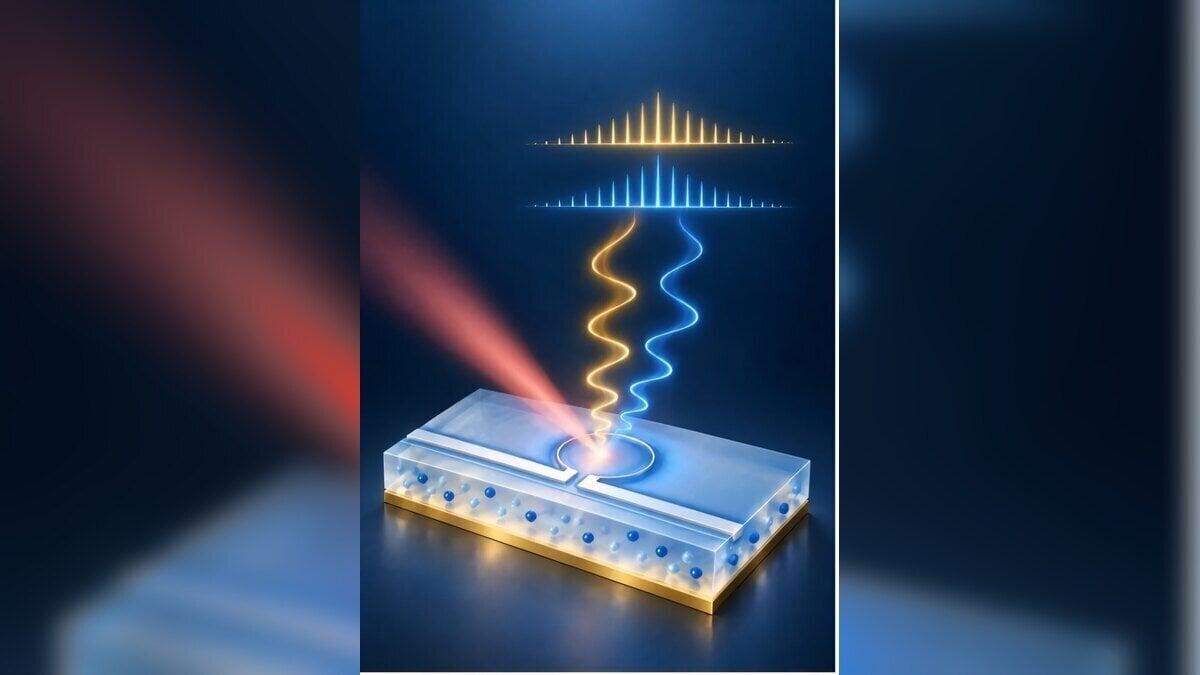
Caltech researchers have synchronized atoms in a crystal to create a frequency comb, offering a potential tool for more stable measurements and quantum links. The work follows an unexpected observation in early 2024.
The atoms flashed in two forms of light. They emitted microwaves and infrared light in step, a combination the researchers had not observed before.
The team worked with Stanford University researchers led by assistant professor Joonhee Choi to explain the flashing. Their findings appear in the journal Nature.
A frequency comb produces evenly spaced frequencies of light, like the teeth of a comb. Such devices serve as rulers for light and have helped improve measurements of time and distance.
Existing frequency combs have contributed to advances in atomic clocks, ultrafast science and chemical identification. The new design could be more stable than other lasers, the researchers said.
Billions of atoms flash together
The effect relies on superradiance, a quantum phenomenon in which atoms synchronize through a shared electromagnetic field and emit light together. Scientists have known about it for more than 50 years.
Conventional lasers use mirrors to help coordinate light. Even tiny changes in the distance between those mirrors can change the light's frequency.
Superradiant atoms coordinate without mirrors. Previous work showed that synchronized atoms could produce a quick flash or a steady beam at a frequency determined by the atoms.
In the new experiment, the researchers found a repeated rhythm instead. They embedded billions of ytterbium ions, or charged atoms, in a yttrium orthovanadate crystal beneath a tiny superconducting circuit that trapped microwaves.
A laser energized the ions, causing them to emit microwaves. The shared microwave field let the ions influence one another and synchronize.
At first, the ions emitted light steadily. Above a certain laser power, they switched to rhythmic pulses.
Lead author Tian Xie, now a postdoctoral researcher at Stanford, said the approach could improve stability. “Other mode-locked frequency combs depend on bouncing light off mirrors in a cavity, and those cavity lengths can fluctuate due to things like temperature,” Xie said.
Microwaves and infrared move together
The dual emissions could help connect quantum devices. Some quantum computers use superconducting circuits that operate with microwaves, which easily lose quantum information unless kept near absolute zero.
Optical light can carry information over long distances through fiber cables. Superconducting circuits cannot directly send or receive it.
Ytterbium ions can interact with both microwave and optical light because of the different energy gaps within each ion. That raises the possibility of using one emission with superconducting hardware and the other for long-distance communication.
Caltech applied physics and electrical engineering professor Andrei Faraon said the team wants to control the pulse rhythm, “so that the atoms become a kind of programmable light source.”
The researchers want to adjust each emission's strength, the separation between pulses and the emission format for different applications, Faraon said.
 Take the quizWhat Kind of Holiday Spender Are You? Take the Black Friday QuizStart →
- 1Gold Silver Price November: Futures Rise Near Yearly Lows

- 2Michael Clarke Says Sandpapergate Scars Drew Steve Smith to New York

- 3U.S. Emergency Alert Test Nov. 17 Is Not a Power Outage

- 4Brent Crude Slides 4.05% as Rising US Stockpiles Weigh on Oil

- 52027 NFL Mock Draft Puts Ohio State’s Jeremiah Smith at No. 1

 Lifestyle · Food & HealthWhat Is Raynaud’s Syndrome? Why Fingers Turn White in the Cold
 Lifestyle · Food & Health4 Ways Walking After Meals Helps Your Body, Doctors Say
 Lifestyle · Food & Health4 Reasons to Eat Oatmeal, According to Nutrition Experts
 Lifestyle7 Signs Your Social Battery Is Running Low (and Why You Keep Cancelling Plans)