Webb Confirms Rare Merger of Giant and Smaller Star
NASA’s James Webb Space Telescope helped researchers confirm that a smaller star spiraled into a supergiant on the outskirts of the Andromeda galaxy. Observations taken just 47 days after the eruption peaked helped the team reconstruct the merger and estimate the stars’ earlier masses.
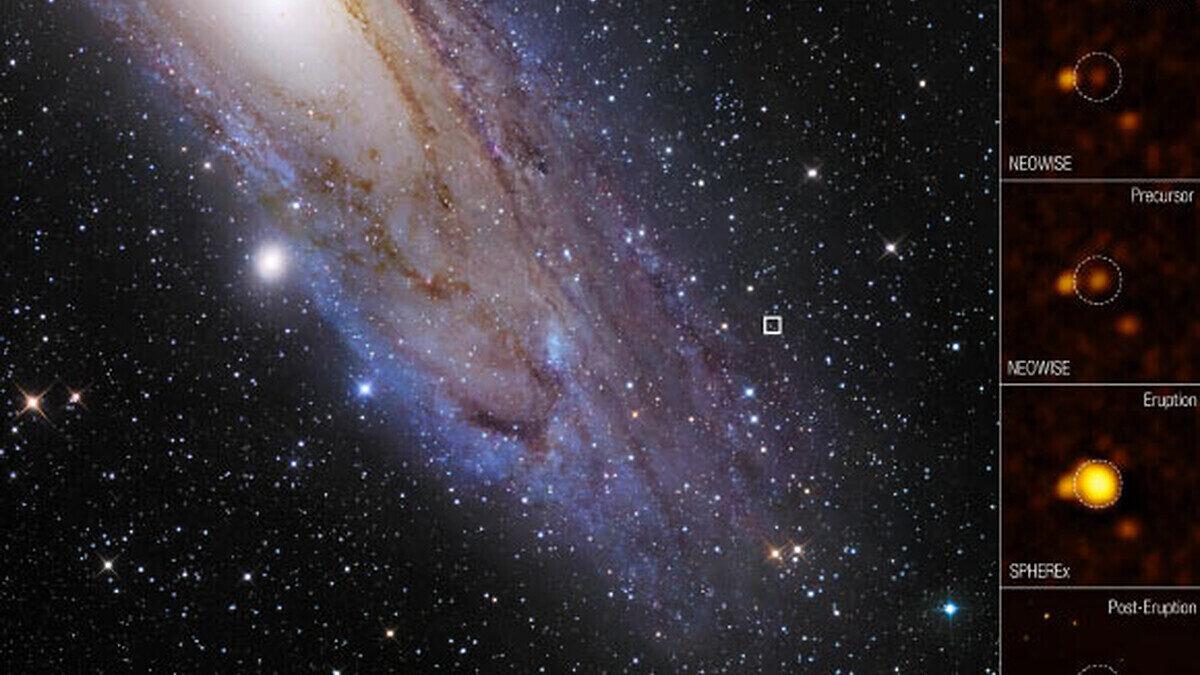
NASA’s James Webb Space Telescope confirmed a first-of-its-kind merger of a supergiant and a smaller star in the Andromeda galaxy, using observations taken on December 24, 2025.
Researchers named the resulting star Bao. Webb observed it 47 days after the eruption peaked, giving astronomers an unusually early look at a stellar merger.
The team combined Webb’s data with observations from space and ground telescopes to reconstruct the encounter. The findings appeared in Nature.
“Stellar mergers are very, very difficult to observe in real time because they are hard to predict,” said lead author Viraj Karambelkar, a NASA Hubble Fellow at Columbia University.
Seven orbits before the merger
The stars had orbited each other for millennia. Once the smaller star touched the giant’s surface, they merged after seven orbits, or about seven years.
Other known mergers involving two smaller stars took thousands of orbits. In Bao’s case, the giant engulfed its companion, which spiraled inward as drag robbed it of orbital energy.
The stars shared an outer layer of gas during a process called common envelope evolution. In some other systems, both stars survive that phase and remain in tight orbits.
Co-author Nadia Blagorodnova, an associate professor at the University of Barcelona, said the speed of the outburst surprised researchers.
“We thought an outburst from such an extended star would take years,” she said. “One day, its brightness started rising and within a week, it peaked.”
Webb helped reconstruct the stars
The team updated its simulations and found a model matching Webb’s mid-infrared observations of dust shed by the giant over centuries.
Before the eruption, the larger star was seven times as massive as the sun, 350 times its radius and 18,000 times brighter. Researchers nicknamed it Big Bao.
The model also produced the first mass estimate for the smaller companion, Little Bao. It was likely about 0.7 solar masses, with a slightly smaller radius than the sun.
Further analysis showed the smaller star had been dragged into the giant’s core. Future observations will reveal how the merged star’s mass settles.
Telescopes tracked Bao’s eruption
Bao first drew the team’s attention in February 2023, in data from NASA’s retired NEOWISE mission. Before 2018, the object had a consistent luminosity.
Observations from the Wide-field Infrared Transient Explorer in September 2024 showed it brightening and releasing dust.
NASA’s SPHEREx observed Bao fading rapidly in visible light and brightening in infrared during a survey in July 2025. The Zwicky Transient Facility detected the eruption on October 17, 2025.
In November 2025, the team received observations from NASA’s now-retired Neil Gehrels Swift Observatory and NOIRLab’s Gemini North telescope in Hawaii.
Karambelkar said similar analyses could benefit from surveys by NASA’s Nancy Grace Roman Space Telescope. “There’s going to be a large influx of similar discoveries just ahead,” he said.
 Take the quizWhat Kind of Holiday Spender Are You? Take the Black Friday QuizStart →
- 1Gold Silver Price November: Futures Rise Near Yearly Lows

- 2Michael Clarke Says Sandpapergate Scars Drew Steve Smith to New York

- 3U.S. Emergency Alert Test Nov. 17 Is Not a Power Outage

- 4Brent Crude Slides 4.05% as Rising US Stockpiles Weigh on Oil
- 52027 NFL Mock Draft Puts Ohio State’s Jeremiah Smith at No. 1

 Lifestyle · Food & HealthWhat Is Raynaud’s Syndrome? Why Fingers Turn White in the Cold
 Lifestyle · Food & Health4 Ways Walking After Meals Helps Your Body, Doctors Say
 Lifestyle · Food & Health4 Reasons to Eat Oatmeal, According to Nutrition Experts
 Lifestyle7 Signs Your Social Battery Is Running Low (and Why You Keep Cancelling Plans)