James Webb Telescope Spots Evidence of Stellar Merger
Astronomers used the James Webb Space Telescope to investigate a giant star that swallowed its smaller companion in the Andromeda galaxy. Webb observed the system 47 days after its eruption peaked, helping researchers reconstruct the merger and identify the single star left behind.
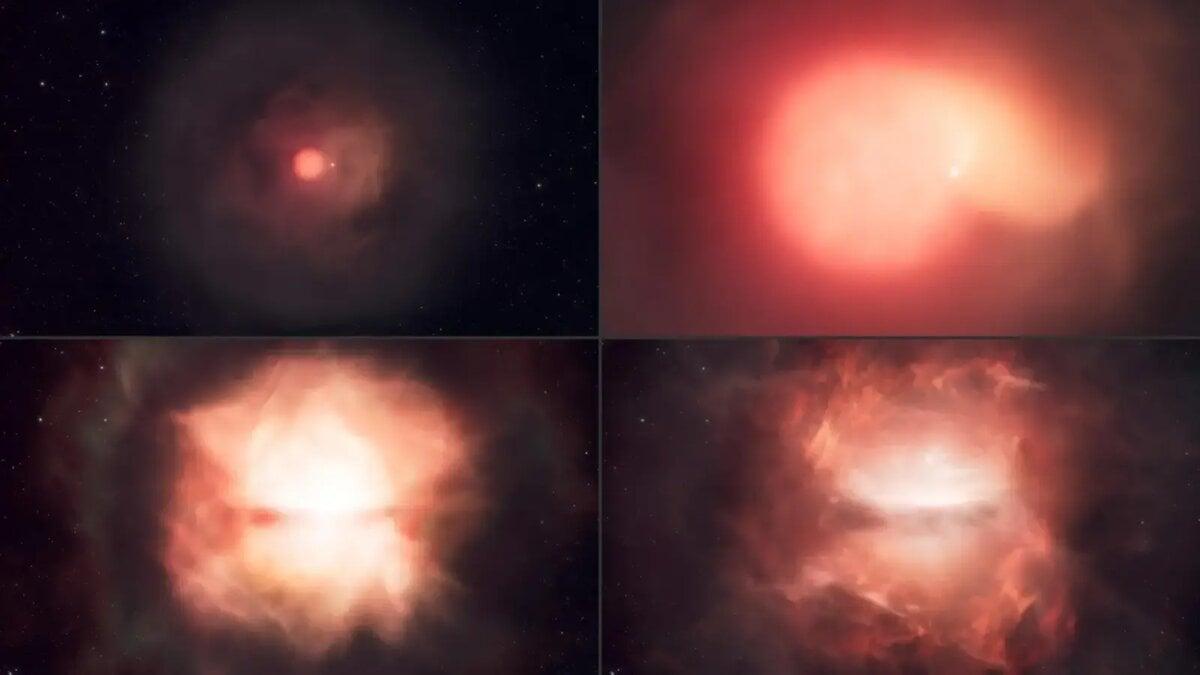
The James Webb Space Telescope has spotted evidence that a giant star swallowed its companion in the Andromeda galaxy. Researchers say the merger left a single star, nicknamed Bao, about 2.5 million light-years from Earth. Webb observed the system 47 days after its eruption peaked in 2025.
The observation filled a gap. Astronomers combined Webb’s measurements with years of telescope records to reconstruct the system before, during and after the merger.
“Stellar mergers are very, very difficult to observe in real time because they are hard to predict,” said Viraj Karambelkar, a NASA Hubble Fellow at Columbia University and first author of the study published in Nature.
Researchers noticed unusual activity in 2023 and kept watching, Karambelkar said. The system erupted in 2025.
Seven orbits before the merger
The two stars had orbited each other for thousands of years before the smaller one began brushing against the giant’s outer atmosphere. They merged after seven more orbits, or about seven years. Previously observed mergers involving smaller stars took thousands of orbits.
As the companion moved through the giant’s atmosphere, it disturbed gas and stripped material from the larger star. The system gradually grew brighter.
Co-author Nadia Blagorodnova, an associate professor at the University of Barcelona, said the final outburst was faster than expected. “One day, its brightness started rising and within a week, it peaked!” she said.
Astronomers call the shared-gas phase common envelope evolution. Gas slows the smaller star’s orbit and draws it inward. In some systems, both stars survive in tighter orbits; in Bao’s case, they merged.
Webb revealed the giant’s history
Webb’s infrared measurements revealed dust the giant had expelled over hundreds of years. Researchers compared those observations with computer simulations to estimate the stars’ properties before the merger.
The larger star, nicknamed Big Bao, was approximately seven times as massive as the Sun. Its radius was 350 times larger, and it shone with 18,000 times the Sun’s brightness.
The smaller companion, called Little Bao, had an estimated mass of about 0.7 solar masses. The simulations initially suggested it might escape, but further investigation indicated it plunged deep into the giant’s core.
The team also examined observations from other telescopes. Archived NASA NEOWISE records showed the system’s luminosity had been steady before 2018. By September 2024, the WINTER telescope showed it was brightening and releasing dust.
Researchers continue to monitor the merged star. Its final structure and mass distribution remain uncertain.
 Take the quizWhat Kind of Holiday Spender Are You? Take the Black Friday QuizStart →



 Markets · FintechHow to Calculate Compound Interest: Formula, Examples and the Rule of 72
 Lifestyle · Food & HealthNormal Blood Pressure Chart by Age: Healthy Ranges Explained
 Lifestyle · Food & HealthWhat Is Raynaud’s Syndrome? Why Fingers Turn White in the Cold
 Lifestyle · Food & Health4 Ways Walking After Meals Helps Your Body, Doctors Say