Little Red Dots: A Black Hole Model May Explain Webb’s Finds
Researchers at Johns Hopkins University say a primordial black hole model can reproduce the observed properties of one mysterious object known as a little red dot. The team plans to test the idea against other dots spotted by the James Webb Space Telescope, while researchers still consider other explanations.
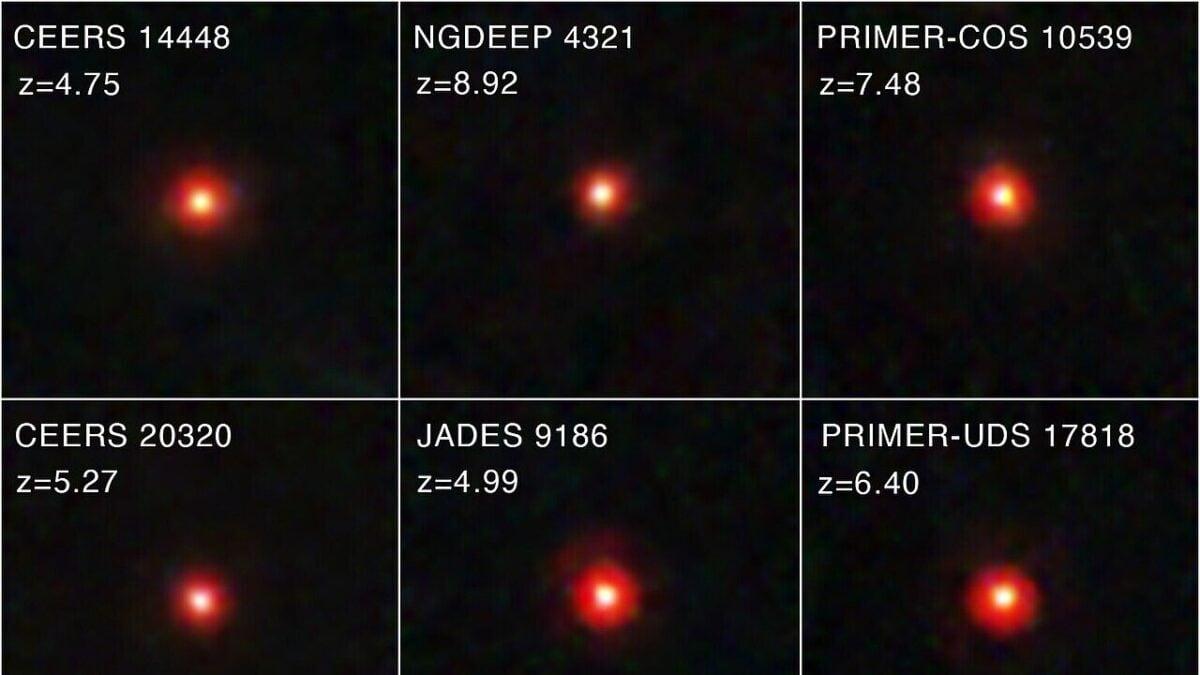
A Johns Hopkins University team says a primordial black hole model could explain one of the mystery hundreds little red dots spotted by the James Webb Space Telescope. The researchers plan to check whether the same explanation fits other objects.
Scientists have identified about 300 of the compact, red objects since 2023. They appear in observations from the telescope, sometimes occupying just one pixel, and date from the universe’s first billion years.
One object supports the model
The team tested its idea against Abell 2744-QSO1, a dot seen when the universe was 700,000,000 years old. It sits in Abell 2744, also called Pandora’s Cluster, a group of galaxies four billion light-years from Earth.
The object appears to contain hydrogen and helium, the first elements formed in the universe, along with a swirling disc of hot material and gas. Researchers modelled how it might have formed around a primordial black hole.
Study co-author Valerio De Luca, a postdoctoral researcher at Johns Hopkins, outlined three possible explanations. The researchers ruled out one scenario because it would have left a detectable imprint on the cosmic microwave background, the afterglow of the Big Bang.
A second possibility was that QSO1 formed from smaller primordial black holes, but the team considered that unlikely. The remaining model starts with lighter “seeds” that grow by taking in dust and gas.
“This one works,” De Luca said. He added that the model “can reproduce the properties of well-studied dots such as QSO1, whose light is magnified by the gravity of a galaxy cluster in front of it.”
Other explanations remain
Primordial black holes would have existed before the first galaxies formed. Their early start could help explain how massive black holes appeared so early, said study co-author Loris Del Grosso.
Del Grosso said the objects could instead be black holes formed through more familiar processes, such as the collapse of a galactic gas cloud. In that scenario, dense gas could absorb and re-emit the black hole’s light, making it glow like a cool star.
“The black hole may be wrapped in an extremely dense cocoon of gas that absorbs its light and re-emits it, so the whole thing glows like the surface of a giant, cool star,” Del Grosso said. The team plans to examine other little red dots for signs that they fit the primordial black hole model.