JWST Detects Forbidden Signal From Molecule Predicted in 1986
Astronomers led by David Neufeld of Johns Hopkins University have used the JWST to find a faint rotational light from the trihydrogen cation, H3+, predicted in 1986 and never seen before, even in laboratories. The signal came from a newborn star's shock waves.
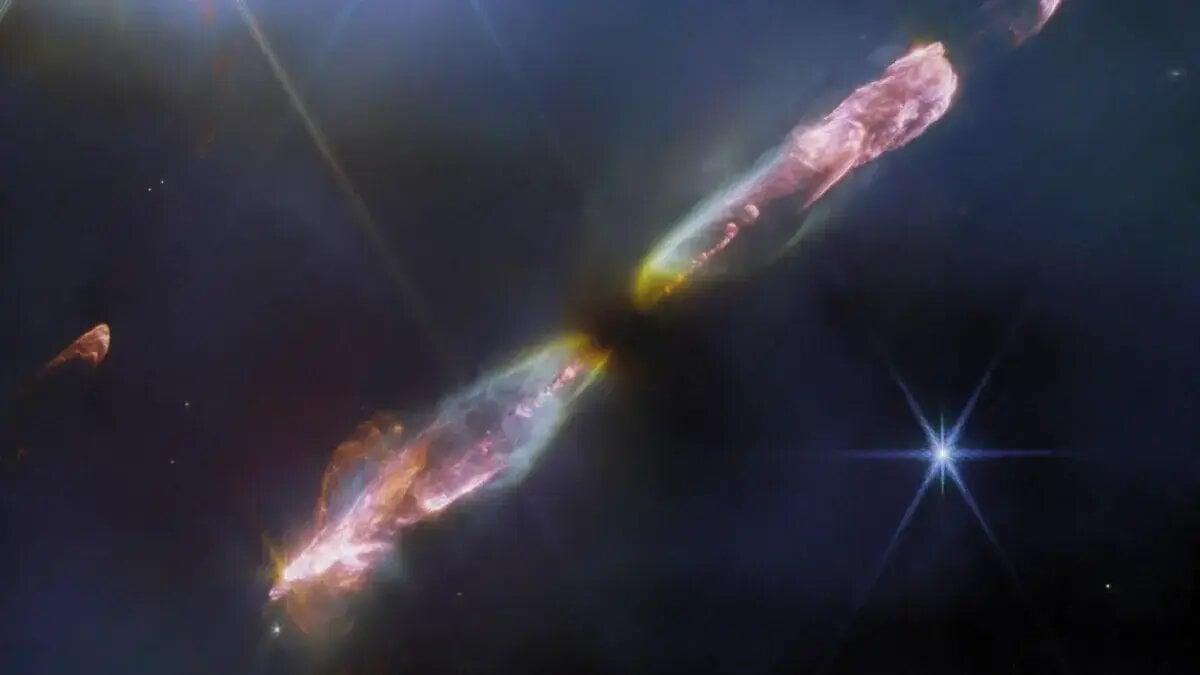
The JWST detects a forbidden signal from the trihydrogen cation (H3+) for the first time, according to a team of astronomers led by David Neufeld of Johns Hopkins University. The faint light was predicted in 1986 and had eluded every search since, including laboratory attempts.
H3+ is among the most important molecules in space. It underpins almost all gas-phase interstellar chemistry, including the formation of the complex organic molecules that supply the ingredients for life. It is often called "the molecule that made the Universe."
Why the light was thought impossible
H3+ has three hydrogen nuclei sharing just two electrons. They form an equilateral triangle, so the molecule has no permanent dipole moment (a built-in imbalance of electric charge) and no allowed pure rotational spectrum.
In practice, that means a spinning H3+ molecule keeps its charge evenly spread. Nothing shifts to generate the radiation that molecules normally give off as they rotate.
In 1986, astrophysicists Fu-Shih Pan and Takeshi Oka of the University of Chicago found a loophole. Spinning creates centrifugal forces that distort the triangle slightly, producing a tiny electric dipole moment and allowing a very faint emission.
The resulting transitions are so weak that they are called "forbidden." They do not break the laws of physics. They are prohibited only by the usual rules governing molecular radiation.
A newborn star's tantrum
For four decades the prediction stayed unconfirmed. The signal was too faint to detect, even in the lab.
The breakthrough came from pairing the JWST with a Herbig-Haro object, one of the galaxy's most spectacular phenomena. These form when baby stars throw violent outbursts.
A forming star feeds on material swirling around it, but not all of that ends up in the star. Powerful magnetic fields fling some of it back into space in tightly focused jets traveling at hundreds of kilometers per second.
When those jets hit the surrounding molecular cloud, they create immense shock waves. The gas heats to thousands of degrees and blazes with light.
That phase is short-lived but important in a star's life, and hard to observe because it often unfolds inside a thick nebula. The JWST is attuned to infrared light, which penetrates dust more effectively than visible light, so it can peer into these stellar nurseries.
What Neufeld's team found
Neufeld and his colleagues were examining JWST observations of Herbig-Haro 168, or HH 168, when something looked odd. Buried among the infrared emissions from the hot, shocked gas was a series of extraordinarily faint spectral lines.
Their wavelengths matched the forbidden rotational transitions of H3+ that Pan and Oka had calculated 40 years earlier. The light came from gas thousands of light-years away.
The discovery could help astronomers understand the physics of the giant shock waves that newborn stars generate. It could also show what happens to this critical molecule amid that turbulence.