Microsoft Outage Disruption Continues as Email Backlog Lingers
Microsoft says services recovered at 16:10 GMT on November 13, just over a day after a global outage began. Delayed email may still take time to arrive, and the company is monitoring for an extended period after problems in 74 countries.

Microsoft said on Friday, November 13, that its email and other key services had fully recovered at 16:10 GMT, just over a day after a global outage began. The Microsoft outage disruption continues for some users, though, because delayed email may still take time to arrive.
The company will not declare that part of the incident resolved until its backlog of undelivered messages is cleared. "Due to the severity of impact this incident caused, we're monitoring for an extended period," Microsoft said on its service-status page.
What went wrong
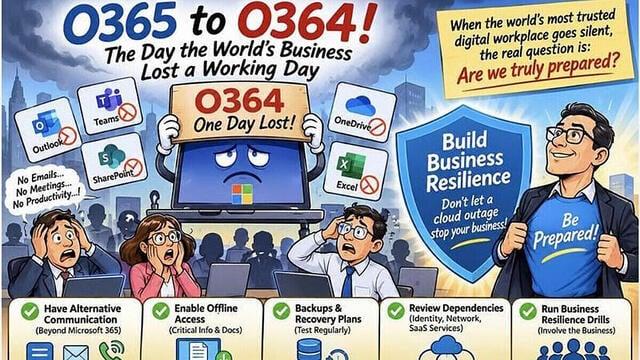
The outage began around 16:00 GMT on Thursday and hit users in at least 74 countries. It affected Microsoft 365 services including Outlook, Teams and the Copilot AI assistant.
Microsoft said overloaded servers caused the failure. An earlier network-capacity upgrade created a problem that surfaced after a further change to its systems, leaving servers unable to cope. The company said it found no sign of a cyberattack or malicious activity.
Prof James Ferryman of the University of Reading's department of computer science said the part of the servers that sets up secure connections was getting swamped. "Once that happens the server just stops answering," he said.
Failures like this snowball, he said. One server falls over, its work passes to the next, and phones and laptops keep trying to reconnect. "You can't just turn it all back on at once. You have to bring it back bit by bit."
What users may still see
Microsoft warned that some users may still face intermittent access problems and delayed email delivery. It said email queues had been significantly reduced and were approaching normal levels.
The company extended the email timeout window to 48 hours to help protect delayed messages as delivery catches up. The timeout window is how long Outlook waits to receive an email. Late messages will carry the time they were delivered, not the time they were sent.
Who was affected
Foreign banks and financial institutions in Taiwan were hit especially hard, a trader said, because their data is emailed to overseas headquarters through Microsoft's systems. Fax machines were used in Taipei. The European exchange operator Euronext told companies to phone in their trades.
Norway's parliament and several ministries lost access to email. Between 80 and 90 Danish municipalities were reportedly affected. Rail operators in Germany, the United Kingdom and Canada said timetables and emailed tickets were hit, and the UK's National Health Service switched to paper records.
In the United States, the House of Representatives and local governments were also affected. The Pentagon, which relies heavily on Microsoft's services, did not comment on whether it was hit.
Microsoft has not said how many people were affected. It announced in January that it had more than 450 million Microsoft 365 commercial subscribers.
Walter Pasquarelli, a strategy adviser to governments on AI and an affiliated researcher at the University of Cambridge, called it "first and foremost a communication risk". Government services and infrastructure rely on the same systems, he said.
Microsoft said it would review the incident, along with measures to prevent future disruptions.