NASA’s Voyager 1 Closes In on One Light-Day From Earth
NASA's Voyager 1 is set to become the first human-made object to sit one light-day from Earth, more than 16 billion miles away. Its radio signals will take 24 hours to arrive. NASA is asking the public to flash Morse code skyward on Tuesday, November 17.
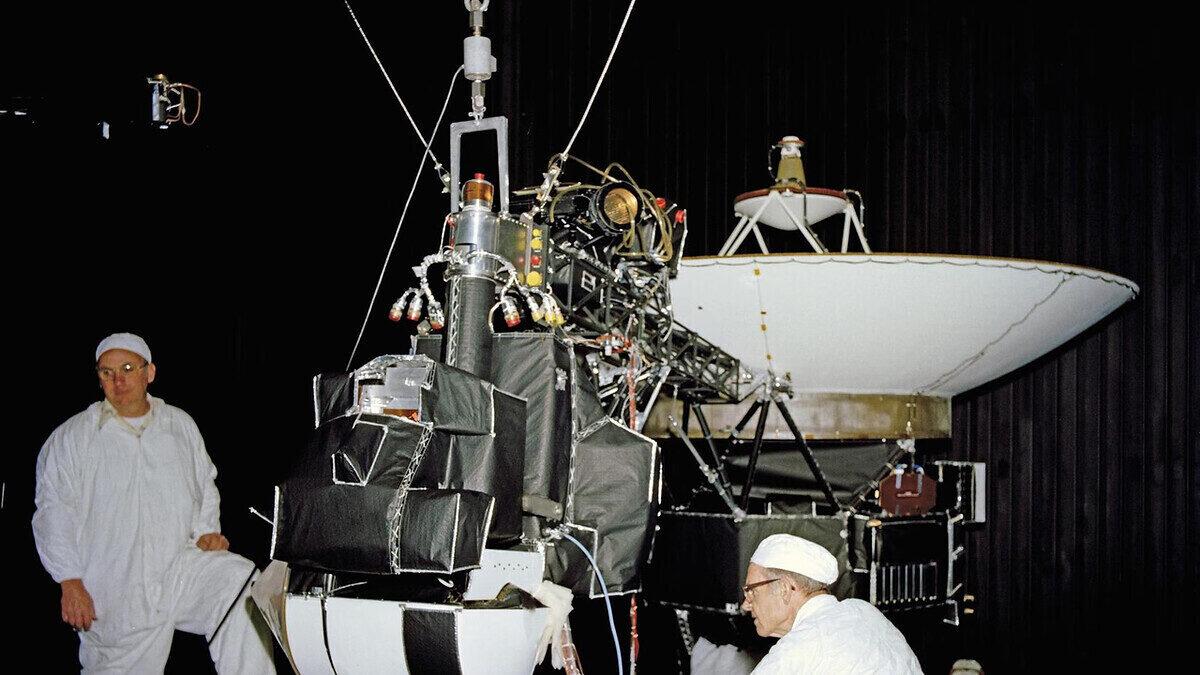
NASA's Voyager 1 closes in on one light-day from Earth on Wednesday, becoming the first human-made object to reach that distance. At that point, its radio signals will need exactly 24 hours, traveling at the speed of light, to reach the planet.
The spacecraft is more than 16 billion miles (26 billion kilometers) away. It launched 49 years ago.
How NASA wants the public to mark it
NASA is asking people to grab a phone or flashlight after sunset on Tuesday, November 17. The agency wants them to flash Morse code spelling V-G-R, Voyager's call sign, into the night sky.
Project manager Suzanne Dodd calls the probe Earth's ambassador between the stars. She says it gives people at home a "sense of wonder." Of the spacecraft itself, she said: "It's a national treasure. Really extraordinary."
Still working, with some problems
Voyager 1 and its twin, Voyager 2, still send back science and engineering data. Both travel at 38,000 mph (61,000 kph), toward different points in space, despite sporadic problems typical of old age.
Almost every day, the probes report on the strength and direction of the magnetic field. They also measure pressure, dust and galactic cosmic rays in a region no spacecraft had explored before. Dodd, who has worked with the Voyagers since 1984, compares them to weather satellites.
A skeleton flight control team at NASA's Jet Propulsion Laboratory in Pasadena, California, sends commands about once a week. Work ramps up when something goes wrong, and a couple of retirees who once worked on the project sometimes help.
In September, controllers finished the latest effort to conserve power on the plutonium-powered spacecraft. In October they briefly lost contact with it. They are still trying to work out why communication was disrupted.
A record-setting career
Voyager 1 swept past Jupiter in 1979 and Saturn in 1980, then left the solar system. It reached interstellar space, the region between star systems as NASA defines it, in 2012. Voyager 2 visited those two planets plus Uranus and Neptune and entered interstellar space in 2018.
Besides going farther than any other human-made object, Voyager 1 took the most distant picture of Earth in 1990. That image is the "Pale Blue Dot," shot from beyond Neptune.
Most people alive today were not born when the Voyagers launched. Even so, "all of us — everyone on Earth — have been touched by these missions," said Bill Nye of the Planetary Society, which Carl Sagan co-founded in 1980.
Each probe carries a 12-inch (30-centimeter) gold-plated record with greetings in 55 languages, plus images and diagrams. It was also Sagan's effort. A full light-year is still about 18,000 years away for Voyager 1, and Voyager 2 will not reach one light-day until 2035.
 Take the quizWhat Kind of Holiday Spender Are You? Take the Black Friday QuizStart →
- 1Column: 4 Reasons to Eat Dark Chocolate, Dietitians Say

- 2Aspyn Ovard Reveals Daughter Has Terminal Cancer on Mormon Wives

- 3Chrissie Swan, 52, Tears Up Over Secret Surprise While Recovering

- 4Box Office: Johnny Depp’s Ebenezer Rings Up $7.1M on Friday

- 5Microsoft Outage Not a Cyber Attack, Company Says, as Fixes Roll Out
 Lifestyle7 Quiet Habits of Emotionally Intelligent People, According to Psychologists
 LifestylePeople Who Don’t Like Celebrating Their Birthday Often Share These 7 Traits
 Lifestyle · Food & HealthVitamin D in Winter: Do You Need a Supplement, and How Much?
 Lifestyle · Food & HealthWhat Is Seasonal Affective Disorder? Signs, Causes and What Helps