Strange Metal Potatoes Contain Life Found Nowhere Else on Seafloor
Researchers who cracked open 244 deep-sea nodules from the Clarion-Clipperton Zone found miniature ecosystems inside, distinct from the surrounding sediment. The study in Scientific Reports raises fresh concerns about the biodiversity cost of seabed mining for nickel, cobalt and copper.
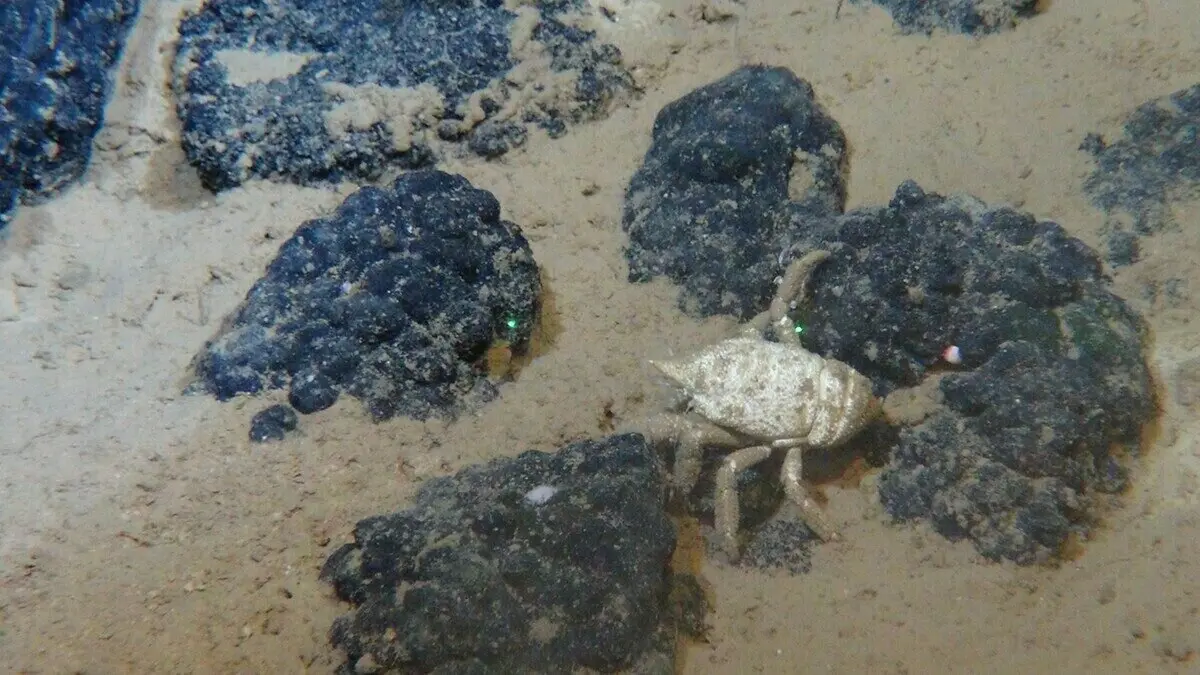
Strange metal potatoes contain entire communities of microscopic animals found nowhere else on the seafloor, according to a study of 244 deep-sea nodules from the Clarion-Clipperton Zone, published in Scientific Reports.
The lumpy rocks, formally called polymetallic nodules, are rich in nickel, cobalt, copper, iron and manganese. Demand for those metals is growing fast, and the nodules have become a target for a speculative mining industry.
Scientists fear that industry could wipe out an ecosystem before anyone understands it.
What the researchers found
Researchers cracked the nodules open and found miniature ecosystems in the cracks and pores. Roundworms and crustaceans were the most common residents. One species of armored amoeba, Thurammina, dominated its group.
A few nodules also held bristleworms, mud dragons, tardigrades and other rarer animals.
Most earlier biodiversity surveys in the zone looked at life in the sediment or on the nodules' surface. Far less was known about what lives inside.
"We already knew that polymetallic nodules provide attachment surfaces for deep-sea organisms, but very little was known about the animals living inside them," marine genomicist Coral Diaz-Recio Lorenzo said.
Different from the mud around them
The inside communities did not resemble those in nearby sediment. "What surprised us most was how different the communities living inside nodules were from those in nearby sediments," Diaz-Recio Lorenzo said.
Nodule communities from areas about 1,000 kilometers apart were more similar to each other than to the sediment communities beside them.
Under the microscope, the team also saw fossils of diatoms, radiolarians and sea sponges embedded in the nodules' ancient layers.
How the samples were collected
A crew aboard the German research vessel RV Sonne collected the nodules in 2019 as part of the JPI Oceans Mining Impact II project. They lowered a box corer to depths of roughly 4 to 6 kilometers (2.5 to 3.7 miles) to lift chunks of seafloor sediment with nodules embedded in it.
Of the 244 nodules studied, 153 came from an area where Germany's Federal Institute for Geosciences and Natural Resources holds an exploration contract from the International Seabed Authority. The other 91 came from an area held under an exploration contract by Global Sea Mineral Resources, a Belgian subsidiary of DEME.
Mining concerns
Plucking a nodule from the seabed takes minutes. Forming one took millions of years, so the resource is not renewable in any practical sense.
Deep-sea biologist Sabine Gollner, of the Royal Netherlands Institute for Sea Research, warned of the consequences. "Our findings point out that commercial mining may result in an irreversible loss of undescribed and unique biodiversity associated to nodules," she said.
She added that the finding "needs to be considered in environmental management of deep-sea mining."
 Take the quizWhat Kind of Holiday Spender Are You? Take the Black Friday QuizStart →
- 1Column: 4 Reasons to Eat Dark Chocolate, Dietitians Say

- 2Mavericks Surfers Race to California for Waves Near 50 Feet

- 3Meghan Markle Plans US Return to See Mother After Father’s Arrest

- 4Chrissie Swan, 52, Tears Up Over Secret Surprise While Recovering

- 5NYC Medical Examiner Has Not Determined Cause of Death of Beau Rose Jessup

 Lifestyle7 Signs Your Social Battery Is Running Low (and Why You Keep Cancelling Plans)
 Lifestyle · Food & HealthThanksgiving Food Safety: How Long Leftovers Last and the Safe Turkey Temperature
 Lifestyle7 Quiet Habits of Emotionally Intelligent People, According to Psychologists
 LifestylePeople Who Don’t Like Celebrating Their Birthday Often Share These 7 Traits