Giant Fungus Dianjunus rex Found in China, 20 Inches Tall
Researchers at the Kunming Institute of Botany reported Dianjunus rex, a hand-shaped fungus up to 20 inches tall and nearly 5 pounds, found in Yunnan Province. DNA analysis suggests its lineage split from other fungi about 65 million years ago.
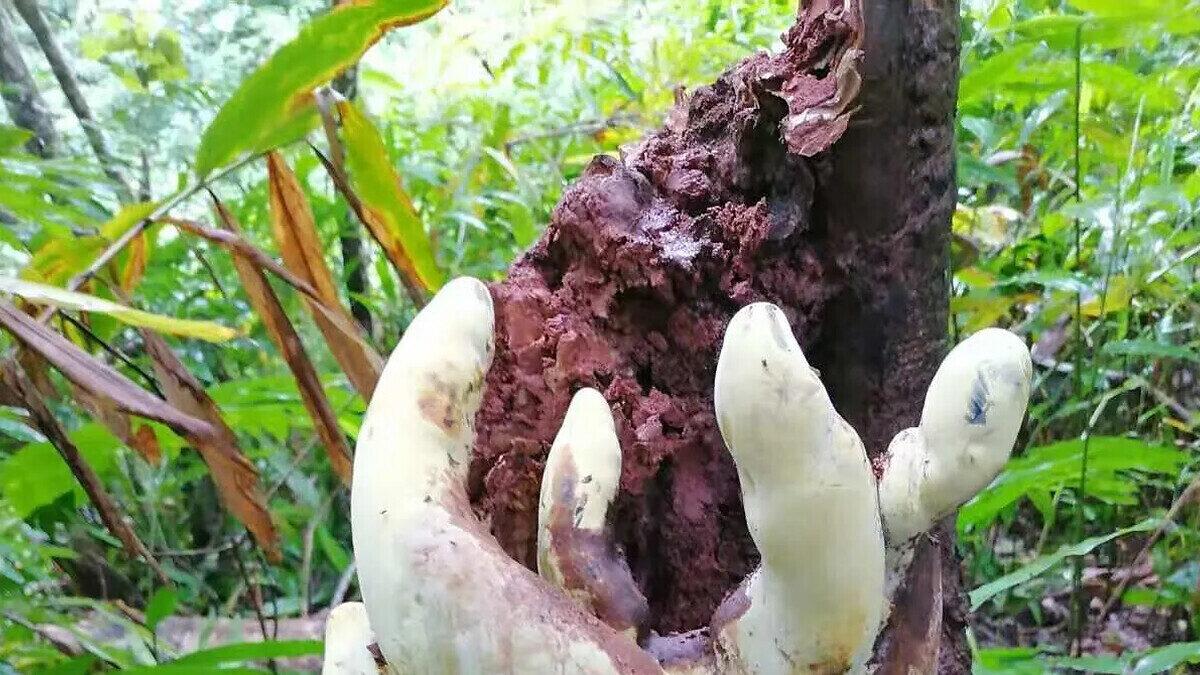
A research team at the Kunming Institute of Botany in China has reported a new species giant fungus discovered in Yunnan Province, naming it Dianjunus rex. Its fruiting bodies grow up to 20 inches tall and weigh nearly 5 pounds.
The institute is part of the Chinese Academy of Sciences. The team found the fungus deep in the forest, shaped like a hand reaching out of the ground.
What the researchers found
The name comes from the region's ancient Dian Kingdom and the Chinese pronunciation of the word fungus. D. rex is an Ascomycete, the largest phylum of fungi, with more than 64,000 known species. Among them, this one produces the largest masses of mushroom recorded.
It does not grow a cap and stem like a typical mushroom. Instead it forms fruiting bodies, structures that release spores so the fungus can reproduce.
The fungus also forms an entirely new biological family within the Ascomycetes. That means it has no close known relatives.
Lead author Indunil C. Senanayake, an associate professor at the institute, said in a press release: "The discovery illustrates how much fungus biodiversity remains to be discovered in East Asian forests." About 6,000 fungal species have been documented in Yunnan. Mycologists believe the province could harbor 100,000.
Where it grew
Senanayake and his colleagues surveyed the Nanban tropical rainforest. There they found large, whitish fruiting bodies growing in soil near the roots of dying trees.
The team collected specimens in shapes including cylinders, spindles and cupped palms. Mature fruiting bodies appeared to develop finger-like branches. Above ground, they are covered in white, powdery fibers that turn dark yellow with age. The buried parts are black and smooth.
The samples dried quickly in the lab. Inside, they were dense and sponge-like, white or yellow, with no strong odor or taste.
A 65-million-year-old lineage
The researchers analyzed the fungus's DNA and built what is called a molecular clock. It showed D. rex diverged from other species about 65 million years ago. That is the end of the Cretaceous period, just after the mass extinction believed to have wiped out three-quarters of all plant and animal species, including the dinosaurs.
So D. rex and T. rex never met. The aftermath may still have helped fungi, since huge amounts of dead plant material became available for organisms that decompose it.
Genome analysis turned up a surprise. D. rex has only about half the usual number of decomposition-related genes found in some close relatives that also feed on plant matter.
A theory about its energy
Senanayake suggests the fungus may lead a "double life". It could live inside healthy trees, then feed on dead plant material once the hosts die. That might explain how it stores enough energy to build such large fruiting bodies.
It is only a theory for now. The team has so far found the fruiting bodies only around dying plants.
Senanayake also hypothesizes that the size helps the fungus. Towering above surrounding plants and fallen leaves could aid spore dispersal by wind in a dense forest.
 Take the quizWhat Kind of Holiday Spender Are You? Take the Black Friday QuizStart →
- 1Women With Autoimmune Diseases Wait About 4 Years for Diagnosis, Study Finds

- 2Micron Stock Falls 28% as $35.16 Billion Buyback Nears

- 3I’m A Celebrity 2026 Line-Up: Rooney Leads 11 Stars Into Jungle

- 4Taylor Swift and the Falcons Game Today: Chiefs in Atlanta

- 5Actor Says David Walliams Sexually Humiliated Him on Stage

 Lifestyle7 Signs Your Social Battery Is Running Low (and Why You Keep Cancelling Plans)
 Lifestyle · Food & HealthThanksgiving Food Safety: How Long Leftovers Last and the Safe Turkey Temperature
 Lifestyle7 Quiet Habits of Emotionally Intelligent People, According to Psychologists
 LifestylePeople Who Don’t Like Celebrating Their Birthday Often Share These 7 Traits