Scientists Discover Star System With Pulses Every Eight Minutes
Astronomers traced radio pulses to GPM J071507−114153, a pair of stars more than 5,000 light-years from Earth. The system includes a white dwarf that rotates every eight minutes and a companion like the Sun. Researchers say the observations also revealed powerful magnetic activity on the companion star.
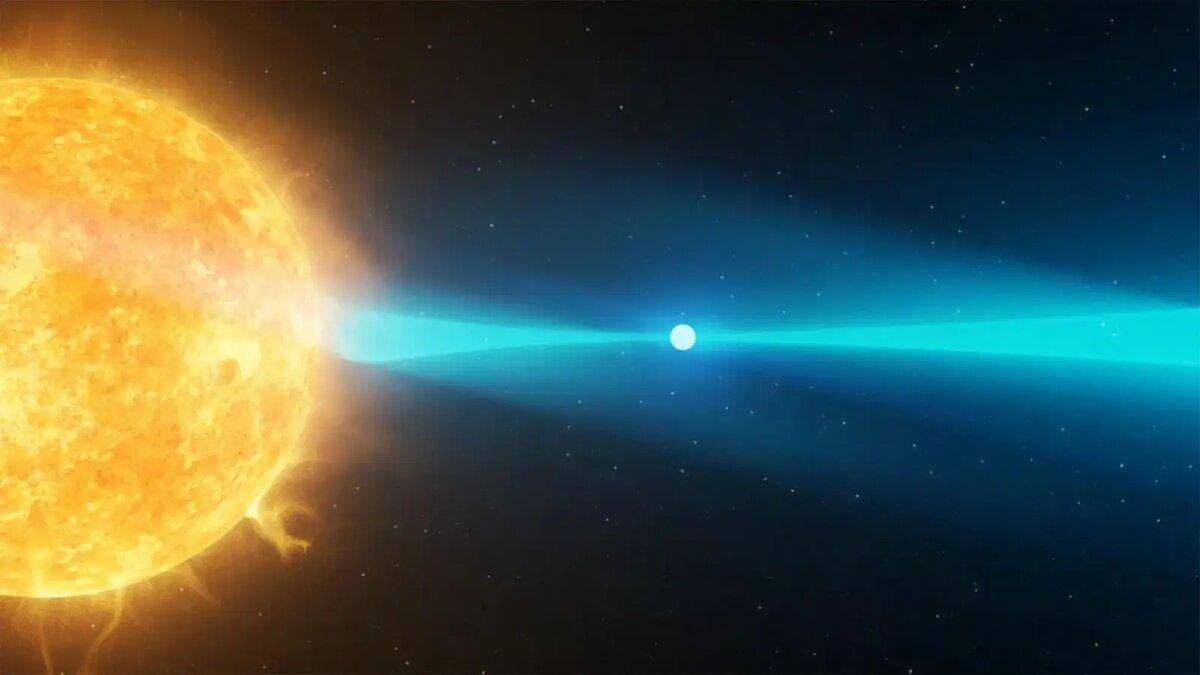
Researchers at Curtin University's branch of the International Centre for Radio Astronomy Research traced radio pulses to a star system more than 5,000 light-years from Earth, in a discovery that shows a white dwarf moving around a Sun-like companion. Scientists discover star system GPM J071507−114153 with pulses linked to a region near the white dwarf.
The dead star rotates every eight minutes. Its companion is a G-type star, in the same general category as the Sun.
First such pairing detected
The system belongs to a rare class called long-period transients, which produce radio emissions that appear and disappear over periods from several minutes to hours. Only about a dozen have been identified.
Astronomers had previously found similar pulses in systems where a white dwarf orbits a smaller, cooler red dwarf. This is the first detection of the signals from a white dwarf paired with a Sun-like star.
The observations also helped researchers locate the pulses. Lead author Dr. Sam McSweeney said: “This is the first time the pulses are clear enough to see the white dwarf moving in its orbit around its companion, so we know that the pulsations are coming from a region close to the white dwarf, or possibly even from the white dwarf itself.”
McSweeney made the discovery while working at Curtin University's research center and is now a commissioning scientist with the Square Kilometre Array Observatory. The team analyzed more than 100 hours of radio observations using computing resources at the Pawsey Supercomputing Research Centre.
Radio signals reveal magnetic activity
The data also showed stellar flares associated with powerful magnetic disturbances on the Sun-like companion, according to study co-author Associate Professor Natasha Hurley-Walker. Similar magnetic processes on the Sun can lead to auroras on Earth when energetic particles interact with the planet's magnetic field and atmosphere.
Researchers also found evidence that the white dwarf passed behind a magnetically active region near its companion. A team member described it as “most likely a 'stellar prominence', which is a large loop of plasma erupting from a star's surface.”
Such prominences are loops of electrically charged gas held by magnetic fields. Their detection in this distant system gives astronomers a way to study activity in a star's outer atmosphere through radio observations.
 Take the quizWhat Kind of Holiday Spender Are You? Take the Black Friday QuizStart →
- 1I’m A Celebrity 2026 Line-Up: Rooney Leads 11 Stars Into Jungle

- 2Mavericks Surfers Race to California for Waves Near 50 Feet

- 3NYC Medical Examiner Has Not Determined Cause of Death of Beau Rose Jessup

- 4Mountaineer Finds Ice Age Cave Bear Graveyard in the Dolomites

- 5Rugby League World Cup Final 2026: Kick-Off Times and How to Watch Kangaroos v New Zealand

 Lifestyle7 Signs Your Social Battery Is Running Low (and Why You Keep Cancelling Plans)
 Lifestyle · Food & HealthThanksgiving Food Safety: How Long Leftovers Last and the Safe Turkey Temperature
 Lifestyle7 Quiet Habits of Emotionally Intelligent People, According to Psychologists
 LifestylePeople Who Don’t Like Celebrating Their Birthday Often Share These 7 Traits