Lumina Simulation Recreates the Universe’s First 2 Billion Years
Researchers built Lumina to model the young universe from about 50 million years after the Big Bang through the first 2 billion years of cosmic history. The simulation tracks galaxies, black holes and radiation, giving scientists predictions to compare with observations from the James Webb Space Telescope.
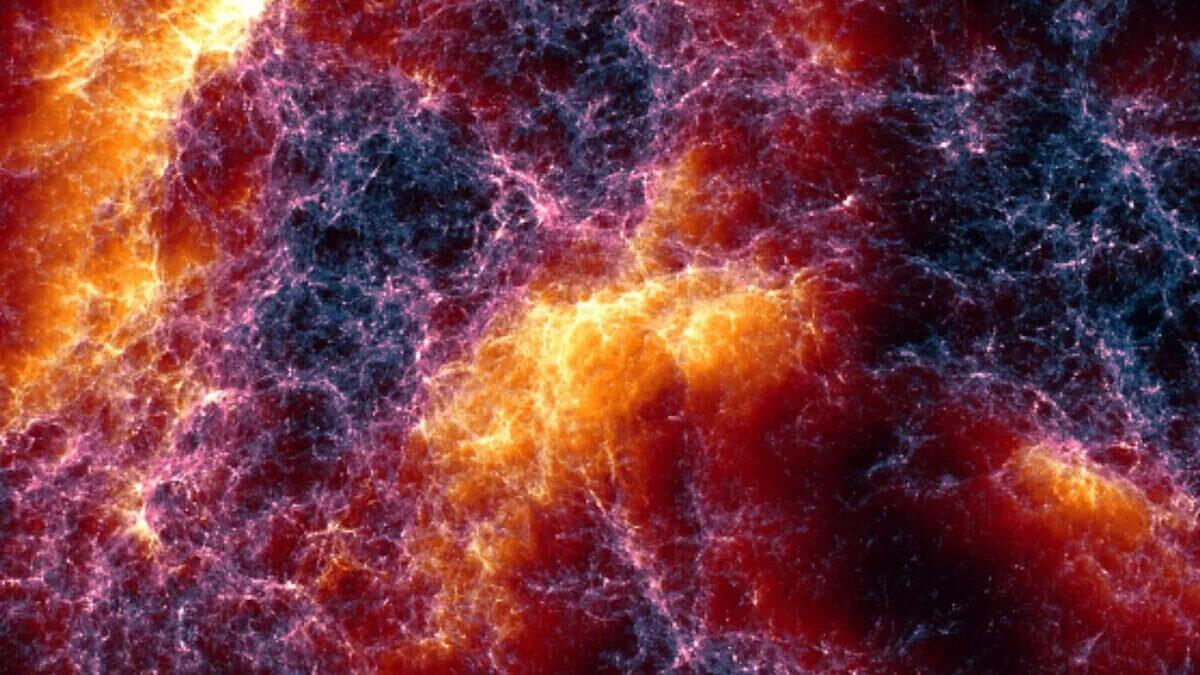
Researchers from MIT, the Center for Astrophysics | Harvard & Smithsonian and partner institutions built Lumina to recreate the first 2 billion years of the universe, modeling how early galaxies and light emerged from an opaque cosmos.
The simulation follows the universe from about 50 million years after the Big Bang across approximately 1.6 billion light-years. Its predictions give scientists a way to compare models of early cosmic history with observations from NASA’s James Webb Space Telescope.
How Lumina models the early universe
After the Big Bang, neutral hydrogen filled the space between galaxies and blocked ultraviolet radiation. The first stars and galaxies eventually produced enough ultraviolet light to strip electrons from hydrogen, a transition known as reionization that allowed radiation to travel more freely.
Lumina tracks dark matter, gas, stars, galaxies, black holes and radiation as they evolve together. It is the first simulation of its type to model helium reionization and include its effects in the same calculation, according to the Smithsonian Institution.
The project ran on the Frontier supercomputer at Oak Ridge National Laboratory. It contains approximately half a trillion computational sectors and covers more than 100 times the volume of comparable earlier simulations while retaining enough resolution to study individual developing galaxies.
Predictions to test against telescope observations
Large-scale coverage can capture rare structures and varied environments that smaller simulations may miss. Those settings matter for studying where early galaxies formed.
Lumina’s predictions include galaxy counts, brightness and radiation patterns that researchers can compare with James Webb Space Telescope observations. Agreement would support the model’s assumptions; differences could point to missing physics or formation rules that need revision.
“To understand what we are seeing with [these telescopes], we need to translate our theories into detailed predictions,” said Oliver Zier, the study’s lead author and a computational astrophysicist at the Center for Astrophysics | Harvard & Smithsonian.
The simulation is a theoretical tool, not a confirmed account of what happened. Its results depend on the physical laws, formation rules, initial conditions and numerical methods built into the model.
Researchers can use Lumina as a reference dataset for studying the formation of the first galaxies, early black-hole growth and the intergalactic medium between ancient galaxies.
 Take the quizWhat Kind of Holiday Spender Are You? Take the Black Friday QuizStart →
- 1U.S. Emergency Alert Test Nov. 17 Is Not a Power Outage

- 2DUP Chairman Lord Morrow Loses Wife and Daughter Within Hours in NI

- 3NASA’s Curiosity Rover Burst Open a Rock and Found Pure Sulfur
- 4Women With Autoimmune Diseases Wait About 4 Years for Diagnosis, Study Finds

- 5Stock Market Today: Dow Futures Slip as Nasdaq Futures Climb Before Earnings

 Lifestyle · Food & Health4 Reasons to Eat Oatmeal, According to Nutrition Experts
 Lifestyle7 Signs Your Social Battery Is Running Low (and Why You Keep Cancelling Plans)
 Lifestyle · Food & HealthThanksgiving Food Safety: How Long Leftovers Last and the Safe Turkey Temperature
 Lifestyle7 Quiet Habits of Emotionally Intelligent People, According to Psychologists