NASA’s Curiosity Rover Burst Open a Rock and Found Pure Sulfur
NASA’s Curiosity rover cracked open a rock in Mars’ Gediz Vallis Channel in 2024, exposing unusually pure elemental sulfur. Two studies published in 2026 offer possible explanations for how the fragile sulfur-rich rocks formed, including ancient gases and chemical reactions in water.
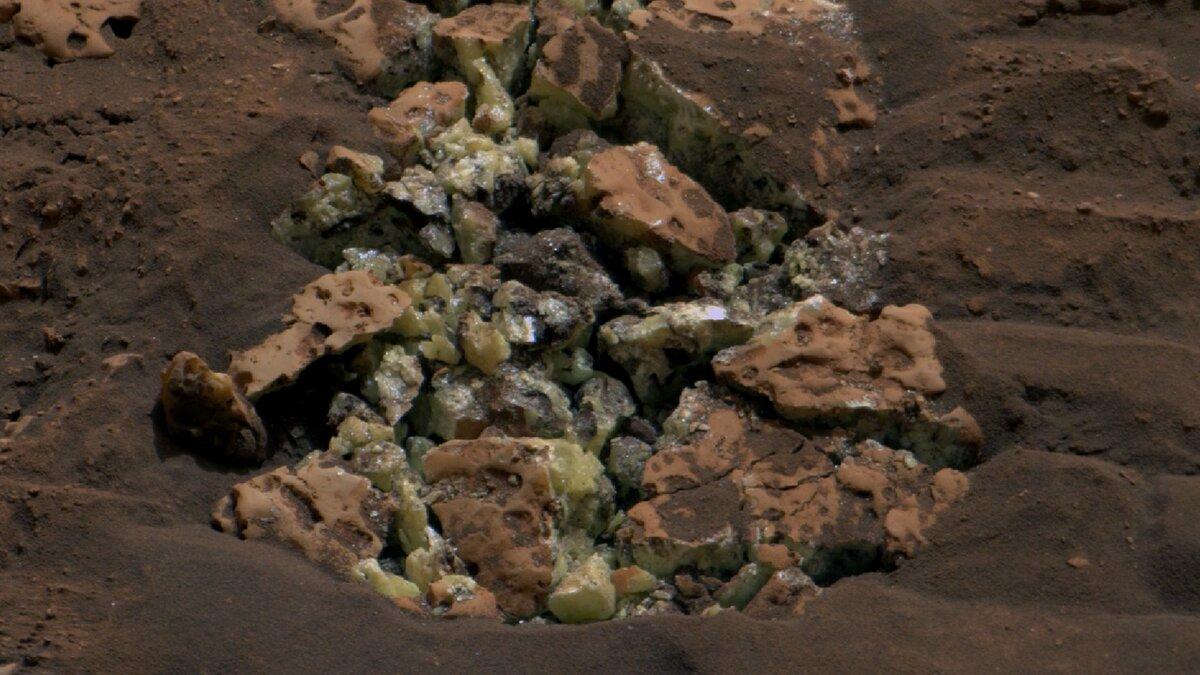
NASA’s Curiosity rover burst open a rock in Mars’ Gediz Vallis Channel in 2024, revealing crystals of pure elemental sulfur and a wider field of similar rocks.
The discovery marked the first time scientists had found sulfur in its pure form on Mars. A study of Curiosity’s observations found the rocks spread across about 2,100 square meters, and confirmed that the sulfur was remarkably pure compared with the sulfate minerals commonly found on the planet.
“Finding a field of stones made of pure sulfur is like finding an oasis in the desert,” said Ashwin Vasavada, Curiosity project scientist at NASA’s Jet Propulsion Laboratory.
Two possible ways the sulfur formed
One study proposes that sulfur-bearing gases from ancient volcanic activity became trapped underground, possibly in ice structures called clathrates. As erosion carved out Gediz Vallis, pressure may have fallen and released the gases, allowing chemical reactions to form sulfur deposits without high temperatures at the site.
The researchers estimate that deposit formed between 3.1 and 2.8 billion years ago. The rock Curiosity crushed was fragile, which supports the idea that the sulfur-rich rocks formed in the area and remained there.
A separate study tested another possibility: a reaction in acidic water at room temperature. Researchers mixed dissolved sulfide with chlorate, a compound that may have existed on ancient Mars, and produced tiny crystals of elemental sulfur.
Lower chlorate concentrations favored pure sulfur, while higher concentrations produced more sulfate. The crystals were microscopic, but the researchers said similar reactions over much longer periods could create larger deposits. They also suggested the hydrogen sulfide could have come from the underground gas reservoirs proposed in the other study.
What the discovery can tell scientists
Sulfates can preserve clues about Mars’ water history. Pure sulfur raises a different question because large sulfur deposits on Earth are often linked to volcanic or hydrothermal activity, yet the surrounding area showed no evidence of the high temperatures needed to form the deposit directly.
Sulfur is essential to life, but the discovery is not evidence that life existed on Mars. The water experiment showed that living organisms are not needed to explain one possible route to elemental sulfur.
“Mars provides us with a frozen snapshot from billions of years ago,” said Jeff Berger, a geochemist at NASA’s Johnson Space Center who co-led the study. “We can go back and look at deep time in a way that we can’t do on Earth.”
 Take the quizWhat Kind of Holiday Spender Are You? Take the Black Friday QuizStart →





 Lifestyle7 Signs Your Social Battery Is Running Low (and Why You Keep Cancelling Plans)
 Lifestyle · Food & HealthThanksgiving Food Safety: How Long Leftovers Last and the Safe Turkey Temperature
 Lifestyle7 Quiet Habits of Emotionally Intelligent People, According to Psychologists
 LifestylePeople Who Don’t Like Celebrating Their Birthday Often Share These 7 Traits