Atomic Clocks Could Test Whether Time Has Quantum States
A Kyushu University-led team has proposed using advanced atomic clocks to look for different rates of time within a single quantum state. The approach remains theoretical, but researchers say controlling a clock’s motion could make the predicted effect detectable with existing technology.
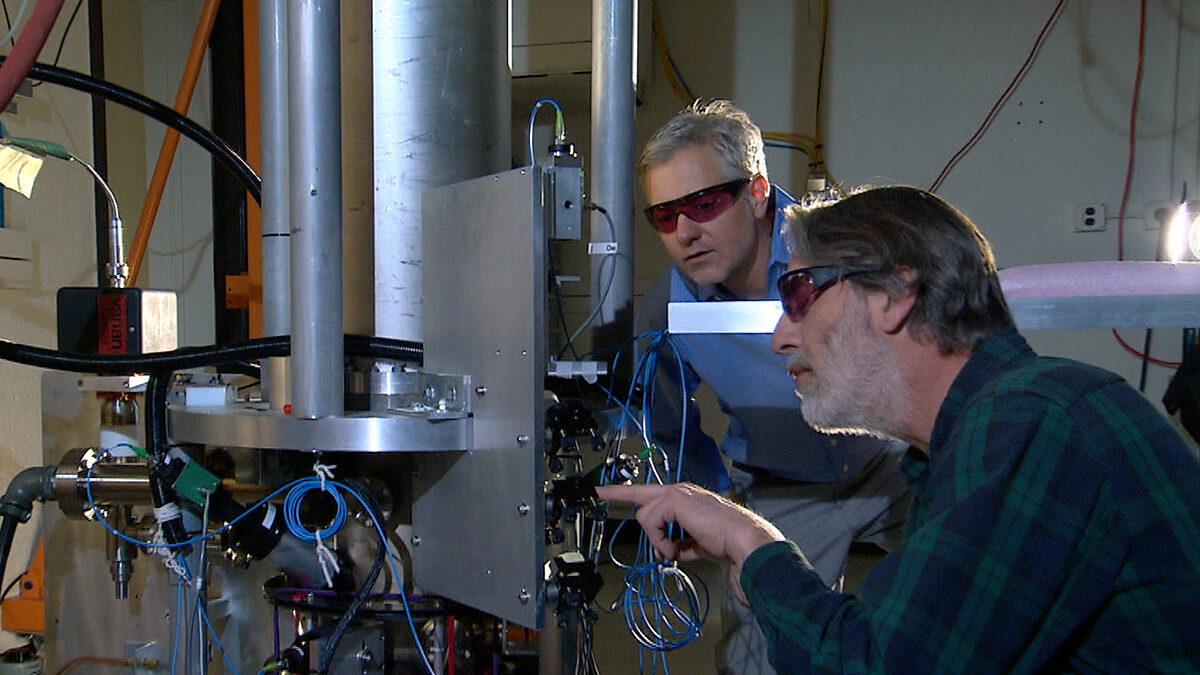
Researchers led by Kyushu University have proposed an atomic clock experiment to test whether different rates of time can coexist in a single quantum state. Their theoretical approach could make the effect detectable with advanced clocks already in use, though the experiment has yet to be conducted.
The study, published in Physical Review Letters, examines a connection between quantum mechanics and Einstein’s theory of relativity. Scientists have not directly observed the effect the team proposes to test.
Relativity predicts that time passes at different rates depending on an object’s speed and the strength of gravity it experiences. Quantum mechanics allows a clock’s motion to follow multiple possibilities at once, a condition called superposition.
Because motion affects the passage of time, the researchers say those possibilities could produce different rates of time within one quantum state.
Clock motion could reveal effect
The team’s model uses trapped-ion atomic clocks, which measure time through the consistent frequencies associated with atoms. Modern atomic clocks can detect relativity’s predicted time differences between clocks separated vertically by just a few millimeters.
Such precision also supports everyday technology. GPS relies on accurate timing to calculate locations.
The researchers found that a clock’s quantum motion can become entangled with its internal energy. Entanglement links properties so they cannot be described independently.
That connection changes the clock’s quantum behavior. Researchers could look for those changes as evidence of different rates of time in superposition.
Joshua Foo, an associate professor at Kyushu University’s Institute for Advanced Studies and a lead author, said the team developed a way to control the clock’s motion. “We introduced a new technique for controlling the atomic clock’s motion, improving its sensitivity to this effect by 100 to 1000 times,” he said.
Researchers plan a laboratory test
The proposal remains theoretical. The next challenge is to design an experiment that can detect the predicted effect while accounting for disturbances and uncertainty in a real laboratory.
The research team also included scientists from the Stevens Institute of Technology, University of Waterloo, the National Institute of Standards and Technology, Colorado State University and Stockholm University.
Foo said the team also wants to investigate another question: “We are also interested in exploring whether atomic clocks could eventually be used to probe the quantum realm of gravity, the other fundamental question in physics.”
 Take the quizWhat Kind of Holiday Spender Are You? Take the Black Friday QuizStart →





 Markets · FintechHow to Calculate Compound Interest: Formula, Examples and the Rule of 72
 Lifestyle · Food & HealthNormal Blood Pressure Chart by Age: Healthy Ranges Explained
 Lifestyle · Food & HealthWhat Is Raynaud’s Syndrome? Why Fingers Turn White in the Cold
 Lifestyle · Food & Health4 Ways Walking After Meals Helps Your Body, Doctors Say