Project CETI Finds Patterns in Sperm Whale Clicks
Researchers studying sperm whales off Dominica have identified complex patterns in their clicks, including changes during a birth. The findings have sparked debate over whether the sounds resemble language. No one has established what the click patterns mean, and scientists disagree about how far the comparisons can go.
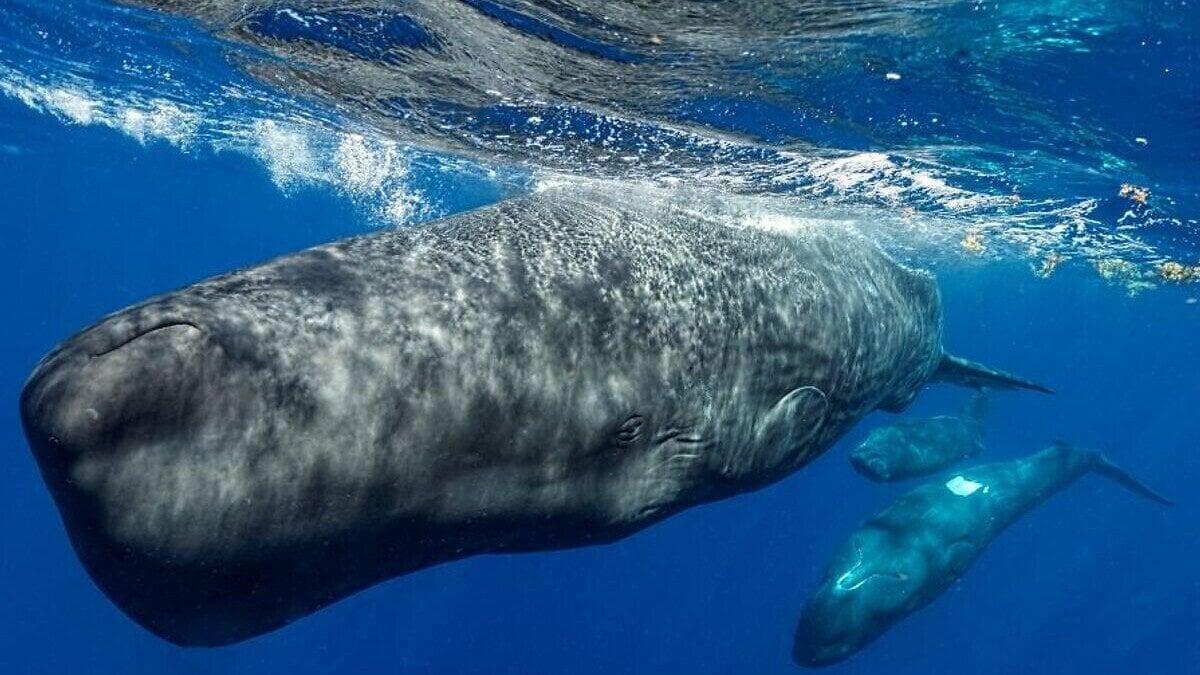
Project CETI researchers studying sperm whales off Dominica have found complex patterns in their clicks, bringing scientists closer to understanding the secrets of whale communication. The findings include changes in vocal patterns during a birth. No one has established what the click patterns mean.
Scientists disagree about what the patterns show. Some see similarities to the building blocks of language. Others say comparisons with human speech go beyond the evidence.
On July 8, 2023, researchers recorded a sperm whale giving birth in deep water off Dominica. Eleven whales gathered around her, and the birth lasted just over 30 minutes.
Other females repeatedly swam beneath the mother during delivery. After the calf surfaced for its first breath, several whales lifted and supported it as it learned to swim.
Underwater microphones and aerial drones captured more than five hours of audio and video. The researchers found that the whales changed their clicking patterns at several key moments.
“Communication doesn’t happen in isolation,” said David Gruber, founder and CEO of Project CETI, the Cetacean Translation Initiative.
Click patterns vary between communities
Sperm whales use rapid clicks to find squid in deep water. Near the surface, they produce short sequences called codas while resting or spending time together. A coda can contain three, four or five clicks separated by timed pauses.
A study published in June in Proceedings of the Royal Society B analyzed 5,291 codas recorded in the Mediterranean between 2003 and 2021. It found differences between whales in the western and eastern basins.
Whales around Spain’s Balearic Islands repeatedly used one slow pattern. Those along the Hellenic Trench off Greece used a larger collection of patterns, some noticeably faster.
The eastern whales occasionally used an older, slower western pattern. Researchers never recorded western whales using the faster patterns that developed in the east.
Researchers debate language comparisons
In 2024, Project CETI researchers analyzed 8,719 codas recorded off Dominica. They identified at least 143 commonly used combinations of rhythm, speed and smaller variations, describing the collection as a sperm whale phonetic alphabet.
The team did not claim to know what the combinations meant. Researchers also found frequency patterns in clicks that resembled human vowels.
“By speeding up the sperm whale vocalizations, we observed patterns that parallel human vowels,” said Gašper Beguš, a linguist at the University of California, Berkeley, and CETI’s linguistics lead.
Luke Rendell, a whale researcher at the University of St Andrews who coordinated the Mediterranean study, says language requires sounds to represent shared ideas and follow rules for creating messages.
“We are very, very, very far from that,” Rendell said.
Gruber said whether the findings reflect something like conversation “is exactly what our ongoing research is designed to determine, not something we’ve claimed outright.”
Ships change whale clicks
Project CETI’s next goal is to predict whale behavior from vocalizations alone, including whether a whale is about to dive or sleep.
Separately, researcher Roee Diamant and colleagues reported in July in Ecological Informatics that whales off Dominica shorten their codas and tighten the gaps between clicks when ships pass.
The team said the pattern was consistent enough to identify whether a vessel was nearby from the vocalizations alone.
 Take the quizWhat Kind of Holiday Spender Are You? Take the Black Friday QuizStart →




 Markets · FintechHow to Calculate Compound Interest: Formula, Examples and the Rule of 72
 Lifestyle · Food & HealthNormal Blood Pressure Chart by Age: Healthy Ranges Explained
 Lifestyle · Food & HealthWhat Is Raynaud’s Syndrome? Why Fingers Turn White in the Cold
 Lifestyle · Food & Health4 Ways Walking After Meals Helps Your Body, Doctors Say