Vampire Camel Found in Museum Fossil Collection
A newly described camel species had unusually large, pointed teeth but ate plants. Researchers identified Vampyrocamelus welshi while reviewing a museum collection, and say its fangs may have helped males compete for mates.
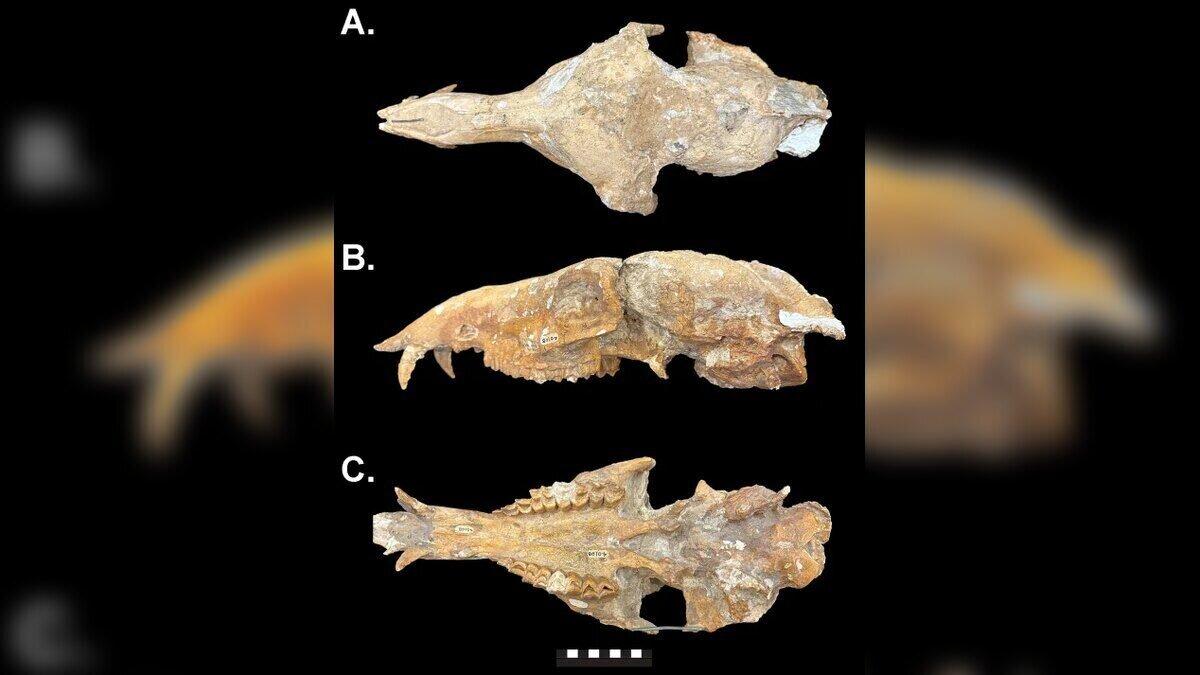
A newly described vampire camel had enormous fangs but ate plants, researchers say. They identified Vampyrocamelus welshi in a museum fossil collection and found that it lived in North America roughly 10 to 13 million years ago.
The teeth stand out. Its fang-like canines were roughly 40 millimeters (1.6 inches) long, with curved tips and sharp points.
The researchers described the species in a monograph set to be published in the New Mexico Museum of Natural History and Science Bulletins. Their work also establishes Vampyrocamelus as a new genus, a grouping of related species.
Fangs may have attracted mates
Vampyrocamelus was a vegetarian despite its fearsome teeth. The study’s co-authors consider it more likely that males used the fangs to compete for female attention than to defend themselves against predators.
“They may have been using [the fangs] to attract females, because the female animals did not have these,” said Katherine Marriott, a paleontologist at the American Museum of Natural History.
The researchers described the canines as enormous compared with those of any other known camelid, the family that includes camels, llamas and alpacas. Where preserved, the first upper premolar was also large, curved and sharply pointed.
Old fossils reveal new species
The identification came from a review of tens of thousands of camelid specimens in paleontologist Childs Frick’s collection at the American Museum of Natural History. Frick funded many fossil digs in the early 20th century.
The fossils have been in museums for the better part of a century. Vampyrocamelus bones have commonly been found in Texas and Oklahoma, and occasionally in Nebraska.
Scientists know relatively little about its skeleton beyond the skull. The collection includes a few broken limb and foot bones, which resemble those of the related genus Aepycamelus.
Aepycamelus had stilt-like legs and a long neck that reached up to 3 meters (10 feet) off the ground. Vampyrocamelus could have looked and lived similarly, though further specimens could clarify its appearance and behavior.
The researchers say some bones previously attributed to Aepycamelus may belong to Vampyrocamelus. The fangs are the main distinguishing feature, making isolated leg bones difficult to identify.
 Take the quizWhat Kind of Holiday Spender Are You? Take the Black Friday QuizStart →





 Markets · FintechHow to Calculate Compound Interest: Formula, Examples and the Rule of 72
 Lifestyle · Food & HealthNormal Blood Pressure Chart by Age: Healthy Ranges Explained
 Lifestyle · Food & HealthWhat Is Raynaud’s Syndrome? Why Fingers Turn White in the Cold
 Lifestyle · Food & Health4 Ways Walking After Meals Helps Your Body, Doctors Say