Ferrari 296 Challenge Stradale Drops Hybrid Power
Ferrari has removed the battery and electric motors from its 296 Challenge Stradale, a road car developed alongside the Challenge Evo racer. The 670bhp model will be a full-production car, priced at around £260,000, rather than a limited edition.
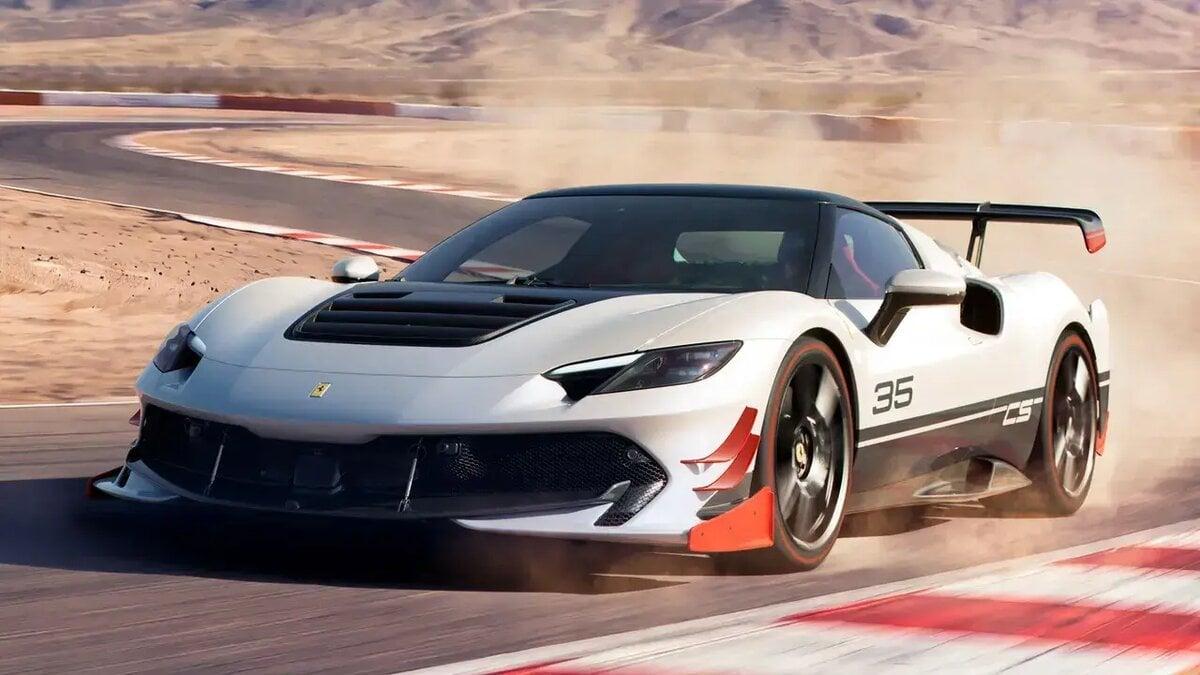
Ferrari’s 296 Challenge Stradale drops hybrid power for a lighter, petrol-only road car with 670bhp. The non-hybrid model removes the electric motors and battery, cutting weight by 140kg and power by nearly 200bhp. It will cost around £260,000, almost the same as the entry-level 296 GTB.
Ferrari will offer the Challenge Stradale as a full-production model, rather than a limited edition. It is the second derivative of the standard 296 GTB, following the 868bhp Speciale.
The road car was developed alongside the enhanced 296 Challenge Evo, which is used in one-make racing. The two cars have different wing mirrors and windows; the road car has plexiglass windows.
Less weight, less power
The Challenge Stradale uses the Speciale’s engine, including titanium connecting rods and a nitrided steel crankshaft. Its output has risen by 7bhp to 670bhp. Ferrari also adjusted the engine’s low-end torque and power delivery above 8,000rpm.
A new exhaust is intended to enhance harmonics. Ferrari also recalibrated the 296’s sound tube, which carries engine noise into the cabin.
Ferrari claims the car can reach 62mph in 2.8 seconds and 124mph in 7.9 seconds. It matches the 296 Speciale to the first speed and is a second slower to the second.
Track performance differs by circuit, said Matteo Turconi, the Challenge Stradale’s senior product manager. “At Fiorano and other twistier tracks the Challenge Stradale is faster,” he said. “At high speed circuits like Monza, the Speciale is faster.”
Race-car changes reach the road
The rear wing produces 270kg of downforce, the force that presses a car toward the road. Total downforce reaches 617kg at 155mph. Ferrari quotes a dry weight of 1,330kg.
The front luggage compartment remains, although it has been reduced to 67 liters. Air channels beside it carry hot air from the radiators through the hood.
Ferrari made the main suspension spring almost twice as stiff and added a softer helper spring, a setup taken from the Evo race car. The adaptive Magneride damping system now offers two bumpy-road settings.
Carbon ceramic brakes are standard equipment, while optional carbon wheels save 2kg per corner. The car’s track widths increase by 13mm at the front and 22mm at the rear.
Turconi said the car is “more precise, more challenging, with less assistance.” He also described a firmer brake pedal, a stiffer throttle spring and heavier steering.
Inside, carbon race seats borrowed from the F80 sit lower, though other seats are available. Race harnesses are optional, and Ferrari has removed some sound-deadening material to save weight.
The Challenge Stradale retains adaptive cruise control, lane keeping, sign recognition and driver drowsiness detection.
 Take the quizWhat Kind of Holiday Spender Are You? Take the Black Friday QuizStart →




 Markets · FintechHow to Calculate Compound Interest: Formula, Examples and the Rule of 72
 Lifestyle · Food & HealthNormal Blood Pressure Chart by Age: Healthy Ranges Explained
 Lifestyle · Food & HealthWhat Is Raynaud’s Syndrome? Why Fingers Turn White in the Cold
 Lifestyle · Food & Health4 Ways Walking After Meals Helps Your Body, Doctors Say