Earth Captures Temporary Mini-Moon Until Early December
A small asteroid named 2026 QQ8 is temporarily orbiting Earth after being captured by the planet’s gravity in April. Astronomers expect it to leave in early December. The object is too small to see without a large telescope and poses no known impact concern.
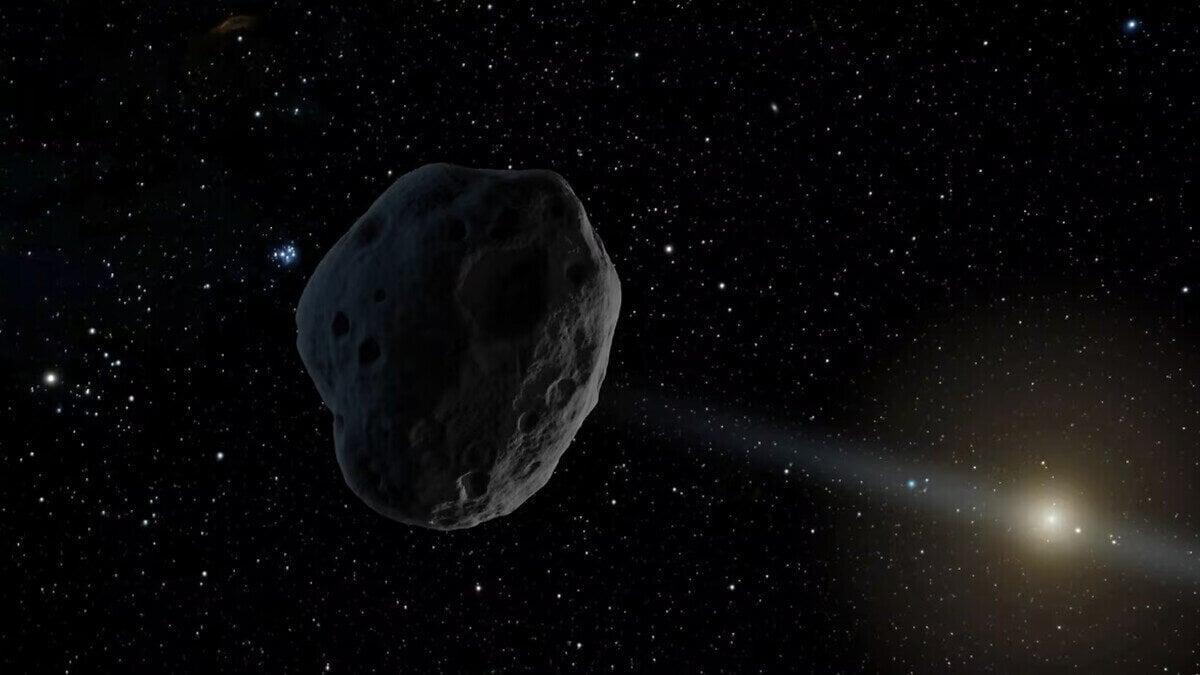
A 2-meter (6-foot) asteroid is temporarily orbiting Earth after the planet’s gravity captured it in April. Earth’s temporary mini-moon, named 2026 QQ8, is expected to leave in early December and continue around the sun.
The asteroid is too small to see with the naked eye. Observers need a large telescope to spot it. There is no current concern that it could strike Earth.
Even if the object entered the atmosphere, its small size means it would break up harmlessly. “At best, you would get a bright meteor in the sky and a bit of a bang,” said Matthew Payne, director of the International Astronomical Union’s Minor Planet Center.
The center tracks asteroids, comets and other small bodies in the solar system. It named the object 2026 QQ8 in late October.
Weeks of observations confirmed asteroid
Astronomer Krisztián Sárneczky detected the object in August and initially called it Sar2901. Researchers needed several weeks of observations to establish that it was a natural object rather than a defunct satellite or a fragment.
Sárneczky, a research coordinator at Hungary’s Konkoly Observatory, said the object initially looked like other near-Earth asteroids he had found. Its unusual nature became apparent after precise orbital calculations.
Astronomers studied how solar radiation affected its motion. The Lowell Discovery Telescope in Arizona and the University of Hawaii’s 2.2-meter (88-inch) telescope on Mauna Kea helped confirm its natural origin.
Near-Earth asteroids have orbits that bring them relatively close to the planet. They are part of a broader group of near-Earth objects that also includes comets.
The precise origin of 2026 QQ8 is still under investigation, Payne said. Most near-Earth objects originate in the asteroid belt between Mars and Jupiter, where gravitational forces can shift their orbits toward the inner solar system.
Small visitors often escape detection
Mini-moon is not an official designation, though astronomers have used it for several natural objects. Asteroid 2006 RH120 spent around one year in Earth orbit, while 2020 CD3 orbited the planet for about three years.
Payne said temporary companions are probably present around Earth much of the time. “They hang around for a few weeks or months. Sometimes it’s none, sometimes it’s a couple,” he said.
Many are hard to detect because they are small, distant or moving quickly from Earth’s point of view. Payne said astronomers have identified about 40,000 near-Earth objects and about 1.5 million objects across the solar system.
The Vera C. Rubin Observatory in Chile is conducting a 10-year survey called the Legacy Survey of Space and Time. Payne said the survey is expected to expand the catalog of known objects.
“The expectation is that we’ll go from knowing 1.5 million objects to knowing 5 million,” he said.
 Take the quizWhat Kind of Holiday Spender Are You? Take the Black Friday QuizStart →




 Markets · FintechHow to Calculate Compound Interest: Formula, Examples and the Rule of 72
 Lifestyle · Food & HealthNormal Blood Pressure Chart by Age: Healthy Ranges Explained
 Lifestyle · Food & HealthWhat Is Raynaud’s Syndrome? Why Fingers Turn White in the Cold
 Lifestyle · Food & Health4 Ways Walking After Meals Helps Your Body, Doctors Say