Cheap Electric Cars 2026: Prices, Subsidy Rules, and Models
Cheap electric cars 2026, prices, range, and subsidy requirements explained clearly for buyers weighing the switch.
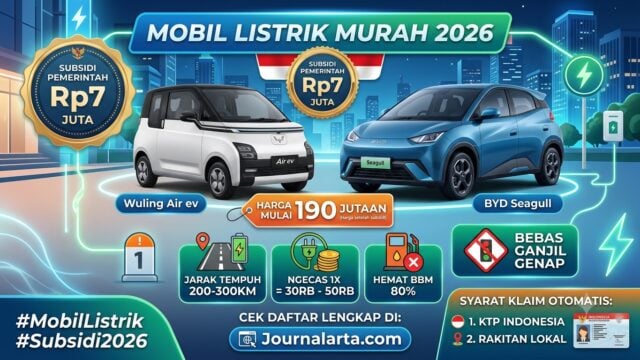
JAKARTA, JOURNALARTA.COM — Cheap electric cars in 2026 are attracting fresh buyer interest as Google searches rise, fuel costs stay high, and government subsidies keep the entry price within reach for some consumers. The key questions are simple: which models are cheapest, what do they cost on the road, and who can claim the Rp7 million incentive?
For young families and office workers, the math is getting harder to ignore. Charging a battery can cost far less than filling a fuel tank, and some cities also give electric cars a practical edge in daily use.
Why cheap electric cars 2026 are getting more attention
The shift comes from three forces at once. Government incentives reduce the upfront burden, especially for locally assembled electric cars that qualify under the subsidy scheme. Daily running costs are also lower because electricity is cheaper than gasoline. Charging access is widening too, from public stations to malls and home wall chargers.
In the draft circulating, one full charge is said to cost around Rp30,000 to Rp50,000 for a driving range of about 300 kilometers. For the same distance, fuel spending can reach Rp400,000. That gap changes the buying calculation fast.
An automotive observer who follows the electric vehicle market said the entry-level segment is getting a second look from middle-class buyers. “If the starting price gets more reasonable, people become braver about making the switch. What they are looking for now is not only the brand, but the total cost of owning the car,” he said.
Cheap Electric Cars 2026: Price List and Government Subsidy Requirements
Prices vary by region, but Jakarta on-the-road figures give a clear picture of the current market. The Wuling Air EV Lite sits around Rp190 million with a driving range of about 200 kilometers, making it a compact option for city travel.
The BYD Seagull is listed at around Rp250 million with a range of 300 kilometers. The VinFast VF 5 appears near Rp220 million, with a range of 280 kilometers and an eight-year battery warranty. For buyers who want a small SUV body, the Chery Omoda E5 comes in at around Rp450 million with a range of about 430 kilometers. The Hyundai Ioniq 5 remains in the premium bracket, starting above Rp700 million, with a range said to reach 600 kilometers and fast-charging support.
| Model | Jakarta OTR price range | Range |
|---|---|---|
| Wuling Air EV Lite | Rp190 million range | 200 km |
| BYD Seagull | Rp250 million range | 300 km |
| VinFast VF 5 | Rp220 million range | 280 km |
| Chery Omoda E5 | Rp450 million range | 430 km |
| Hyundai Ioniq 5 | Starting above Rp700 million | 600 km |
Subsidy rules are strict
The Rp7 million subsidy is designed to stay targeted. Buyers must be Indonesian citizens and have a national ID card. One NIK can only be used for one subsidized unit per year. The car also has to be locally assembled with a domestic component level above 40 percent, and the on-the-road price cannot exceed Rp600 million for four-wheeled vehicles.
That means buyers need to check the model status before walking into a dealership. The incentive only applies if the purchase goes through an official dealer registered in the government scheme. In practice, the Rp7 million deduction is usually applied directly to the selling price at the time of purchase.
“Consumers should not look only at the brochure price. Make sure the unit is included in the program, check the TKDN, then confirm the official dealer is part of the incentive scheme,” said a representative from the automotive industry who understands electric vehicle distribution.
What charging access means for buyers
Charging infrastructure has improved compared with a few years ago. PLN public charging stations are available at toll-road rest areas, malls, and PLN offices, with tariffs of around Rp2,400 per kWh. Home wall chargers can also be installed for around Rp5 million to Rp15 million, making overnight charging a realistic option for many households.
Shopping centers and office buildings now offer charging services too, and some provide them free for customers. Users can track charging points through apps such as Charge.IN or Volta. The map is denser now, though long out-of-town trips still need planning.
For consumers, this is where the real impact lands. Cheap electric cars 2026 are no longer just a tech novelty. They are becoming a budget decision. A driver who uses the car for office runs, school drop-offs, and short city trips can see lower monthly costs, especially if charging happens mostly at home or at a cheap public station. But for people who often drive long distances without a sure charging point, the calculation stays tighter. The subsidy helps, yet the route map and daily use still decide whether the car makes sense.
One more number keeps shaping the debate: Rp7 million. That is the incentive many buyers will be checking first before they compare price, range, and charging access.