How to Check 2026 BLT Dana Desa Recipients, Third Tranche
Check BLT Dana Desa recipients for the 2026 third tranche, including the official Kemensos link, schedule, amount, and eligibility rules.
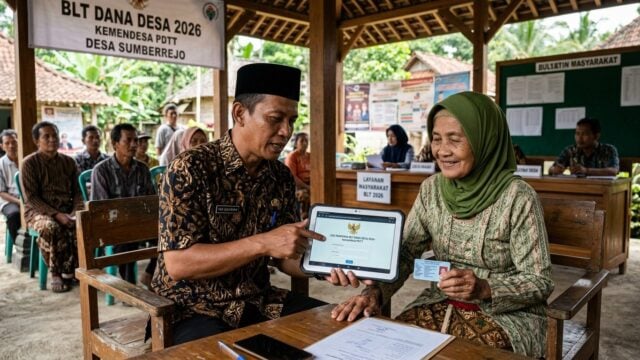
JAKARTA, JOURNALARTA.COM — How to Check 2026 BLT Dana Desa Recipients for Third Tranche matters now because the payout period covers September to December 2026, with eligible beneficiary families set to receive Rp300,000 per month. For the full third tranche, that means Rp1,200,000 per family if the four-month allocation is disbursed at once.
The payment comes from Village Fund money, and the rules require at least 10 percent of that budget to be set aside for BLT. The system follows Ministry of Finance rules and technical guidance from the Ministry of Villages, Development of Disadvantaged Regions, and Transmigration, known as Kemendesa PDTT.
2026 BLT Dana Desa disbursement schedule
The government splits BLT Dana Desa 2026 into three tranches. The first tranche covers January to April, the second runs from May to August, and the third tranche covers September to December 2026.
Each tranche is worth Rp1,200,000 per beneficiary household, or KPM, because the monthly amount stays fixed at Rp300,000. Over one full year, one KPM can receive Rp3,600,000 if all stages are paid on time.
There is no single national payout date that applies everywhere. Village administrations handle the submission, data checking, and confirmation process before funds move. So a village in one district may disburse earlier than another nearby village. For residents, the practical answer usually comes from the village office, not from a blanket schedule on paper.
BLT Dana Desa 2026 amount and allocation
The amount has not changed: Rp300,000 per month for each eligible KPM. That figure remains tied to the applicable regulations for the 2026 fiscal year.
The Village Fund allocation also keeps the same basic structure. A portion must be reserved for BLT support, and village officials must match local recipient data with the relevant social protection records before funds are released.
| Tranche | Period | Total per KPM |
|---|---|---|
| Tranche 1 | January–April 2026 | Rp1,200,000 |
| Tranche 2 | May–August 2026 | Rp1,200,000 |
| Tranche 3 | September–December 2026 | Rp1,200,000 |
Who can receive the third tranche
Not every village resident can automatically get the cash aid. Recipient selection depends on village proposals and verification against the Ministry of Social Affairs’ Integrated Social Welfare Data, or DTKS.
Priority usually goes to poor families, households facing economic hardship, elderly people living alone, families with members who have chronic illness, and other vulnerable residents proposed by village officials. A valid national ID number, or NIK, must match the village where the person lives.
If a family feels eligible but does not appear in the social data, it can ask the village head or village apparatus to update the records. That step matters, because many delays start with incomplete local data rather than with the disbursement itself.
How to check BLT Dana Desa 2026 recipients
The official online check is through cekbansos.kemensos.go.id, the Ministry of Social Affairs portal. Residents should avoid other links claiming to provide government checks, since fake sites often try to collect personal data.
The steps are straightforward. Open the site, choose the province, regency or city, district, and village. Then type the full name exactly as listed on the ID card, complete the captcha, and press the search button. The result will show “YES” if the name is registered, or “NO” if it is not recorded.
If the result says “NO,” the family should not assume it has been rejected forever. The data may still be awaiting update at village level, or the payment may not yet have been finalized. In many cases, the village office still holds the most current recipient list.
Village boards often post the list before money is handed out. For residents without stable internet access, that notice can be the fastest route. It also cuts down on unnecessary trips to district offices.
Why the check matters for households
For low-income families, the third tranche is not a small top-up. It can cover food, school needs, transport, or medicine for one quarter of the year, especially in villages where wage work is irregular and prices move fast.
That is why timing matters. A family that waits for a promise and misses the local notice may lose days trying to confirm a status that the village office already posted. In places with limited signal, a simple printed list can matter more than a website.
The direct cash also affects local spending. When funds arrive, they usually move quickly into kiosks, markets, and daily necessities. Village economies feel the impact almost immediately.
Watch for fraud during disbursement
BLT Dana Desa disbursement is free. No registration fee, no transfer charge, no secret deduction. If someone asks for money to “process” the aid, the request should be treated as a scam.
Funds may be transferred directly to the KPM’s account or handed out through the post office, depending on the village mechanism. Recipients are usually asked to bring an ID card or savings book when collecting the money.
The official information cited in this report comes from Kemendesa PDTT and the Ministry of Social Affairs. As one village official often reminds residents during aid distribution, “Check the list at the village office first. That is the cleanest way to know where your name stands.”