
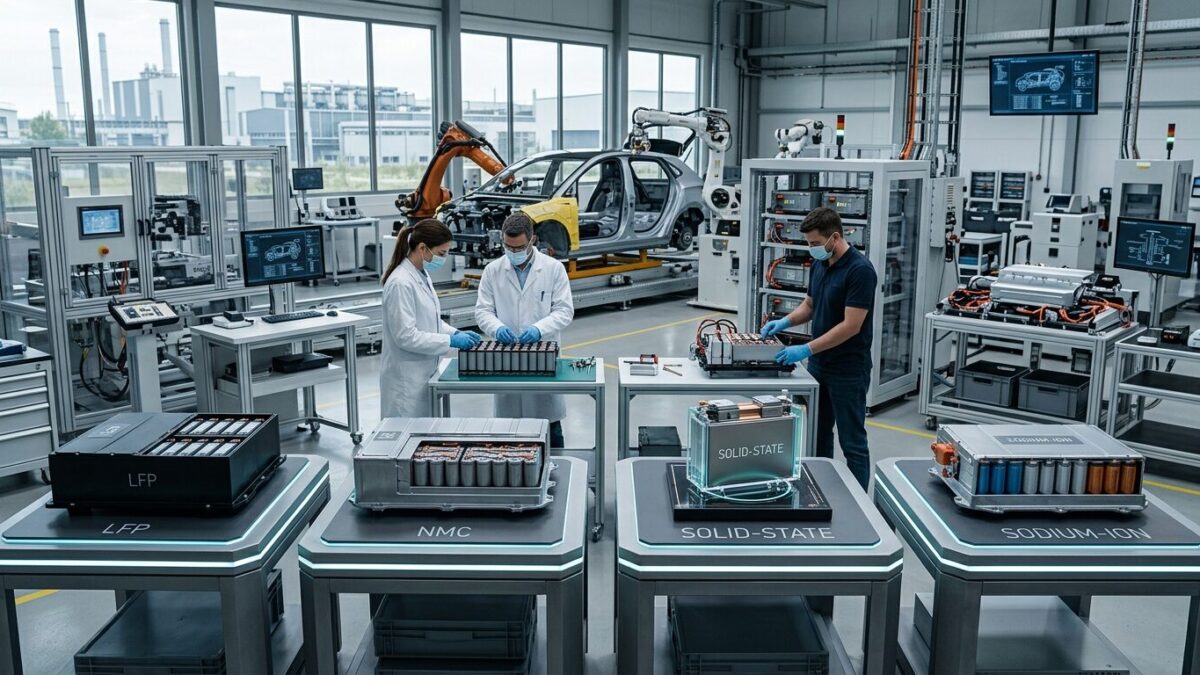
JAKARTA, JOURNALARTA.COM – Batteries remain the most expensive part of an electric car, accounting for as much as 40 percent of a vehicle’s total price. That is why the race for EV battery technology is heating up ahead of 2026, as manufacturers scramble to build batteries that are cheaper, safer, and capable of longer driving range.
Four types of electric vehicle batteries are now competing in the global market in 2026: LFP, NMC, solid-state, and sodium-ion. Each has its own strengths. Some focus on lower cost, some chase longer range, and some are still in the testing phase.
Journalarta compiled the data from the IEA, CATL, GM, and Toyota. All of it is based on facts, not speculation.
Four Types of Electric Vehicle Batteries in 2026
Start with the most widely used: Lithium Iron Phosphate (LFP). Its composition uses lithium, iron, and phosphate, without nickel or cobalt. It is the cheapest option, at around US$52 per kWh for low-end cells, compared with the 2025 average for lithium-ion of US$74 per kWh.
LFP is also relatively safe. “LFP does not generate its own oxygen to feed a fire,” said a Telemetry analyst. That means the risk of thermal runaway, or battery fire, is lower. Its lifespan has also increased 40 percent over the past five years.
But there is a trade-off. LFP energy density is lower than NMC, so the driving range is shorter. Performance in cold weather is also weaker. Even so, three out of four EVs in China in 2024 already used LFP. GM even imported cells from CATL for the Chevrolet Bolt 2027.
Then there is NMC (Nickel Manganese Cobalt). Its main advantage is clear: high energy density and longer range. It is widely used in premium EVs and commercial trucks. Its weakness is also clear — it is expensive because of its nickel and cobalt content. Cobalt is often tied to ethical mining concerns, and its thermal runaway risk is higher than LFP.
Solid-State, the Star Still Waiting to Break Through
This is the technology most people are waiting for. Solid-State Battery (SSB) uses a solid electrolyte made from ceramic or sulfide instead of a liquid. The result: energy density 50 percent higher than conventional lithium-ion, and much greater safety because there is no flammable liquid.
The range claims sound eye-catching. Changan says 1,500 km under CLTC testing. Toyota is targeting 600 miles by the end of 2026. Samsung even claims the battery life can reach 20 years with minimal degradation after more than 1,000 cycles.
The problem is that most of it is still in the testing stage. Dongfeng will only begin mass production of 350 Wh/kg solid-state cells in 2026. Toyota, Mercedes, and Stellantis, together with Factorial Energy, are also testing them in vehicles. Full mass production is expected in 2027-2028.
The main obstacle is technical: dendrites, microscopic lithium structures that can trigger short circuits. Production costs are still high, too.
Sodium-Ion: Cheap and Cold-Weather Friendly
The fourth type, Sodium-Ion, replaces lithium with sodium. The average price is US$59 per kWh, cheaper than the average lithium-ion battery. The material is abundant, since sodium is far more available than lithium. It also performs well in cold temperatures.
But its energy density is low, so the driving range is shorter. Charging in cold weather is also weak. Even so, CATL launched Naxtra, a sodium-ion battery for EVs, in 2026 with a target range of 600 km. Changan Nevo A06 became the world’s first mass-produced sodium-ion EV, starting in February 2026.
Trends in Price, Lifespan, and Charging
Battery prices have plunged. Lithium-ion cells that cost US$568 per kWh in 2013 fell to US$74 per kWh in 2025, a drop of about 30 percent in just five years.
Battery life has also improved by 40 percent. CATL says its AI-based battery management system can extend battery life by another 20 percent. On charging, BYD’s Blade Battery 2.0 with Flash Charging is claimed to charge in five minutes.
For large-scale energy storage, iron-air technology has emerged. Ore Energy from the Netherlands has developed an iron-air battery with 100 hours of storage capacity, using iron, water, and air. It is cheap, but bulky, and designed for storage, not cars.
| Type | Best For | Notes |
|---|---|---|
| LFP | Affordable cars, ride-hailing | Safe and cheap, shorter range |
| NMC | Premium long-range cars | Expensive but long range |
| Solid-State | Future EVs in 2027+ | 1,000 km+ range, safer |
| Sodium-Ion | Low-cost EVs, electric scooters | Cheap, not yet for long distances |
Frequently Asked Questions
Which type of battery is the safest for electric cars? LFP. With no nickel or cobalt, the fire risk is low.
How long does an EV battery last? Lifespan has improved by 40 percent over the past five years. Samsung’s solid-state version is even claimed to last up to 20 years.
When will solid-state batteries be used at scale? Small-scale production is expected in 2027-2028. Dongfeng will start mass production of the cells in 2026.
Is sodium-ion cheaper than LFP? Not yet. Sodium-ion costs US$59 per kWh, while low-end LFP is US$52 per kWh.

📝 Leave a Comment
Comment as . Reviewed by an admin before it appears.