Air Quality Crisis: Palembang Hits Hazardous AQI of 485
Air quality reaches hazardous levels in Palembang and other Indonesian cities due to forest fires. AQI hits 485; health warnings issued for residents.
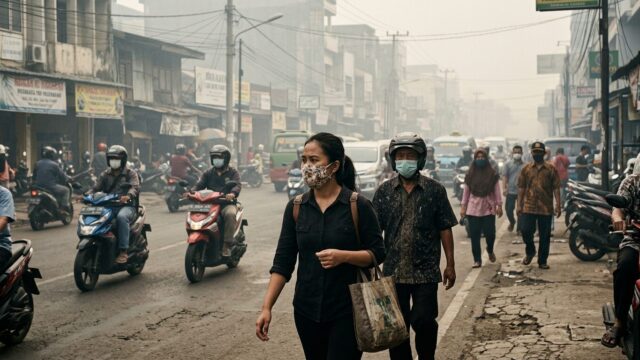
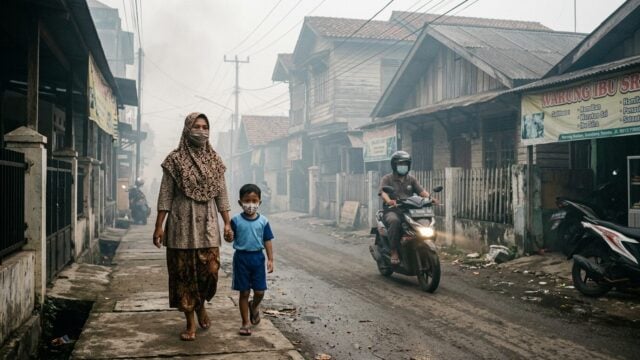
JAKARTA — A thick blanket of smog from rampant forest and land fires has pushed air quality across major Indonesian cities into the hazardous category, with Palembang recording an Air Quality Index (AQI) of 485 on Monday, Oct. 5, 2026. Data from the air quality technology firm IQAir confirms that the pollution levels in Sumatra and Kalimantan are now reaching critical thresholds, far exceeding World Health Organization safety guidelines.
Palembang, the capital of South Sumatra, currently leads the nation in air pollution. Monitoring stations have reported readings fluctuating between 171 and 1,218, with the 485 figure placing the city in the 'hazardous' bracket—defined by IQAir as an AQI above 301. The concentration of PM2.5—microscopic particulate matter that can penetrate deep into the lungs—has surged to more than 10.2 times the level recommended by the World Health Organization.
The crisis extends across the region. In Pontianak, West Kalimantan, the AQI spiked as high as 412, with some stations recording extreme bursts reaching 804. Although afternoon wind speeds of 14 kilometers per hour provided temporary relief by dispersing pollutants, the PM2.5 concentration remains at 108 micrograms per cubic meter, or 17.2 times the global health guideline. Meanwhile, Jambi is grappling with AQI levels between 168 and 320. Indonesia's Meteorology, Climatology, and Geophysical Agency (BMKG) has confirmed numerous active hot spots near these urban centers, which are now causing significant disruptions to local economic activities, including reduced commerce and lower worker productivity due to poor visibility.
Jakarta and its satellite cities are also contending with unhealthy air. Although not as severe as the smog in Sumatra and Borneo, Jakarta recorded an average AQI of 152, keeping the capital in the 'unhealthy' category. Between Oct. 2 and Oct. 4, Jakarta frequently appeared in the top six list of the world's most polluted cities, with readings fluctuating between 119 and 156. In neighboring Tangerang, stations have reported average AQI levels of 163, with some residential areas like Serpong seeing peaks as high as 220.
Health authorities, including those monitoring the data from IQAir and the BMKG, have issued urgent advisories. Residents in heavily affected zones are urged to remain indoors, keep windows and doors tightly sealed, and operate high-performance air purifiers. For those who must venture outside, officials strongly recommend the use of N95 or FFP2 respirators to protect against the dangerous particulate matter currently choking the region.