Cat’s Tail: Hubble Reveals a Mysterious 93-Billion-Mile Cosmic Structure
NASA’s Hubble Space Telescope has captured the Cat’s Tail near the young star Beta Pictoris in visible light, revealing details of a dark dust cloud that had previously been seen only in infrared. Researchers say the structure may be debris from a collision between large planetary bodies.
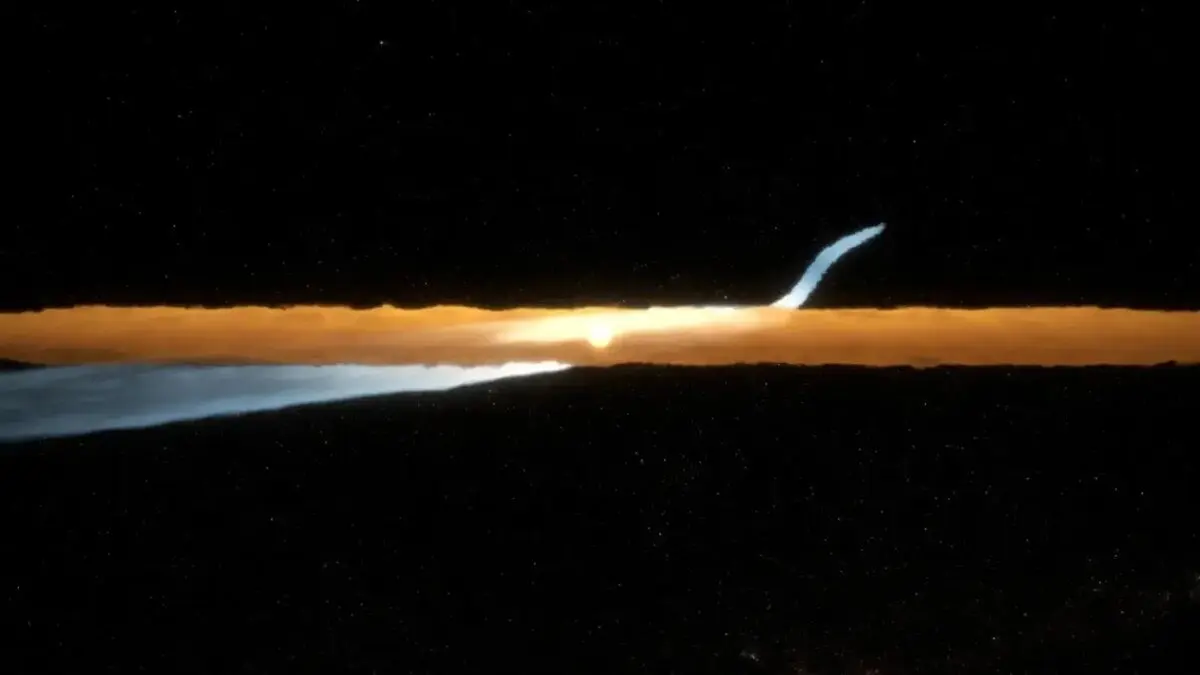
NASA’s Hubble Space Telescope has captured the mysterious 93-billion-mile cosmic structure known as the Cat’s Tail in visible light near the star Beta Pictoris, revealing details of a cloud that had previously been detected only in infrared.
The finding gives astronomers a closer look at possible debris from a collision between large bodies in a young planetary system.
The Cat’s Tail lies about 63 light-years from Earth, in the constellation Pictor. It is part of a broad disk of dust and debris around Beta Pictoris, a young star system whose formation is believed to be nearing its final stages.
Evidence of a possible collision
A study published in The Astrophysical Journal Letters combined the new Hubble images with observations spanning more than 14 years. The research was led by University of Arizona planetary scientist Arin Avsar.
“The Cat's Tail is thought to be the aftermath of a collision between large bodies - think something like Pluto,” Avsar said. He is a doctoral student working with research groups at the University of Arizona’s Lunar and Planetary Laboratory and Steward Observatory.
The structure’s origin remains uncertain. Researchers say the new observations add evidence for a collision, while clarifying the cloud’s composition, position and shape.
Why the dust looks dark
The Cat’s Tail had previously been seen with the James Webb Space Telescope, which detects infrared light, but not at shorter wavelengths. Hubble’s visible-light observations help researchers investigate why.
“We think the Cat's Tail has eluded our observations in visible light until now because of what it's made of,” Avsar said. “It consists almost entirely of we call organic refractory material, which is heavily carbon-based. These long chains of carbon atoms absorb visible light, so they're quite black.”
The material consists of complex carbon compounds that can withstand relatively harsh conditions in space. Its absorption of visible light can make surrounding dust appear exceptionally dark.
The observations also indicate that the cloud contains very small, porous dust grains. Individual particles measure about a micron across, roughly one millionth of a meter, and appear to contain substantial empty space.
Beta Pictoris gives astronomers a view of processes that may resemble those in the early solar system, when rocky objects repeatedly collided, broke apart or joined into larger bodies. The Cat’s Tail study’s new visible-light observations were captured by Hubble.