Webb’s Little Red Dots: Researchers test a black-hole origin
Researchers used James Webb Space Telescope observations to model whether one distant Little Red Dot could have formed around a primordial black hole. Their findings favor a scenario in which a small black hole grew by consuming surrounding gas, and the team plans to examine about 100 more dots.
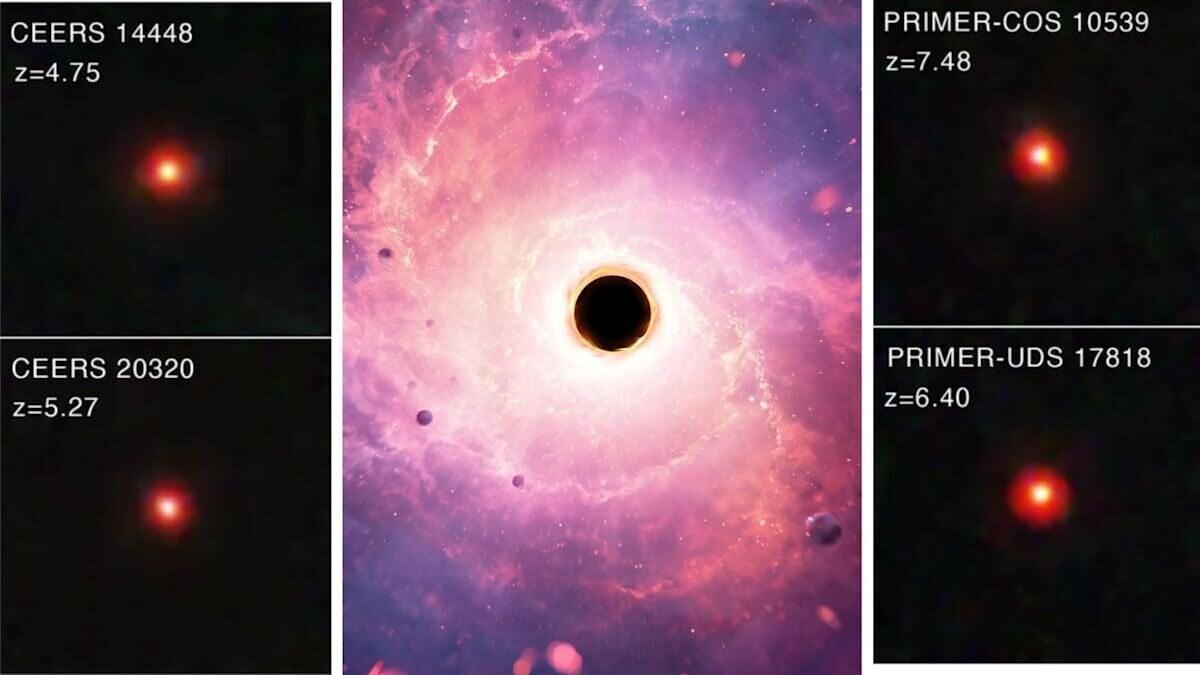
Researchers used James Webb Space Telescope data to test whether a distant Little Red Dot could have formed around a primordial black hole, an idea that could help explain the objects’ origins.
The team modeled blackAbell 2744-QSO1, or QSO1, an object seen as it was 700 million years after the Big Bang. The researchers found that the most likely of three scenarios involved a small primordial black hole consuming surrounding gas and energy until it grew to QSO1’s size.
Primordial black holes are hypothetical objects thought to have formed from fluctuations in matter in the early universe, rather than from the collapse of a dying star. Their existence has not been confirmed.
One object, three formation scenarios
QSO1 lies around 13.1 billion light-years from Earth and is composed almost entirely of hydrogen and helium, the first elements in the universe. The researchers said that composition may make it more pristine than other Little Red Dots.
The team examined whether such an object could form from a primordial black hole, a process that would depend on specific conditions. Cosmological observations limit how many primordial black holes could exist and how many could occupy a cluster, said study team member Loris Del Grosso of Johns Hopkins University’s Department of Physics and Astronomy.
“There can only be so many primordial black holes in the universe, for example, and there cannot be too many of them in a given cluster,” Del Grosso said.
Little Red Dots may also surround conventional black holes formed from the collapse of massive stars. The challenge for researchers is determining which objects, if any, could instead be linked to primordial black holes.
“The door was open on this theory — that Little Red Dots could be primordial black holes,” Del Grosso said. “We’ve now cracked it open a little farther by showing some scenarios are more likely than others.”
Researchers plan to examine more dots
The team plans to study the other 100 or so Little Red Dots observed by the James Webb Space Telescope to assess how many might have begun as primordial black holes.
“We don’t have a clear understanding of what happens in the early universe right after the Big Bang,” said Valerio De Luca, a study team member in the same Johns Hopkins department.