Uranus Weird Magnetic Field May Stem From Deep Interior
Computer simulations suggest that changing electrical conductivity deep inside Uranus and Neptune could explain their unusually tilted, off-center magnetic fields. The model also indicates that both planets’ magnetic fields can change significantly over just a few decades, unlike Earth’s comparatively stable field.
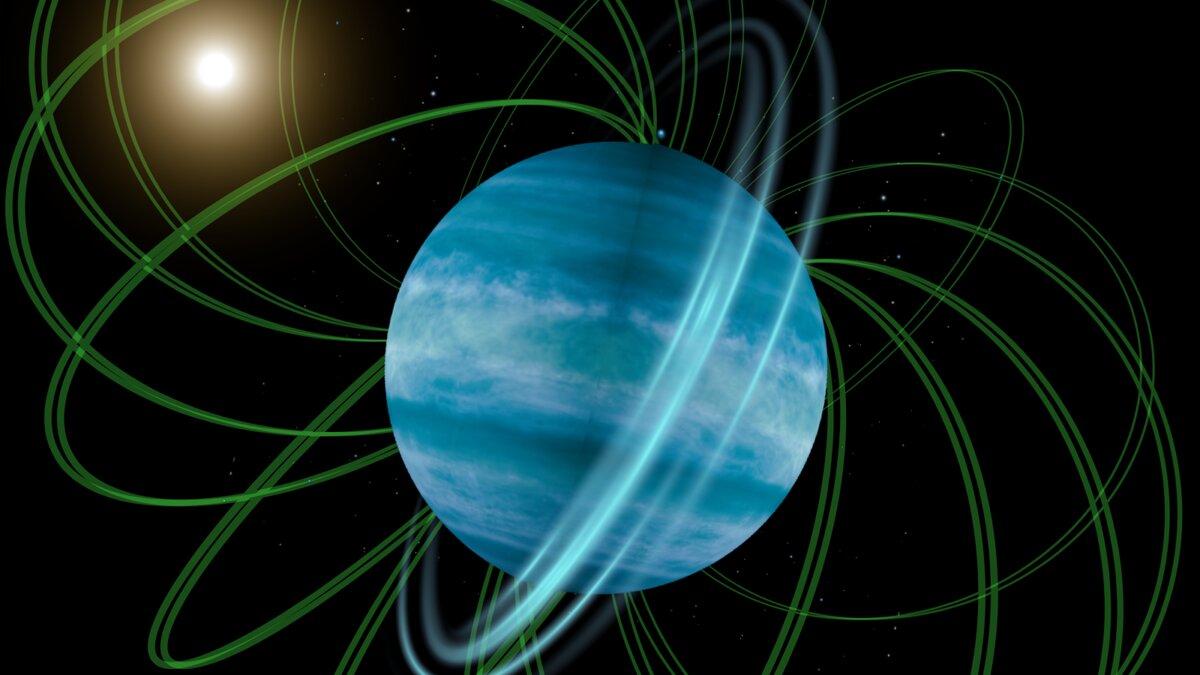
A new computer model suggests the uranus weird magnetic field may arise from changing electrical conductivity deep inside the planet, offering a possible explanation for a mystery also seen on Neptune. The fields may shift over a few decades.
The model combines simulations with measurements made by Voyager 2, the only spacecraft to have visited either ice giant. Researchers say the planets’ extreme interior conditions could help produce magnetic fields that differ sharply from Earth’s.
How the fields differ
Voyager 2 found that Uranus’ magnetic field is tilted 59 degrees from the planet’s rotational axis and is not centered on its core. Neptune’s field is tilted 47 degrees and sits between its core and visible cloud tops.
Earth’s magnetic field is tilted by 11 degrees from its rotational axis. Its more orderly pattern contrasts with the unusually tilted and displaced fields measured at Uranus and Neptune.
Uranus itself is tilted by 97 degrees. One proposed explanation was that a collision with an Earth-sized planet billions of years ago knocked it onto its side and also affected its magnetic field. Neptune’s similarly unusual field, despite lacking that proposed collision, points researchers toward a cause shared by both planets.
Conductivity changes with depth
Planetary magnetic fields can form through a process called the dynamo effect: swirling motion in an electrically conducting fluid generates and sustains a magnetic field. On Earth, that fluid is molten iron in the outer part of the core.
Uranus and Neptune have different interiors. The ice giants contain ammonia, hydrogen, helium, methane and water around probable rocky cores, and their masses are 14.5 and 17 times Earth’s, respectively.
Research team leader Chi Yan of the University of Texas at Austin said pressure and temperature rise deep inside the planets. Those conditions can break water molecules into ions, making the material more electrically conductive farther down.
The simulations reproduced the unusual magnetic fields by modeling how conductivity, fluid motion and temperature change together inside the planets. The results suggest that the magnetic-field structure evolves alongside convection, the movement of fluid driven by heat.
The model also indicates that both planets’ magnetic fields can change significantly over a few decades. Yan contrasted that pace with Earth’s magnetic tilt, which changes by only about a degree over 50 years.