Giant Fungus Dianjunus rex Found in China Grows 20 Inches Tall
Researchers at the Kunming Institute of Botany have named Dianjunus rex, a hand-shaped fungus from Yunnan Province that grows up to 20 inches tall and weighs nearly 5 pounds. DNA analysis suggests its lineage split off about 65 million years ago.
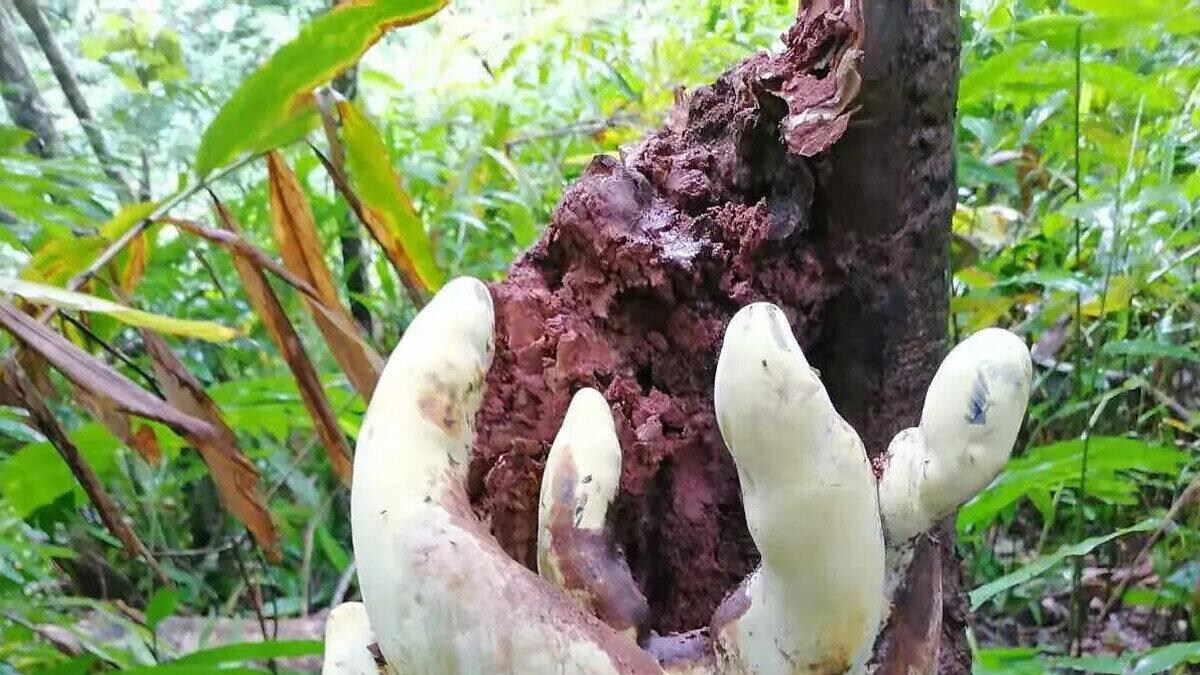
A research team from the Kunming Institute of Botany, part of the Chinese Academy of Sciences, has reported a new species of giant fungus discovered in China's Yunnan Province. They named it Dianjunus rex. Its fruiting bodies grow up to 20 inches tall and weigh nearly 5 pounds.
The fungus looks like a hand reaching out of the ground. It belongs to the Ascomycetes, the largest phylum of fungi, with more than 64,000 known species. Among them, this one produces the largest mushroom masses recorded.
A family with no known relatives
Ascomycetes do not form the caps and stems most people picture as a mushroom. They produce structures called fruiting bodies, which release spores so the fungus can reproduce.
D. rex forms an entirely new biological family, according to the report. That means it has no close relatives, at least none known so far.
The name comes from the ancient Dian Kingdom of the region and the Chinese pronunciation of the word fungus.
Found near dying trees
Lead author Indunil C. Senanayake, an associate professor at the Kunming Institute of Botany, and his team surveyed the Nanban tropical rainforest. There they found large, whitish fruiting bodies growing in soil near the roots of dying trees.
The team collected fungi in shapes ranging from cylinders and spindles to cupped palms. Mature specimens appeared to develop finger-like branches. Above ground, they were covered in white, powdery fibers that turned dark yellow with age. The buried parts were black and smooth.
Samples dried quickly in the lab. Inside, they were dense and sponge-like, white or yellow, with no strong odor or taste.
Linked to the age of the dinosaurs
The researchers analyzed the fungus's DNA and built a "molecular clock" to estimate its history. It showed D. rex diverged from other species about 65 million years ago, at the end of the Cretaceous period.
That was just after the mass extinction believed to have wiped out three-quarters of all plant and animal species, including the dinosaurs. The die-off left large amounts of dead plant material, which may have opened new opportunities for fungi that break it down.
The genes tell a more complicated story. D. rex has only about half the usual number of decomposition-related genes compared with some close relatives that also feed on plant matter.
A possible double life
Senanayake has a theory. The fungus may live inside healthy trees and then feed on dead plant material once its hosts die. That could explain how it stores enough energy to build such large fruiting bodies. The team has so far found the fruiting bodies only around dying plants, and the idea remains a theory.
He also suggests the towering shape helps the fungus. Standing taller than surrounding plants and fallen leaves could aid spore dispersal by wind in a dense forest.
"The discovery illustrates how much fungus biodiversity remains to be discovered in East Asian forests," Senanayake said in a press release.
Yunnan has about 6,000 documented fungal species. Mycologists believe the province, known for its biological diversity, could harbor 100,000.
 Take the quizWhat Kind of Holiday Spender Are You? Take the Black Friday QuizStart →
- 1Mavericks Surfers Race to California for Waves Near 50 Feet

- 2I’m A Celebrity 2026 Line-Up: Rooney Leads 11 Stars Into Jungle

- 3NYC Medical Examiner Has Not Determined Cause of Death of Beau Rose Jessup

- 4Mountaineer Finds Ice Age Cave Bear Graveyard in the Dolomites

- 5Rugby League World Cup Final 2026: Kick-Off Times and How to Watch Kangaroos v New Zealand

 Lifestyle7 Signs Your Social Battery Is Running Low (and Why You Keep Cancelling Plans)
 Lifestyle · Food & HealthThanksgiving Food Safety: How Long Leftovers Last and the Safe Turkey Temperature
 Lifestyle7 Quiet Habits of Emotionally Intelligent People, According to Psychologists
 LifestylePeople Who Don’t Like Celebrating Their Birthday Often Share These 7 Traits