Voyager 1 Forever Changed Jupiter Views Before Its Light-Day Mark
NASA's Voyager 1 will reach 16.09 billion miles from Earth on November 18, 2026, a distance light needs 24 hours to cross. Its 1979 Jupiter flyby revealed faint rings, a volcanic moon and a restless atmosphere.
NASA's Voyager 1 probe will reach 16.09 billion miles (25.89 billion kilometers) from Earth on Wednesday, November 18, 2026, a distance light needs 24 hours to cross. Voyager 1 forever changed how scientists see Jupiter, and it is now humanity's most distant spacecraft.
The probe has been exploring the solar system since 1977. It officially reached interstellar space in 2012.
A camera that went dark in 1990
Voyager 1 will observe its "light-day" milestone in darkness. Mission scientists turned off its camera in 1990, immediately after it snapped the "Pale Blue Dot" and "Solar System Family Portrait" images from beyond the orbit of Neptune.
By then the probe had already taken tens of thousands of images of the outer solar system. Some of them transformed scientists' understanding of the outer planets.
What the Jupiter flyby showed
Voyager 1 observed Jupiter from January to April 1979. According to NASA, it came within 174,000 miles (280,000 km) of the planet in March 1979.
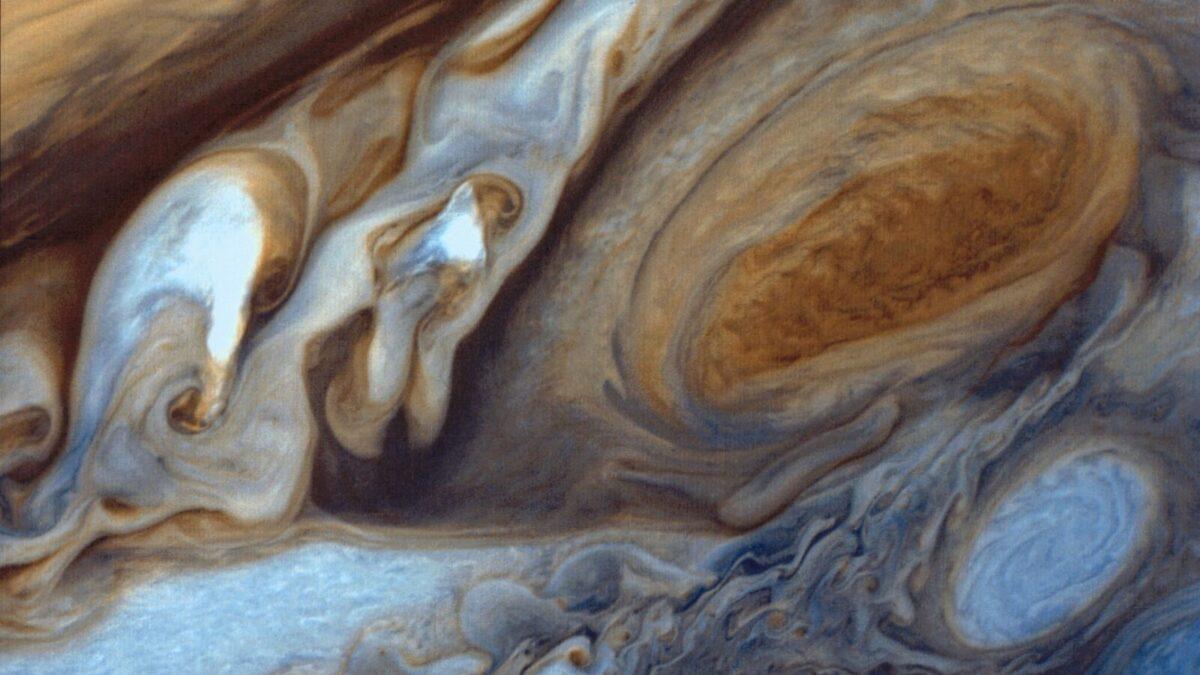
On approach, the probe photographed the gas giant every 96 seconds. The frames became a time-lapse movie of Jupiter's turbulent atmosphere. Discrete bands spun at different speeds and in different directions, clouds raced past, and planet-size storms swirled.
The film captures about 60 full days on Jupiter. Each Jupiter day lasts roughly 10 Earth hours, so that equals about a month on Earth. It gave the most comprehensive and high-resolution look at the planet to date.
It also built on data from NASA's Pioneer 10 and 11 probes, which launched half a decade earlier. Together the data showed an atmosphere much more dynamic than astronomers had realized.
Rings and a volcano on Io
Just before its closest approach, Voyager 1 spotted a thin, faint ring system around Jupiter. The rings are made mainly of dust, and they appeared only when Voyager saw Jupiter backlit by the sun.
No telescope had seen them before. Ground-based observatories soon confirmed they existed, and Voyager 2 took clearer pictures when it reached Jupiter in July 1979.
Jupiter, Saturn, Uranus and Neptune are now all known to have rings. Scientists suspect volcanic eruptions on Jupiter's moon Io partly replenish Jupiter's dusty rings.
During its close approach to Io, Voyager 1 also witnessed the first volcanic eruption ever seen on a world beyond Earth. One image shows Loki Patera, the largest volcano on Io, estimated at 125 miles (200 km) wide. The sighting showed that moons, not just planets, can be geologically active.
The close-up views turned Jupiter and its moons from dots in the sky into fully realized worlds. This week, China's space agency announced its intention to send a lander to Jupiter's moon Callisto, in the first-ever landing mission to the Jovian system.
What Voyager 1 does now
With its camera off, Voyager 1 studies the radiation environment of space using magnetic field and plasma detectors. They are the last two of its 10 science instruments still receiving power.
Scientists suspect the probe will fully run out of power in the 2030s.
 Take the quizWhat Kind of Holiday Spender Are You? Take the Black Friday QuizStart →
- 1Mavericks Surfers Race to California for Waves Near 50 Feet

- 2I’m A Celebrity 2026 Line-Up: Rooney Leads 11 Stars Into Jungle

- 3NYC Medical Examiner Has Not Determined Cause of Death of Beau Rose Jessup

- 4Mountaineer Finds Ice Age Cave Bear Graveyard in the Dolomites

- 5Rugby League World Cup Final 2026: Kick-Off Times and How to Watch Kangaroos v New Zealand

 Lifestyle7 Signs Your Social Battery Is Running Low (and Why You Keep Cancelling Plans)
 Lifestyle · Food & HealthThanksgiving Food Safety: How Long Leftovers Last and the Safe Turkey Temperature
 Lifestyle7 Quiet Habits of Emotionally Intelligent People, According to Psychologists
 LifestylePeople Who Don’t Like Celebrating Their Birthday Often Share These 7 Traits