NASA’s Curiosity Data Points to Possible Water on Mars
A study of more than a decade of atmospheric measurements from NASA’s Curiosity rover suggests small amounts of water may be involved in Martian surface chemistry. Researchers found seasonal oxygen changes that could be explained by water attached to soil or present in extremely thin films.
NASA’s Curiosity rover collected more than a decade of atmospheric data on Mars that suggests water may be present at the surface, according to a study published in 2026.
The findings do not confirm liquid water. Researchers propose that water attached to soil grains or held in extremely thin, liquid-like films could explain seasonal changes in atmospheric carbon dioxide.
The study appeared in the Proceedings of the National Academy of Sciences. It examined measurements from Gale Crater covering 2012–2025.
Seasonal oxygen changes stand out
Curiosity has sampled Mars’ thin, carbon dioxide-rich atmosphere since 2012. Carbon dioxide makes up around 95% of that atmosphere.
The researchers assembled the first long-term record taken on Mars of isotopes in atmospheric carbon dioxide. Isotopes are forms of an element with different masses.
They tracked heavier forms of oxygen and carbon within carbon dioxide molecules. Repeated samples came from two instruments in Curiosity’s Sample Analysis at Mars suite, with emphasis on results from its laser instrument.
Heavy oxygen became more abundant in carbon dioxide during spring and summer. The increase was stronger during southern spring–summer, near Mars’ closest approach to the sun.
Seasonal changes in carbon isotopes were smaller. That difference may mean separate processes primarily control the two elements, the researchers found.
Daily isotope changes were largely insignificant at Curiosity’s location. Earlier telescope measurements from Earth had suggested daily changes in oxygen isotopes.
Models point to water exchange
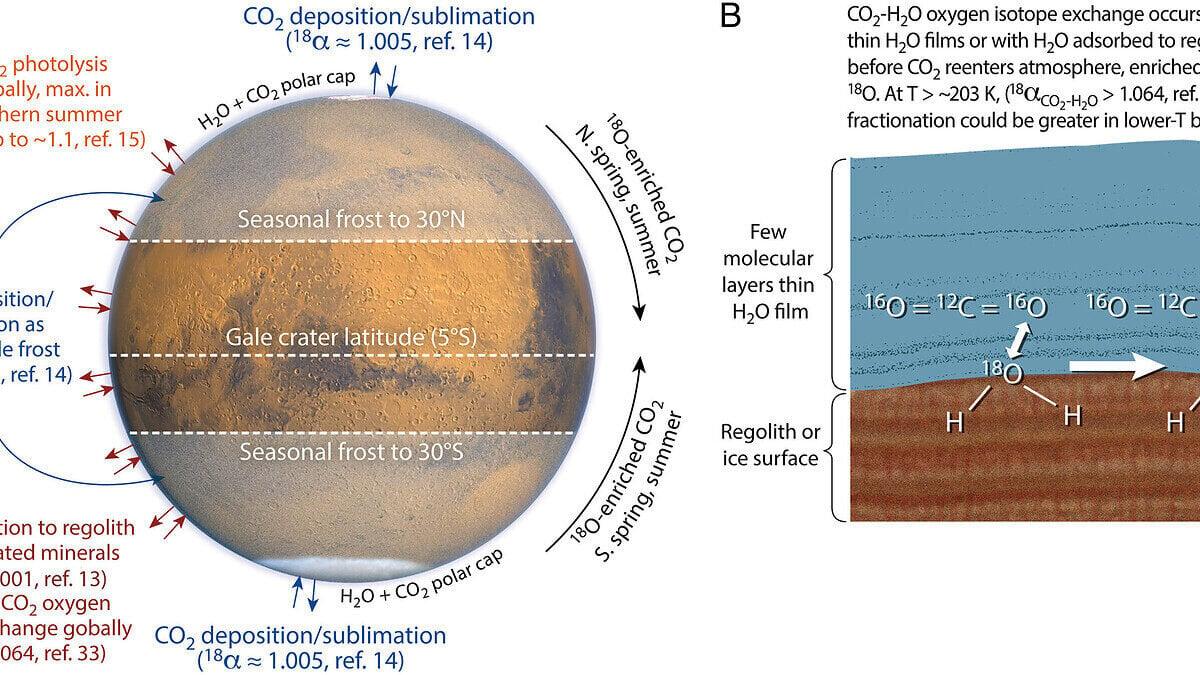
The team tested several explanations for the seasonal oxygen changes. These included carbon dioxide freezing at the poles and being released again, surface attachment and release, and sunlight-driven breakdown of the gas.
None of those modeled scenarios sufficiently explained the observed changes. Researchers then considered whether carbon dioxide could exchange oxygen with water near the surface.
Models of that exchange produced patterns consistent with the observations. They suggested the exchange might involve water attached to soil grains or water in extremely thin, liquid-like films.
Local or regional exchanges appeared more feasible than an explanation spanning the planet, the researchers said.
Further measurements could test patterns
All samples came from one crater near the equator, so the findings cannot establish a global pattern. The proposed exchange is plausible, but it was not directly observed.
Continued Curiosity measurements could test whether the seasonal patterns persist and change after major dust storms. Measurements elsewhere on Mars could help distinguish local crater chemistry from broader atmospheric cycles.
 Take the quizWhat Kind of Holiday Spender Are You? Take the Black Friday QuizStart →
- 1U.S. Emergency Alert Test Nov. 17 Is Not a Power Outage

- 2DUP Chairman Lord Morrow Loses Wife and Daughter Within Hours in NI

- 3NASA’s Curiosity Rover Burst Open a Rock and Found Pure Sulfur
- 4Women With Autoimmune Diseases Wait About 4 Years for Diagnosis, Study Finds

- 5Stock Market Today: Dow Futures Slip as Nasdaq Futures Climb Before Earnings

 Lifestyle · Food & Health4 Reasons to Eat Oatmeal, According to Nutrition Experts
 Lifestyle7 Signs Your Social Battery Is Running Low (and Why You Keep Cancelling Plans)
 Lifestyle · Food & HealthThanksgiving Food Safety: How Long Leftovers Last and the Safe Turkey Temperature
 Lifestyle7 Quiet Habits of Emotionally Intelligent People, According to Psychologists