Voyager 1 Reaches One Light-Day From Earth
NASA’s Voyager 1 has become the first human-made object to reach one light-day from Earth. Radio signals now take 24 hours to travel between the spacecraft and mission teams in either direction, adding to the challenges of operating the aging probe.
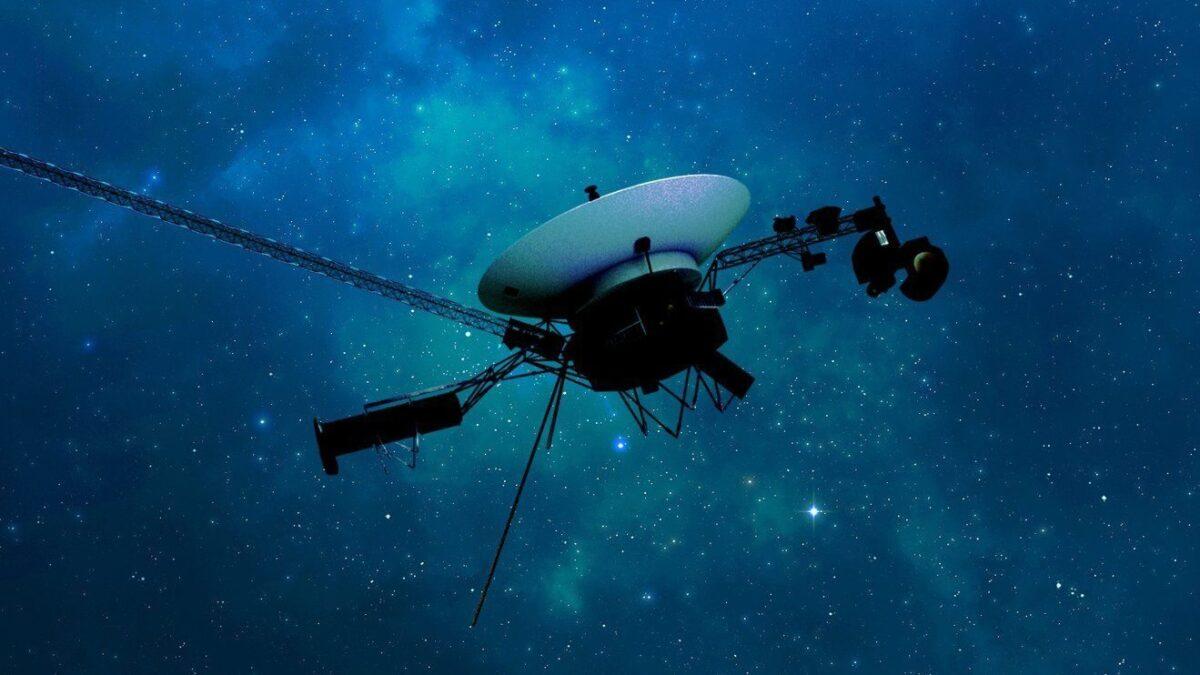
NASA’s Voyager 1 spacecraft reached one light-day from Earth on November 18, becoming the first human-made object to travel that far.
The milestone means radio signals now take 24 hours to travel between Voyager 1 and Earth in either direction. The delay makes problems harder to troubleshoot on a spacecraft operating beyond its original design life.
Voyager 1 crossed the threshold at 5:16 a.m. Eastern time, when it was 16.094 billion miles from Earth. A light-day is the distance light travels in 24 hours.
A faint, slow signal
Distance is only part of the communication challenge. By the time Voyager’s radio signal reaches Earth, its power has faded to approximately 100 attowatts. An attowatt is one quintillionth of a watt.
Voyager sends around 40 bytes per second. NASA’s Deep Space Network handles communications with Voyager 1, Voyager 2 and nearly 4 dozen other NASA and international partner missions.
Voyager 1’s power comes from generators that turn heat from the radioactive decay of plutonium-238 into electricity. That supply weakens over time, and NASA engineers have shut down instruments and other systems to conserve power.
Two science instruments remain active and are expected to stay powered into the 2030s. The spacecraft cannot be repaired or serviced.
Two instruments study interstellar space
Voyager 1’s magnetometer measures the strength and direction of magnetic fields between stars. Scientists use its readings to study how far the Sun’s magnetic influence extends into the surrounding galaxy.
The Plasma Wave Subsystem detects oscillations in electrically charged gas. Its measurements help scientists study the density and behavior of the material surrounding the spacecraft.
“What Voyager has taught me is to expect the unexpected,” said Linda Spilker, the mission’s project scientist. “So many times the ideas and theories we had, Voyager was able to prove them wrong.”
Voyager 1 launched in 1977, after Voyager 2. Different routes and a gravity boost from Jupiter and Saturn helped Voyager 1 reach interstellar space first, in 2012. Voyager 2 crossed the same boundary in 2018 and is expected to reach one light-day in 2035.
A record aboard the probe
Voyager 1 carries a golden record containing sounds, music, images and greetings in dozens of languages. It includes instructions for playing the record and information about the location of the solar system.
The spacecraft is traveling at approximately 38,000 miles per hour, generally toward the star Gliese 445. At its present speed, it will take roughly 40,000 years to pass within about 1.7 light-years of the star.
 Take the quizWhat Kind of Holiday Spender Are You? Take the Black Friday QuizStart →
- 1Gold Silver Price November: Futures Rise Near Yearly Lows

- 2U.S. Emergency Alert Test Nov. 17 Is Not a Power Outage

- 32027 NFL Mock Draft Puts Ohio State’s Jeremiah Smith at No. 1

- 4Michael Clarke Says Sandpapergate Scars Drew Steve Smith to New York

- 5GTA 6 New Zealand Time Trick Is Not Guaranteed to Work

 Lifestyle · Food & Health4 Reasons to Eat Oatmeal, According to Nutrition Experts
 Lifestyle7 Signs Your Social Battery Is Running Low (and Why You Keep Cancelling Plans)
 Lifestyle · Food & HealthThanksgiving Food Safety: How Long Leftovers Last and the Safe Turkey Temperature
 Lifestyle7 Quiet Habits of Emotionally Intelligent People, According to Psychologists