OpenAI’s Artificial Intelligence Papers Stir Math Debate
OpenAI released more than 700 papers claiming solutions to 300 open mathematics problems, prompting concern among researchers. At a Royal Society meeting, mathematicians discussed how to understand AI-assisted proofs and what the technology means for people entering the field.
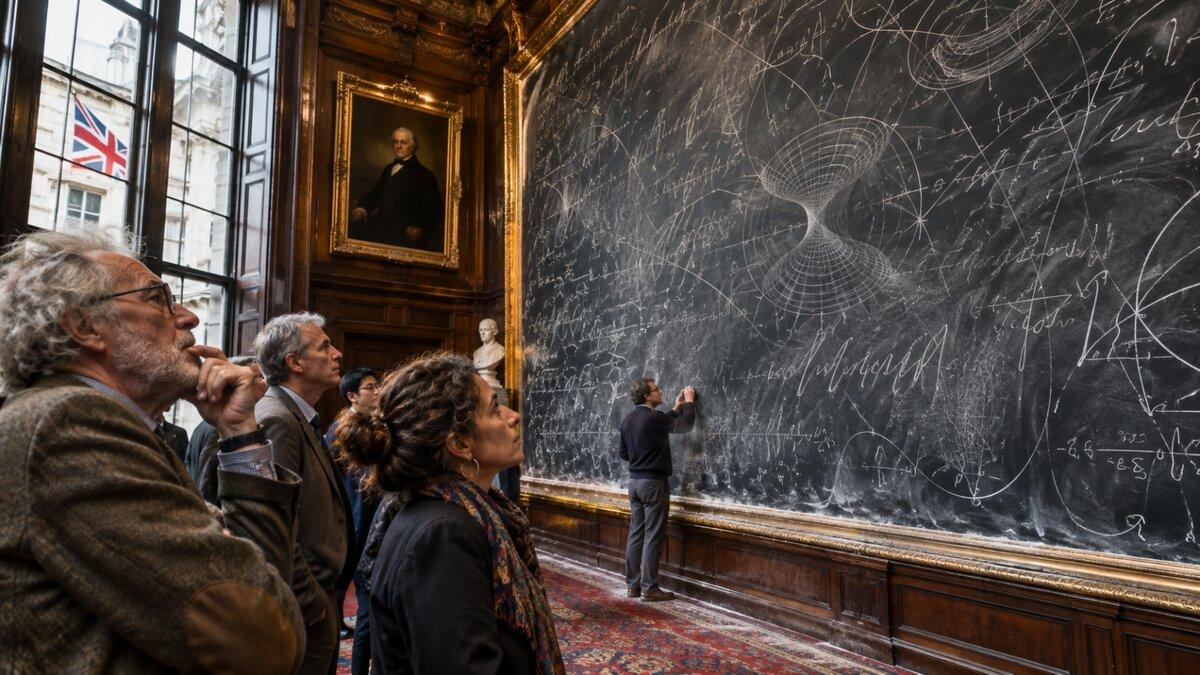
More than 700 papers released by OpenAI claim solutions to 300 open mathematics problems, leaving researchers grappling with how to understand the results. At a Royal Society meeting, mathematicians discussed the impact of artificial intelligence on a field where solving problems has long shaped careers.
The gathering drew more than 300 people in person and 700 online. It followed announcements of AI-assisted solutions to problems that had stood for decades or longer.
Professor Jon Keating, an Oxford mathematician who co-organized the meeting at the end of October, described the response to OpenAI's papers. “It felt like we were in a cataclysmic situation,” he said.
Early-career researchers were among those concerned. Mathematicians have been rewarded for solving problems, and the pace of AI-assisted work has raised questions about how the field will evaluate researchers.
Anthropic claims another major solution
Anthropic has claimed an AI-assisted solution to the Riemann hypothesis, a problem that has stood for more than 160 years. Its proposed solution runs to 17m lines of code, or 250,000 pages, and hundreds, if not thousands, of experts are trying to understand it.
Anthropic released the solution in Lean, a programming language designed to verify mathematical proofs. Levent Alpöge, a mathematician at Anthropic, claims to have solved the problem.
Professor Bryna Kra, a mathematician at Northwestern University in Evanston, Illinois, described the pace of developments as overwhelming. Kra is a former president of the American Mathematical Society.
Researchers seek understanding beyond proofs
Kra said mathematicians must turn proofs into work that makes the reasoning clearer. “It's not just the proof that matters. We want to understand the mechanism behind it that makes things true,” she said.
Mathematicians can spend months or longer refining proofs so others can understand them. Kra said the AI proofs she had examined buried the ideas behind their results.
Professor Geordie Williamson, a mathematician at the University of Sydney, pointed to two different experiences with Alpöge's AI-assisted work. In July, Alpöge posted a counter-example to the Jacobian conjecture after working on it with AI assistance over a weekend.
The result showed that mathematicians had been thinking about the problem the wrong way and pointed to connections with other questions. Williamson said people understood it quickly.
A month later, Alpöge released discoveries involving Hadamard matrices. Williamson said the work made substantial progress without indicating how it had been achieved.
Mathematicians weigh their future
Professor Nestor Guillen at New York University said problem-solving would remain part of human nature. He also voiced concern that mathematicians could leave the field when their skills are needed to understand and control AI.
Professor Hugo Duminil-Copin of the University of Geneva and the Institute of Advanced Scientific Studies near Paris said he cried after OpenAI released its papers in October. Many problems he was working on had been solved, he said.
Duminil-Copin said mathematicians could focus on sharing mathematical knowledge with scientists, teachers and the public. “I don't feel downgraded. There is still so much to do as humans in mathematics,” he said.
 Take the quizWhat Kind of Holiday Spender Are You? Take the Black Friday QuizStart →
- 1Tyreek Hill Still Not Cleared to Play After Knee Injury

- 2Sandisk shares jump nearly 16% to $85.36 after Kioxia-Nvidia test
- 3Magnitude 5 earthquake hits Los Angeles area

- 4Full Retirement Age Chart: Social Security Ages by Birth Year Explained

- 5Sainsbury’s wrongly bans woman after facial recognition alert